

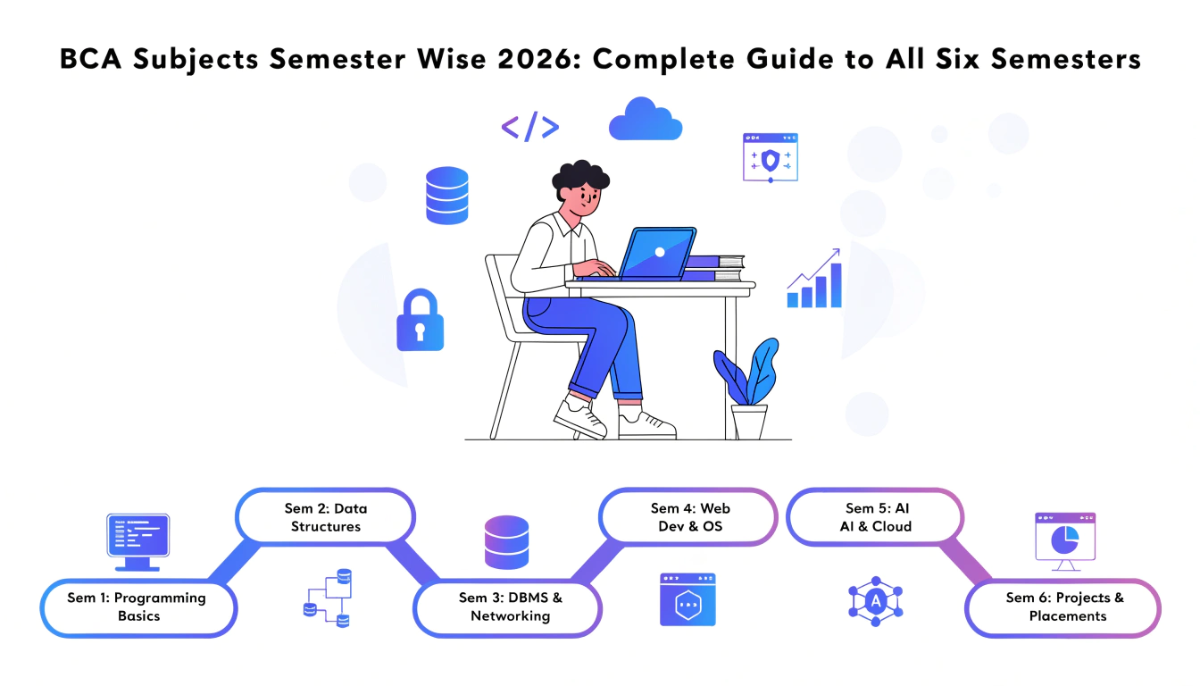
BCA subjects cover a wide range of computer science and IT topics across six semesters and understanding what you will study in each semester before the course begins helps you prepare better and choose the right college.
The BCA is a three-year undergraduate programme and the subjects in each semester are carefully sequenced so that foundational topics like C programming and data structures in the first year build toward more advanced subjects like cloud computing, AI and full stack development in the final year.
Most students searching for BCA subjects semester wise want to know both the subject names and what those subjects actually involve in terms of what you learn and why it matters for your career. This guide covers every BCA subject across all six semesters with a clear explanation of each and tells you which subjects carry the most weight for placements and higher studies
How BCA Subjects Are Structured Across Six Semesters
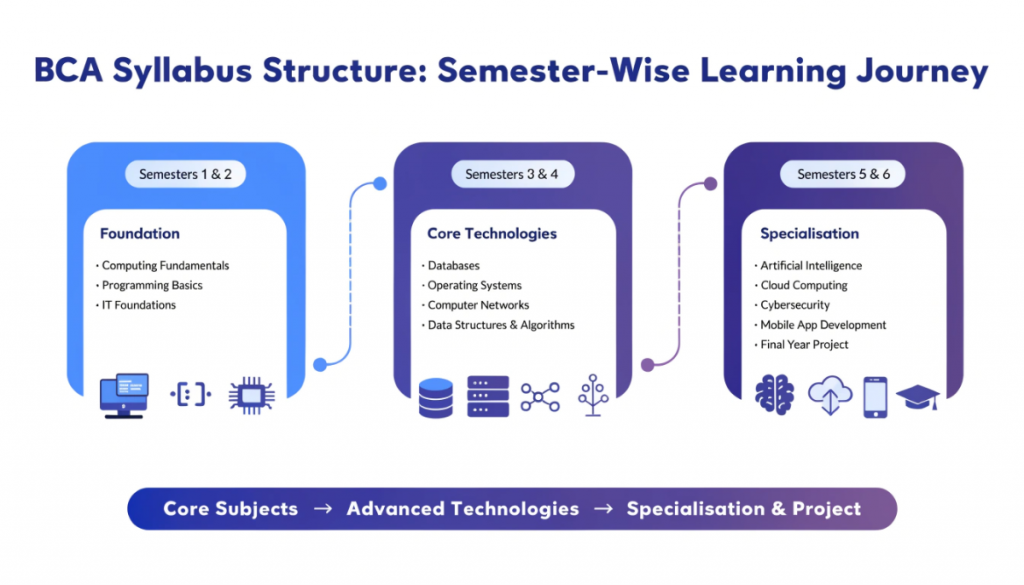
The BCA is designed on a progressive learning model. The first two semesters cover computing fundamentals and programming basics.
Semesters three and four go deeper into core computer science subjects like databases, operating systems, networking and algorithms. Semesters five and six move into specialisation territory including AI, cloud, cybersecurity and mobile development along with a major final project.
Most Indian universities that offer BCA including Delhi University, Pune University, Bangalore University, VTU, Symbiosis, Christ University, Amity and NMIMS follow this same broad structure even though the exact subject names and elective options differ.
The BCA subjects in the first four semesters are almost entirely compulsory core subjects while the final two semesters introduce elective choices that allow students to build depth in one technology domain.
Understanding the full list of BCA subjects semester wise also helps students who are preparing for MCA entrance exams because NIMCET, CUET PG and other MCA entrance tests are primarily based on the BCA subjects covered in semesters one through four.
Semester One and Two: BCA Subjects That Build the Foundation
Semester One BCA Subjects
Semester one introduces students to the basics of computing and programming. These are the BCA subjects you will encounter in the very first semester:
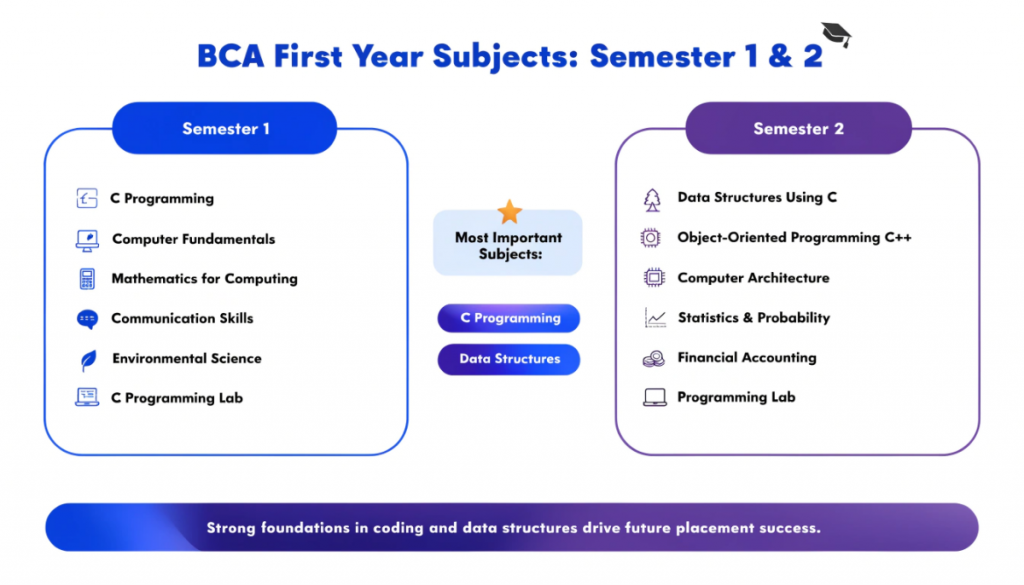
Introduction to Programming Using C: This is the most important BCA subject in semester one. It covers variables, data types, operators, control statements, loops, functions, arrays, pointers and basic file handling. C programming is the foundation on which every subsequent programming subject builds
Computer Fundamentals and Organisation: Covers the history and generations of computers, types of computers, input and output devices, memory types including RAM, ROM and cache and number system conversions between binary, octal, decimal and hexadecimal
Mathematics for Computing: Covers set theory, Boolean algebra, number systems, matrices, determinants and basic calculus with specific focus on how these mathematical concepts apply in computing contexts
Communication Skills in English: Professional writing, business correspondence, email etiquette, presentation skills and communication in technical workplace contexts. This is among the BCA subjects that students most commonly underestimate despite it being directly useful in every job interview and workplace
Environmental Science: Compulsory across most Indian universities under UGC guidelines. Covers ecology, pollution types, sustainability and environmental law
C Programming Lab: Hands-on implementation exercises reinforcing the C programming theory subject
Semester Two BCA Subjects
Semester two advances the programming foundation and introduces the single most career-relevant BCA subject in the entire first year:
Data Structures Using C: This is the most important BCA subject for placement preparation. Covers arrays, linked lists, stacks, queues, trees including binary trees and BSTs, graphs, sorting algorithms including bubble, selection, insertion, merge and quicksort and searching algorithms including linear and binary search. Students who genuinely master this subject have a direct advantage in every technical interview
Object-Oriented Programming Using C++: Covers classes, objects, constructors, destructors, inheritance including single and multiple, polymorphism including function overloading and virtual functions, encapsulation, operator overloading and templates
Computer Organisation and Architecture: Covers CPU design and components, instruction sets, addressing modes, memory hierarchy, cache memory, pipelining stages and input/output systems
Statistics and Probability: Covers descriptive statistics, measures of central tendency and dispersion, probability theory, Bayes theorem, probability distributions including binomial and normal and basics of regression and correlation. Directly foundational for the machine learning and data science BCA subjects in later semesters
Financial Accounting Basics: Covers accounting principles, journal entries, ledgers, trial balance and basic financial statement reading. Included at most institutions to build business awareness alongside technical skills
Data Structures and C++ Programming Lab: Hands-on exercises implementing all major data structures and OOP concepts from scratch
The two most important BCA subjects in the first year are C programming and data structures. These are tested in every technical screening process for software developer roles in India and students who build genuine coding fluency in these two subjects during semesters one and two rather than just clearing exams have a measurable advantage when placements begin in year three.
Semester Three and Four: Where Core Computer Science Gets Serious
Semester Three BCA Subjects
Semester three introduces the four BCA subjects that are most directly relevant to the Indian IT job market:
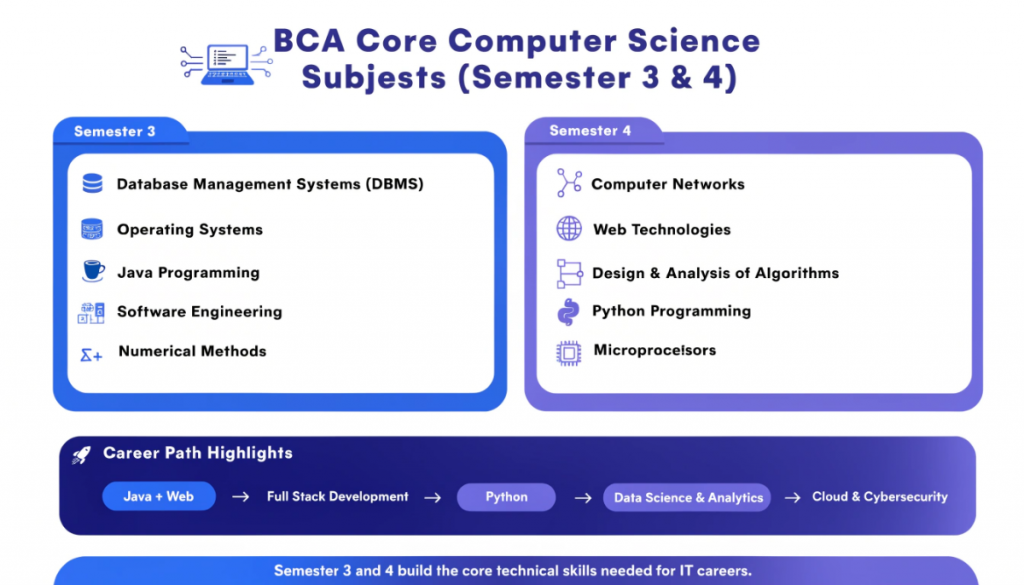
Database Management Systems: One of the most job-relevant BCA subjects across all six semesters. Covers the relational model, SQL in full depth including SELECT queries, joins, subqueries, aggregate functions, DDL and DML commands, entity-relationship diagrams, normalisation up to BCNF, transaction management with ACID properties and indexing. SQL is tested in almost every data and backend development interview in India
Operating Systems: Covers process management, process states and scheduling algorithms including FCFS, SJF and round robin, inter-process communication, synchronisation using semaphores and mutex, deadlock including detection avoidance and recovery, memory management including paging and segmentation, virtual memory with page replacement algorithms and file system organisation. Linux command line basics are also typically included
Java Programming: Covers OOP in Java including classes, interfaces and abstract classes, exception handling with try-catch-finally, multithreading and concurrency, Java collections framework, file I/O and streams, introduction to JDBC for database connectivity and basics of Java Swing for GUI applications
Software Engineering: Covers software development lifecycle models including waterfall, spiral and agile, requirements engineering and use case development, software design principles including cohesion and coupling, software testing including unit, integration and system testing, project estimation using function points and COCOMO and version control basics using Git
Numerical Methods: Covers numerical solutions to equations, interpolation using Newton and Lagrange methods, numerical integration using trapezoidal and Simpson rules and numerical solutions to differential equations
DBMS Lab with MySQL and Java Programming Lab
Semester Four BCA Subjects
Semester four completes the core computer science coverage of the BCA and introduces Python and networking:
Computer Networks: Covers the OSI seven-layer model and TCP/IP model in detail, data link layer protocols, IP addressing including IPv4 and IPv6 with subnetting and CIDR notation, routing protocols including RIP OSPF and BGP, transport layer with TCP and UDP, application layer protocols including HTTP HTTPS DNS FTP SMTP and DHCP and network security basics
Web Technologies: Covers HTML5 semantic elements, CSS3 including flexbox and grid layout, JavaScript for DOM manipulation, events and AJAX, responsive web design, PHP or Node.js for server-side processing, REST API concepts, introduction to web frameworks and web security basics including XSS and SQL injection
Design and Analysis of Algorithms: Covers algorithm design paradigms including divide and conquer with examples like merge sort and quicksort, dynamic programming with examples like LCS and 0-1 knapsack, greedy algorithms with examples like Huffman coding and activity selection, graph algorithms including Dijkstra and Bellman-Ford and computational complexity including P NP NP-hard and NP-complete classes
Python Programming: Covers Python syntax and data types, control structures, functions and modules, file handling, list and dictionary comprehensions, object-oriented Python, introduction to NumPy and Pandas for data analysis and basic data visualisation using Matplotlib
Microprocessors and Interfacing: Covers 8085 and 8086 microprocessor architecture, assembly language programming, instruction sets, memory and I/O interfacing and programmable peripheral devices
Computer Networks Lab, Web Development Lab and Python Programming Lab
The BCA subjects in semester four are where students typically discover which technical domain excites them most. Students who find themselves most engaged by web technologies and Java naturally gravitate toward full stack development. Those drawn to Python and data analysis identify data science as their direction. Those engaged by networking and operating systems lean toward cloud or cybersecurity specialisation. These preferences should inform elective choices in semesters five and six.
Semester Five and Six: Advanced BCA Subjects and Final Project
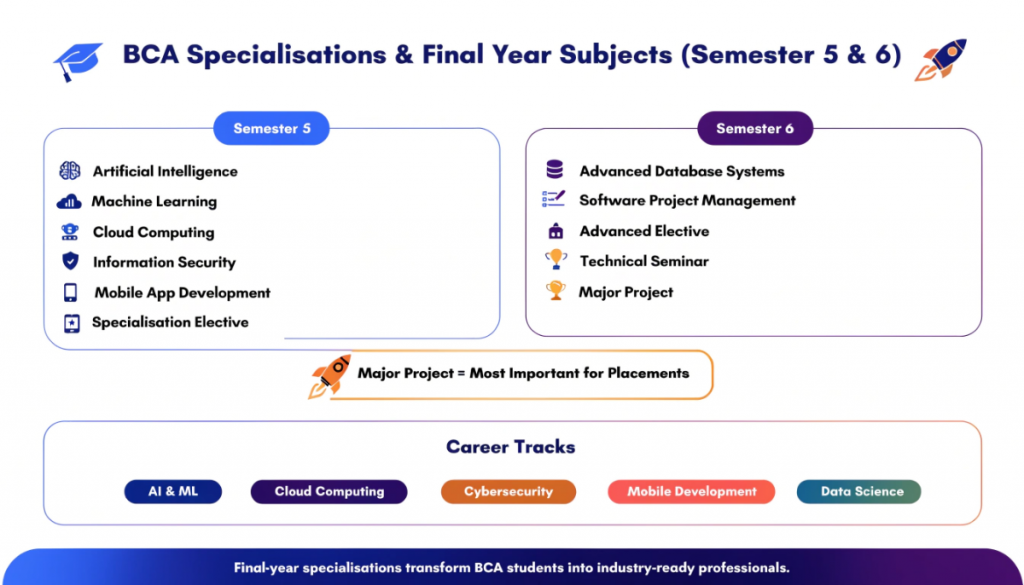
Semester Five BCA Subjects
Semester five marks the beginning of specialisation within the BCA. These subjects are more advanced and more directly aligned with current industry demand:
Artificial Intelligence: Covers problem solving and search algorithms including BFS, DFS, A-star and hill climbing, knowledge representation using logic and semantic networks, expert systems, natural language processing fundamentals, computer vision basics and introduction to machine learning concepts
Machine Learning: Covers supervised learning algorithms including linear regression, logistic regression, decision trees and random forests, unsupervised learning including K-means clustering and PCA, model evaluation metrics including accuracy, precision, recall and F1 score and Python-based implementation using Scikit-learn
Cloud Computing: Covers cloud service models including IaaS, PaaS and SaaS, deployment models including public, private and hybrid cloud, major cloud platforms including AWS, Azure and Google Cloud, virtualisation and hypervisors, containerisation using Docker and introduction to Kubernetes and cloud security basics
Information Security and Cryptography: Covers symmetric encryption including AES and DES, asymmetric encryption including RSA, hashing algorithms including SHA and MD5, digital signatures and certificates, PKI infrastructure, common network attacks and their prevention and ethical hacking fundamentals
Mobile Application Development: Covers Android development using Java or Kotlin, activity lifecycle, layouts and UI components, intents and data passing between activities and either cross-platform development using Flutter or React Native as an alternative track depending on institution
Specialisation Elective 1: Options vary by institution and typically include subjects from data science, full stack development, IoT, blockchain or advanced cybersecurity
AI and ML Lab, Mobile Development Lab
Semester Six BCA Subjects
The final semester combines advanced electives with the most important deliverable of the entire BCA: the major project.
Advanced Database Systems: Covers NoSQL databases including MongoDB document model and Cassandra columnar model, Redis for caching, distributed database concepts including replication and sharding, data warehousing and OLAP for analytical workloads and introduction to big data frameworks
Software Project Management: Covers agile methodology in depth including Scrum roles ceremonies and artifacts, Kanban, project planning using Gantt charts and work breakdown structures, risk identification and management, cost estimation and basics of team leadership in software projects
Specialisation Elective 2: Advanced subject within chosen specialisation track
Technical Seminar or Research Paper: Students select a current technology topic, conduct research and deliver a formal presentation to faculty panel
Major Project or Dissertation: The single most important BCA subject in terms of placement impact. Students build a complete technology solution over the full semester with a faculty or industry guide. The project is what distinguishes strong candidates in technical interviews because it demonstrates the ability to take a real problem from requirement to deployment
The major project in semester six is where all the BCA subjects from the previous five semesters come together in a practical deliverable. Students who build genuinely functional projects using multiple technologies and document them well consistently report better placement outcomes than those who submit minimal projects or copy standard templates. The project is the first thing most interviewers ask about because it is the clearest demonstration of what a candidate can actually do independently.
Which BCA Subjects Matter Most for Placements and Higher Studies
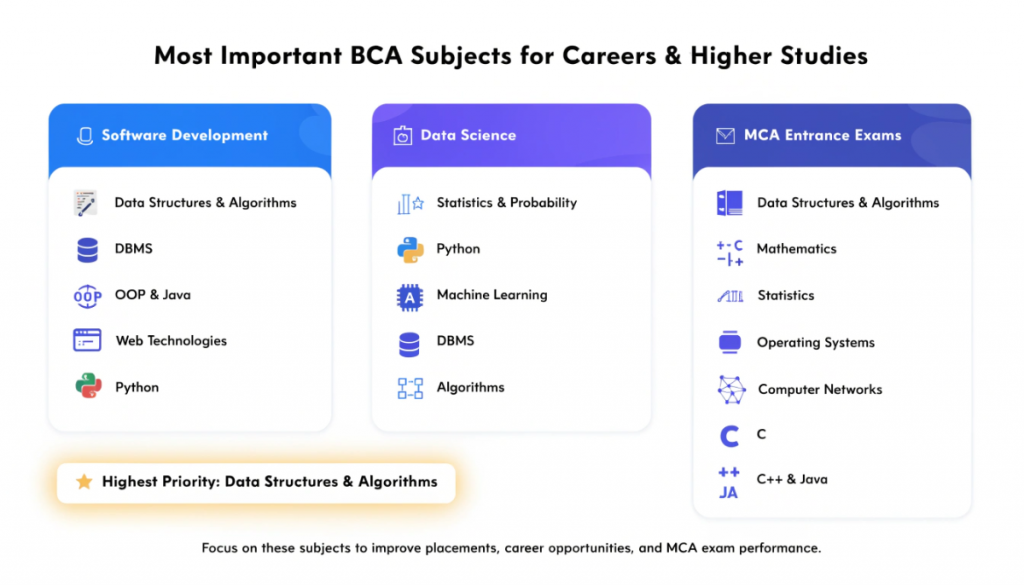
Not all BCA subjects carry equal weight when it comes to job placements and MCA entrance preparation. Here is an honest breakdown of which subjects deserve the most time and attention beyond just passing the semester exams.
For Software Development Roles
The BCA subjects that are most directly tested in software developer technical interviews in India are:
Data Structures and Algorithms from semesters two and four: Almost every company from TCS and Infosys to Amazon and Microsoft tests DSA in technical rounds. This is the single most placement-relevant subject across all six semesters
Database Management Systems from semester three: SQL is tested in practically every backend, data and full stack developer role. Strong SQL skills are a consistent differentiator among BCA candidates
Object-Oriented Programming from semester two and Java from semester three: OOP concepts are tested across language-specific interviews for Java, Python and JavaScript roles
Web Technologies from semester four: For web developer and frontend engineer roles knowledge of HTML, CSS and JavaScript is the primary technical requirement
Python Programming from semester four: Python has become the most versatile language in the market and BCA students with genuine Python fluency have access to both development and data roles
For Data Science and Analytics Roles
For students targeting data analyst or junior data scientist roles after BCA the most important subjects to go deep on are:
Statistics and Probability from semester two: The foundation of every machine learning and analytics concept
Python Programming from semester four: The primary language for data work in India
Machine Learning from semester five: The most directly relevant technical subject for data science career preparation
Database Management Systems from semester three: SQL is as important for data roles as for development roles
Design and Analysis of Algorithms from semester four: Needed for understanding model complexity and optimisation
For MCA Entrance Preparation
Students who plan to pursue MCA after BCA should prioritise:
Data Structures and Algorithms: NIMCET and most MCA entrance exams have the heaviest weightage on this subject
Mathematics for Computing and Statistics: Quantitative aptitude and logical reasoning sections draw heavily from these BCA subjects
Computer Networks and Operating Systems: Core computer science sections in MCA entrance exams cover these directly
Programming concepts from C, C++ and Java: Most entrances test programming logic and OOP concepts
How BCA Subjects Differ Across Universities and What to Look For
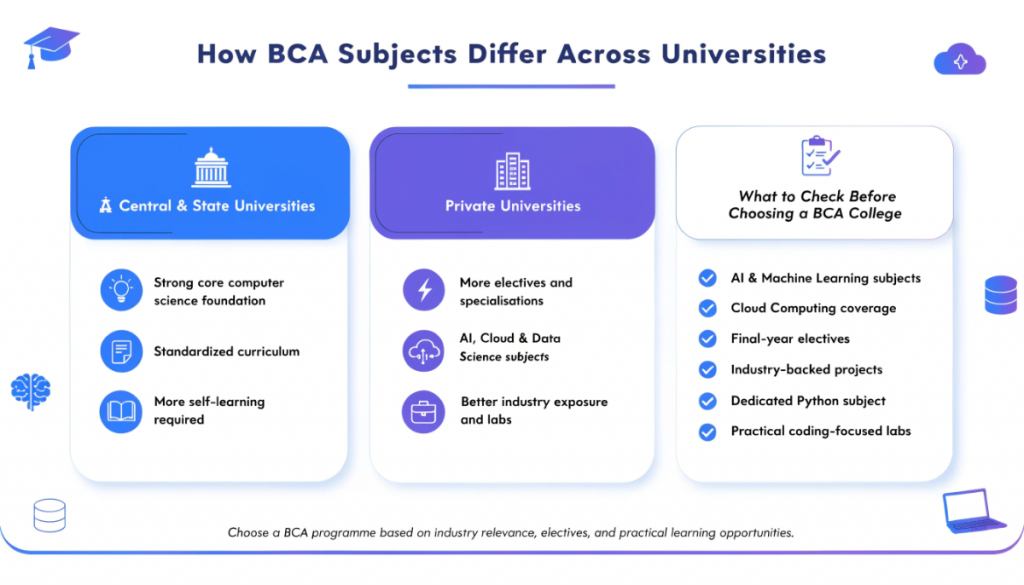
The BCA subjects at different universities follow the same broad structure but there are meaningful differences in depth, elective diversity and practical emphasis that affect how well the degree prepares you for placements.
Central and State Universities
Universities including Delhi University, Pune University, Anna University and Osmania University set the BCA subjects at the university level and all affiliated colleges follow the same curriculum.
The subject list itself is generally strong in core computer science content but delivery quality varies enormously between colleges following the same syllabus. Students at affiliated colleges need to proactively supplement their learning particularly in practical subjects like SQL, Python and web development where hands-on practice beyond the lab syllabus is essential.
Private Universities
Private universities including Symbiosis, Christ University, VIT, NMIMS, Manipal and Amity offer BCA programmes with more flexibility in BCA subjects and elective choices particularly in semesters five and six. The stronger private institutions have updated their BCA subjects to include cloud computing, DevOps basics and AI subjects earlier in the curriculum than many state universities.
They also typically offer better lab infrastructure and more active industry interface through guest lectures, hackathons and internship programmes. The BCA subjects list at better private universities tends to be more industry-current than at institutions that have not updated their curriculum since 2018 or 2019.
What to Specifically Check When Comparing Colleges
When comparing BCA programmes based on their subjects list check these specific things:
Whether AI, machine learning or data science subjects appear in semesters five or six or only as optional extras
Whether cloud computing is a core BCA subject or only an elective that may not run every year
How many elective subjects are available in the final year and which specialisation tracks they represent
Whether the major project in semester six has active industry partnerships or is entirely internal to the college
Whether Python appears as a dedicated BCA subject rather than being mentioned only in lab descriptions
Whether the programming labs require original problem-solving or just reproduction of textbook programs
Conclusion
The BCA subjects across all six semesters build a logical progression from C programming fundamentals in semester one through to AI, cloud computing and project work in semester six. The subjects in semesters one and two build the programming foundation, semesters three and four deliver the core computer science knowledge that underpins every IT career and semesters five and six allow students to specialise and demonstrate capability through a real project.
Among all the BCA subjects the ones that most directly determine placement success are data structures and algorithms, database management systems, Python programming and the major final project. Students who go beyond semester exam preparation and genuinely build proficiency in these specific subjects are consistently better positioned in campus placements and in competitive MCA entrance exams than those who treat the BCA subjects as boxes to check rather than skills to actually develop.


📖 Sources & References
✓ Verified 2026References supporting the semester-wise BCA syllabus, programming subjects, computer science concepts, specialisations, MCA preparation pathways, and industry-relevant technologies discussed in this guide.
- Shoolini Online BCA Programme Official BCA programme structure, semester-wise curriculum framework, specialisations, and industry-oriented learning model.
- University Grants Commission (UGC) National higher education regulations, undergraduate programme guidelines, and curriculum framework recommendations.
- CUET PG Admission Framework Postgraduate entrance examination information relevant for MCA aspirants after BCA.
- Oracle MySQL Documentation Reference material for SQL, relational databases, transaction management, normalization, and database concepts covered in DBMS.
- PostgreSQL Documentation Advanced database concepts including indexing, optimization, distributed databases, and modern data management systems.
- MDN Web Docs Comprehensive documentation for HTML5, CSS3, JavaScript, responsive web development, APIs, and web security concepts.
- Python Documentation Official Python reference covering syntax, OOP, file handling, modules, data structures, and programming fundamentals.
- Scikit-learn Documentation Machine learning algorithms, model evaluation, clustering, classification, regression, and practical AI implementations.
- AWS Cloud Training Cloud computing fundamentals including IaaS, PaaS, SaaS, virtualization, containers, Kubernetes, and cloud architecture.
- Git Documentation Version control workflows, collaboration, branching, software engineering practices, and project management fundamentals.
Book Your
Free Session
Connect with our experts and get personalised guidance for your career, course selection, and future goals.