

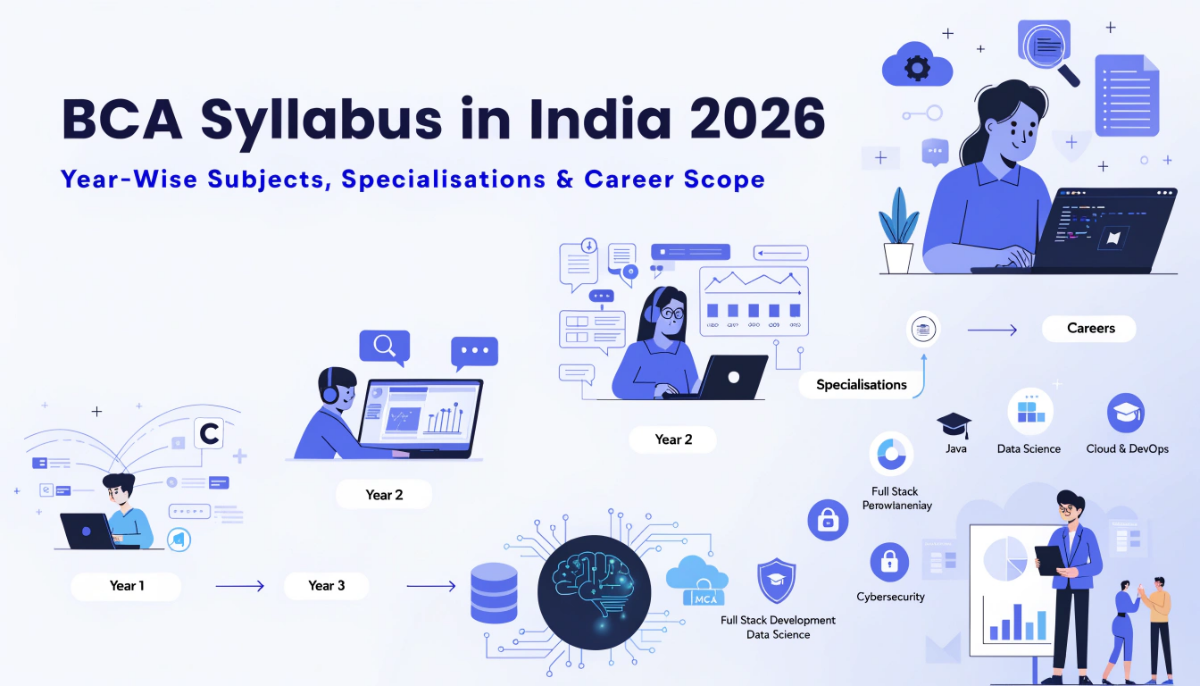
The BCA syllabus in India is a three-year undergraduate programme that covers computer applications, programming, software development and information technology fundamentals and it is the most popular computer science undergraduate degree for students who want to enter the IT sector without pursuing a BTech or BE. Understanding the BCA syllabus in detail before you enrol helps you know what you are signing up for, which subjects matter most for placements and whether the curriculum at the institution you are considering is genuinely industry-relevant. The curriculum across India is broadly similar at the semester level but the depth of programming instruction, the quality of lab components and the availability of specialisation electives in the final year vary considerably between universities and institutions. This guide covers the complete BCA syllabus year by year and semester by semester along with the subjects that matter most for jobs and the career paths this degree realistically opens.
What the BCA Actually Is and Who It Is Right For
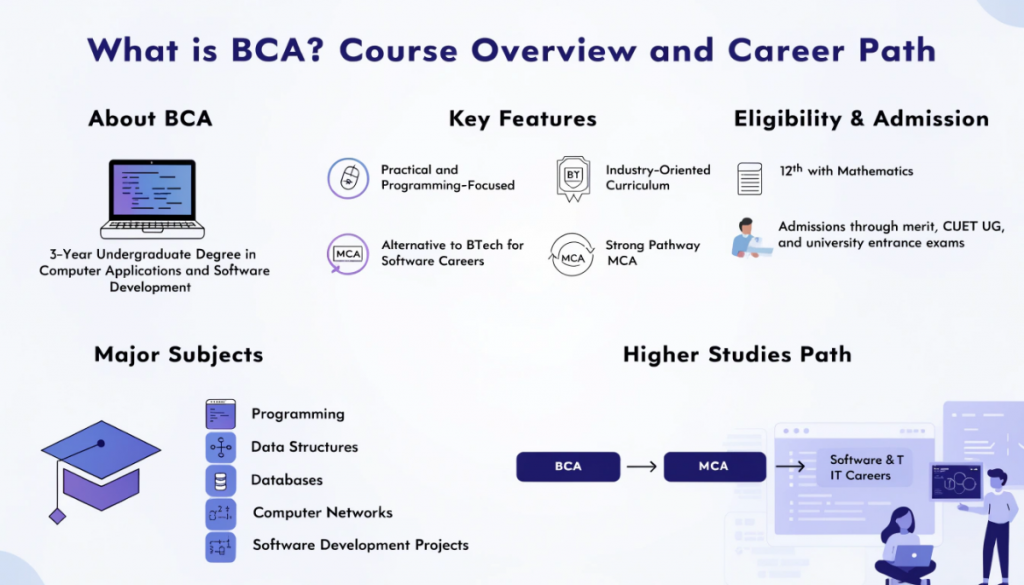
The BCA is a three-year, six-semester undergraduate degree focused on computer applications and software development. It is more practical and programming-oriented than a BSc Computer Science, while being less engineering-intensive than a BTech. This makes it a strong option for students who want to enter the software industry but did not choose the JEE or full engineering route.
Eligibility for BCA usually requires completion of 12th standard with Mathematics as a compulsory subject. Admissions are offered through merit or entrance exams like CUET UG and university-specific tests. The programme includes subjects such as programming, data structures, databases, and computer networks along with projects and practical training.
BCA is also one of the most common pathways to MCA in India because many core subjects overlap with the MCA curriculum, giving students a strong foundation for postgraduate studies in computer science.
Year One BCA Syllabus: Building the Programming Foundation
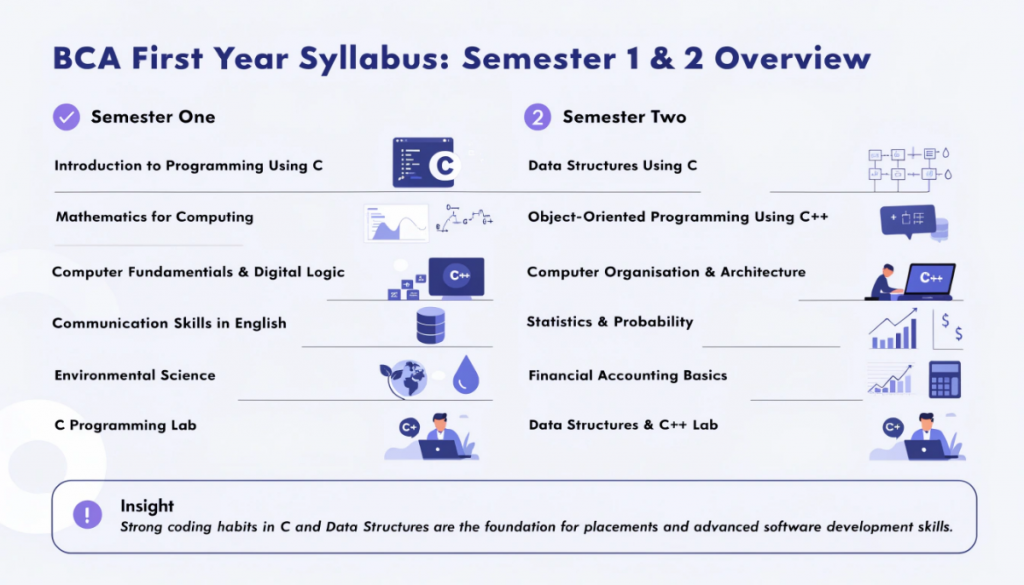
The first year of the BCA syllabus introduces students to computer science fundamentals and programming basics. The subjects across semester one and two are designed to bring students from a 12th standard understanding of computers to a working knowledge of programming and basic digital systems.
Semester One Subjects
Semester one of the BCA syllabus typically covers the following subjects across most Indian universities:
Introduction to Programming Using C: Variables, data types, operators, control statements, loops, functions, arrays, strings, pointers and basic file handling — this is the foundational programming subject that the entire BCA syllabus builds upon
Mathematics for Computing: Set theory, Boolean algebra, number systems including binary, octal and hexadecimal, matrices and determinants and basic calculus and their applications in computing
Computer Fundamentals and Digital Logic: History of computers, generations, types, input and output devices, memory types, number system conversions and basic logic gates and circuits
Communication Skills in English: Professional writing, business correspondence, presentation skills and communication in technical contexts
Environmental Science: Ecology, pollution, sustainability and environmental awareness — compulsory across most Indian universities under UGC guidelines
Practical Lab: C programming lab with hands-on exercises reinforcing the theory programming subject
Semester Two Subjects
Semester two of the BCA syllabus advances the programming foundation and introduces data structures:
Data Structures Using C: Arrays, linked lists, stacks, queues, trees, binary search trees, sorting algorithms and searching algorithms — the most important technical subject in the first year of the BCA syllabus
Object-Oriented Programming Using C++: Classes, objects, constructors, destructors, inheritance, polymorphism, operator overloading and templates
Computer Organisation and Architecture: CPU design, memory hierarchy, instruction sets, pipelining, I/O systems and assembly language basics
Statistics and Probability: Descriptive statistics, probability theory, distributions, regression and correlation — foundational for data analysis subjects in later years
Financial Accounting Basics: Accounting principles, journal entries and basic financial statement reading — included at most institutions for business awareness
Practical Lab: Data structures and C++ lab exercises
The first year of the BCA syllabus is the stage where students either develop genuine programming ability or fall behind. C and data structures are the two subjects that most directly determine how well students perform in subsequent years and in placement preparation. Students who build strong coding habits in semester one and two by practising beyond the lab assignments are significantly better positioned for placements than those who learn only enough to clear the semester examinations.
Year Two BCA Syllabus: Core Computer Science in Depth
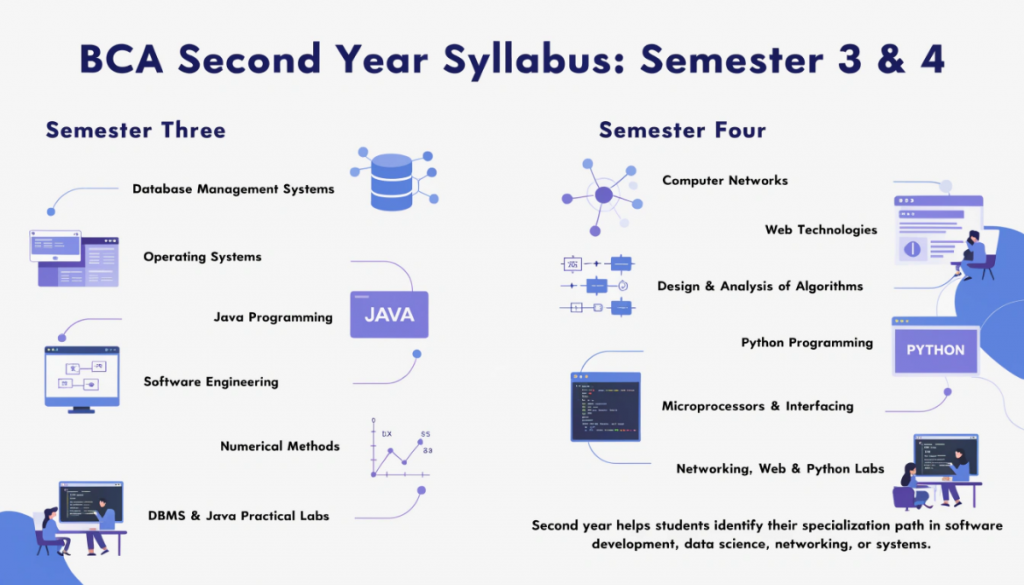
second year of the BCA syllabus is where the curriculum deepens into the core computer science subjects that most directly map to industry skills. Semester three and four introduce software engineering, databases, networking and more advanced programming.
Semester Three Subjects
Semester three typically includes the following subjects in the BCA syllabus:
Database Management Systems: Relational model, SQL including DDL and DML, ER diagrams, normalisation up to BCNF, transaction management and indexing
Operating Systems: Process management, CPU scheduling, memory management, deadlock, file systems and Linux command line basics
Java Programming: Object-oriented programming in Java, exception handling, multithreading, collections framework, file I/O and introduction to Java applets and Swing
Software Engineering: SDLC models, requirements engineering, system design, testing methodologies and project management basics
Numerical Methods: Roots of equations, interpolation, numerical integration and differential equations — foundational for scientific computing and simulation
Practical Lab: DBMS lab with MySQL and Java programming lab
Semester Four Subjects
Semester four of the BCA syllabus continues building on the third semester foundation:
Computer Networks: OSI and TCP/IP models, IP addressing and subnetting, routing protocols, transport layer protocols, application layer services and network security basics
Web Technologies: HTML5, CSS3, JavaScript, responsive web design, PHP or Node.js basics and introduction to web frameworks
Design and Analysis of Algorithms: Algorithm paradigms including divide and conquer, dynamic programming and greedy, graph algorithms and computational complexity
Python Programming: Python syntax, data structures in Python, functions, modules, file handling, libraries including NumPy and Pandas and introduction to data analysis
Microprocessors and Interfacing: 8085 and 8086 architecture, assembly language programming and peripheral interfacing — included at most traditional universities
Practical Lab: Networking lab, web development lab and Python programming lab
The second year of the BCA syllabus is where students typically identify which domain they want to specialise in. Students who enjoy building web applications naturally gravitate toward web technologies and Java. Students who are drawn to data work respond more strongly to the Python and DBMS subjects. Students interested in systems and infrastructure engage more deeply with operating systems and networking. The second year signals which direction the third year should go.
Year Three BCA Syllabus: Specialisations, Electives and Final Projects
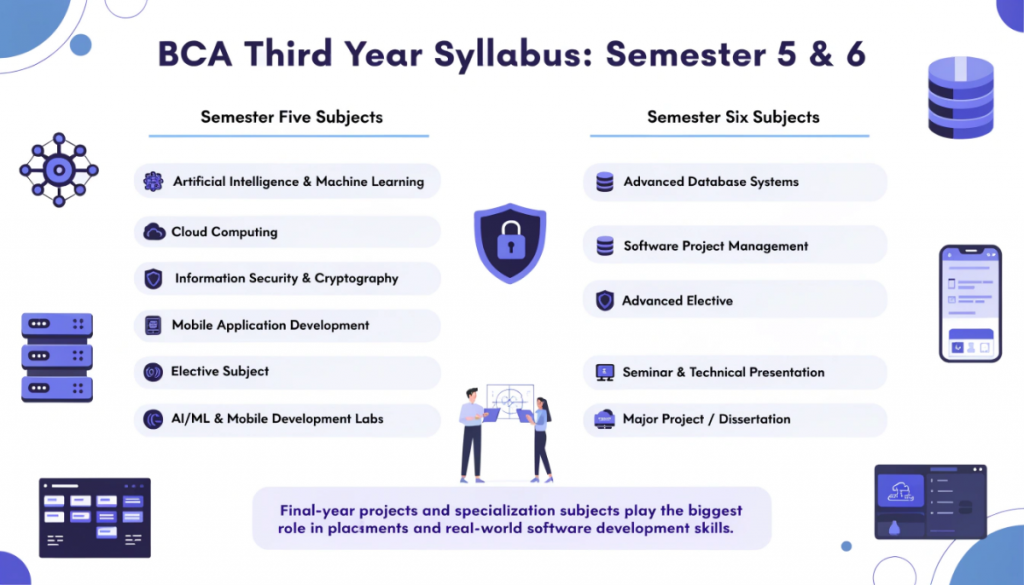
The third year is the most applied and the most differentiated part of the BCA syllabus. Semester five and six combine remaining core subjects with specialisation electives and a final project that is the single most important placement asset students build during the entire programme.
Semester Five Subjects
Semester five of the BCA syllabus typically includes:
Artificial Intelligence and Machine Learning: Search algorithms, knowledge representation, supervised and unsupervised learning, neural network basics and Python-based ML using Scikit-learn
Cloud Computing: Cloud service models, AWS and Azure basics, virtualisation, containerisation using Docker and cloud security fundamentals
Information Security and Cryptography: Symmetric and asymmetric encryption, hashing, digital signatures, PKI, network attacks and ethical hacking fundamentals
Mobile Application Development: Android development using Java or Kotlin, or cross-platform development using Flutter or React Native
Elective Subject 1: Subject depends on institution and chosen track — options commonly include data science, full stack development, cybersecurity or IoT
Practical Lab: AI/ML lab and mobile development lab
Semester Six Subjects and Final Project
The final semester of the BCA syllabus is the most project-heavy and the most career-defining:
Advanced Database Systems: NoSQL databases including MongoDB, distributed databases, data warehousing and big data fundamentals
Software Project Management: Agile methodology, Scrum framework, project planning, cost estimation and team management
Elective Subject 2: Advanced subject in chosen specialisation area
Seminar or Technical Presentation: Research on a current technology topic with a formal presentation to faculty
Major Project or Dissertation: A full-semester industry-standard project that students develop independently or in small teams with a faculty or industry guide
The major project in the final semester of the BCA syllabus is what separates strong candidates from average ones in campus and off-campus placements. A well-documented project that solves a real problem using multiple technologies from across the BCA curriculum gives students something concrete to discuss in technical interviews. Students who build genuinely functional projects rather than copying standard templates consistently report better placement experiences than those who treat the project as an academic formality.
Specialisation Options That Matter in the Final Year
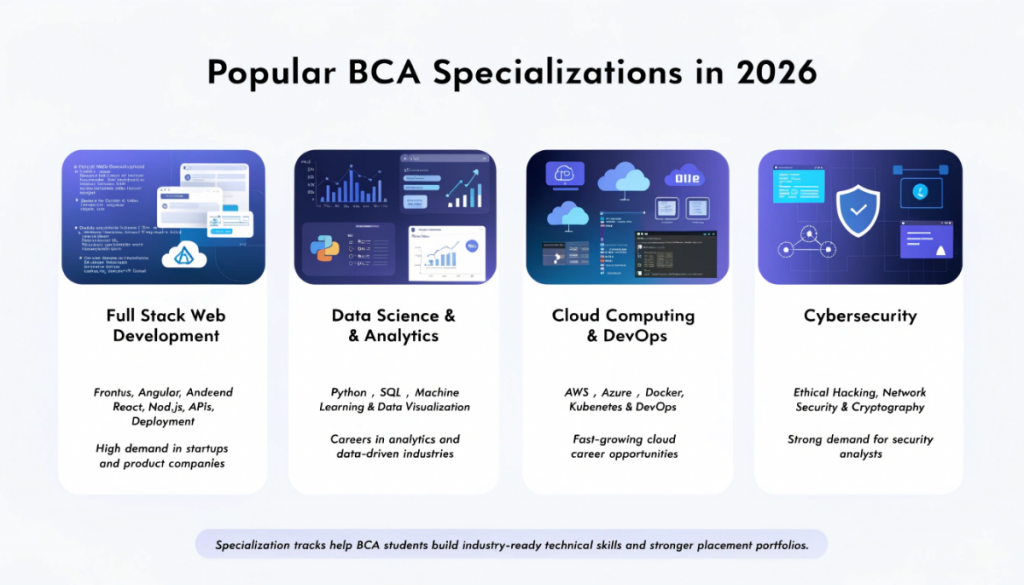
Many universities offering the BCA now allow students to choose a specialisation stream in their final year. The BCA syllabus in these institutions offers elective subjects grouped into specialisation tracks. Here are the most common ones.
Full Stack Web Development
The full stack track covers advanced front-end development using React or Angular, back-end development using Node.js or Django, REST API design, database integration and deployment on cloud platforms. Students who complete this track graduate with the ability to build complete web applications end to end which is one of the most consistently in-demand skill sets in the Indian startup and product company job market.
Full stack developers from BCA programmes at institutions with strong final-year project support consistently secure roles with starting salaries between Rs 3.5 lakh and Rs 7 lakh depending on technical depth and project quality.
Data Science and Analytics
The data science track within the BCA syllabus covers Python for data analysis in depth, SQL for querying large datasets, machine learning algorithms using Scikit-learn, data visualisation using Matplotlib and Tableau and the basics of statistical modelling.
Students from this track target roles as junior data analysts at e-commerce companies, BFSI organisations and analytics firms. Starting salaries for BCA data science track graduates in India range from Rs 3 lakh to Rs 6 lakh per year with those who have strong Python and SQL portfolios consistently commanding better offers than those who only have classroom coursework to show.
Cloud Computing and DevOps
The cloud and DevOps track covers AWS or Azure fundamentals, Infrastructure as Code using Terraform basics, Docker and Kubernetes introduction, CI/CD pipeline basics and Linux system administration.
This is the most rapidly growing specialisation track within the BCA syllabus in India in 2026 because cloud adoption across Indian organisations is creating consistent entry-level demand for cloud-literate graduates. Students who complement the BCA cloud track with an AWS Cloud Practitioner or Azure Fundamentals certification significantly improve their entry-level placement prospects with cloud-focused IT services firms.
Cybersecurity
The cybersecurity track covers network security in depth, ethical hacking fundamentals using tools like Metasploit and Nmap, web application security covering OWASP Top 10, digital forensics basics, cryptography and security operations centre processes.
India’s cybersecurity talent shortage means that BCA cybersecurity graduates with hands-on CTF competition experience or a CompTIA Security+ certification are genuinely competitive for entry-level security analyst positions at BFSI companies, IT services firms and government technology organisations with starting packages between Rs 3.5 lakh and Rs 6.5 lakh.
Jobs After BCA and Realistic Salary Expectations in India
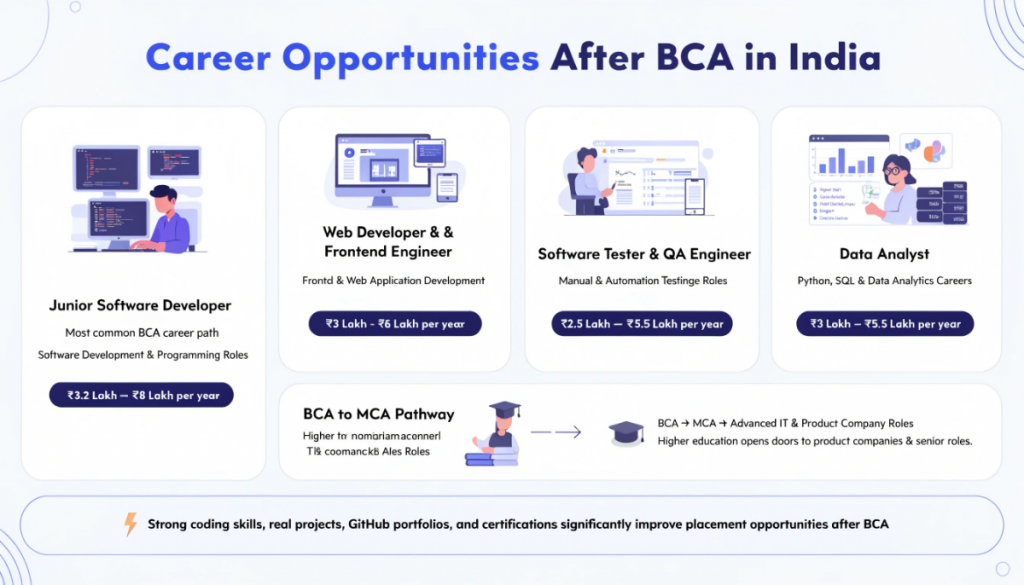
The BCA syllabus prepares graduates for entry-level roles across software development, testing, data work and IT operations. Here is an honest breakdown of where BCA graduates actually end up in India and what they earn.
Junior Software Developer
Junior software developer is the most common career path for BCA graduates in India. IT services companies including TCS, Infosys, Wipro, HCL, Cognizant and Tech Mahindra hire BCA graduates through off-campus drives and pool campus placements at starting salaries between Rs 3.2 lakh and Rs 4.5 lakh per year.
Product companies and startups hire BCA graduates with strong programming portfolios at salaries between Rs 4 lakh and Rs 8 lakh depending on the technology stack and the quality of projects demonstrated during the interview. The programming and data structures content is what is most directly tested in software developer technical interviews and students who practise DSA consistently throughout the three years are significantly better prepared than those who start only in the final semester.
Web Developer and Frontend Engineer
BCA graduates who develop strong HTML, CSS, JavaScript and React skills during the web technologies subjects and the final year project are well positioned for web developer and frontend engineer roles.
Starting salaries for web development roles at digital agencies, startups and product companies in India range from Rs 3 lakh to Rs 6 lakh per year. Students who build a visible portfolio of web projects on GitHub significantly improve their chances in web developer hiring because portfolio work is the primary shortlisting criterion for frontend roles at most Indian startups.
Software Tester and QA Engineer
Quality assurance and software testing is one of the most accessible entry points for BCA graduates into the IT sector. Manual testing roles at IT services firms start at Rs 2.5 lakh to Rs 4 lakh per year while automation testing roles using Selenium, Cypress or Appium start higher at Rs 3.5 lakh to Rs 5.5 lakh.
The software engineering and programming subjects in the BCA syllabus provide the foundational knowledge for testing roles and students who specifically develop automation testing skills in the final year place themselves in the more competitively paid segment of this career track from the start.
Data Analyst
BCA graduates from data science specialisation tracks with strong Python and SQL skills are increasingly targeting junior data analyst roles at analytics firms, e-commerce companies and BFSI organisations. Starting salaries for entry-level data analyst roles for BCA graduates range from Rs 3 lakh to Rs 5.5 lakh per year. Students who supplement the data science subjects with the Google Data Analytics Professional Certificate or a Power BI certification consistently report better success in data analyst interview processes than those who rely only on academic credentials.
BCA as a Stepping Stone to MCA
A significant proportion of BCA graduates in India pursue MCA after completing their undergraduate degree and the BCA to MCA route is one of the most well-trodden paths in Indian IT education. BCA graduates entering MCA programmes have already covered a large portion of the first-year MCA content through the BCA syllabus which means they can focus their MCA first year effort on deepening subjects rather than building them from scratch.
The combined BCA plus MCA qualification positions graduates for higher starting salaries than BCA alone and opens doors to roles at product companies and global IT firms that require a postgraduate computer science qualification.
Conclusion
The BCA syllabus in India in 2026 is a genuinely comprehensive three-year undergraduate programme that covers programming from C through Java and Python, data structures, database management, operating systems, computer networks, web technologies, algorithms and increasingly artificial intelligence and cloud computing in the final year.
The first year builds programming fundamentals, the second year deepens core computer science knowledge and the third year moves into specialisation and applied project work. Students who take the programme seriously rather than just clearing semester examinations consistently outperform their peers in placements because they enter recruitment processes with genuine technical skills rather than only a degree.
Complementing the curriculum with personal projects, open source contributions and relevant certifications in cloud, data or security is the most reliable way to convert a BCA into the starting salary and role you are actually targeting.


Book Your
Free Session
Connect with our experts and get personalised guidance for your career, course selection, and future goals.
📖 Sources & References
✓ Verified 2026Verified BCA syllabus references, programming resources, curriculum frameworks and technical learning materials relevant for 2026 BCA students.
- Shoolini Online BCA Programme Official online BCA programme structure, specialisations and curriculum overview
- UGC NEP 2020 Framework Updated undergraduate curriculum and higher education framework guidelines in India
- CUET UG Official Portal National undergraduate entrance examination structure and admission information
- Oracle MySQL Documentation Database management, SQL syntax and transaction management learning resources
- PostgreSQL Documentation Advanced relational database concepts and query optimisation references
- MDN Web Docs HTML, CSS, JavaScript and full stack web development documentation
- LeetCode DSA and coding interview preparation platform for BCA students
- HackerRank Programming, SQL and algorithm problem-solving practice resources
- CS50 by Harvard Foundational computer science and programming concepts for beginners
- Git Documentation Version control, branching and collaborative software development documentation