

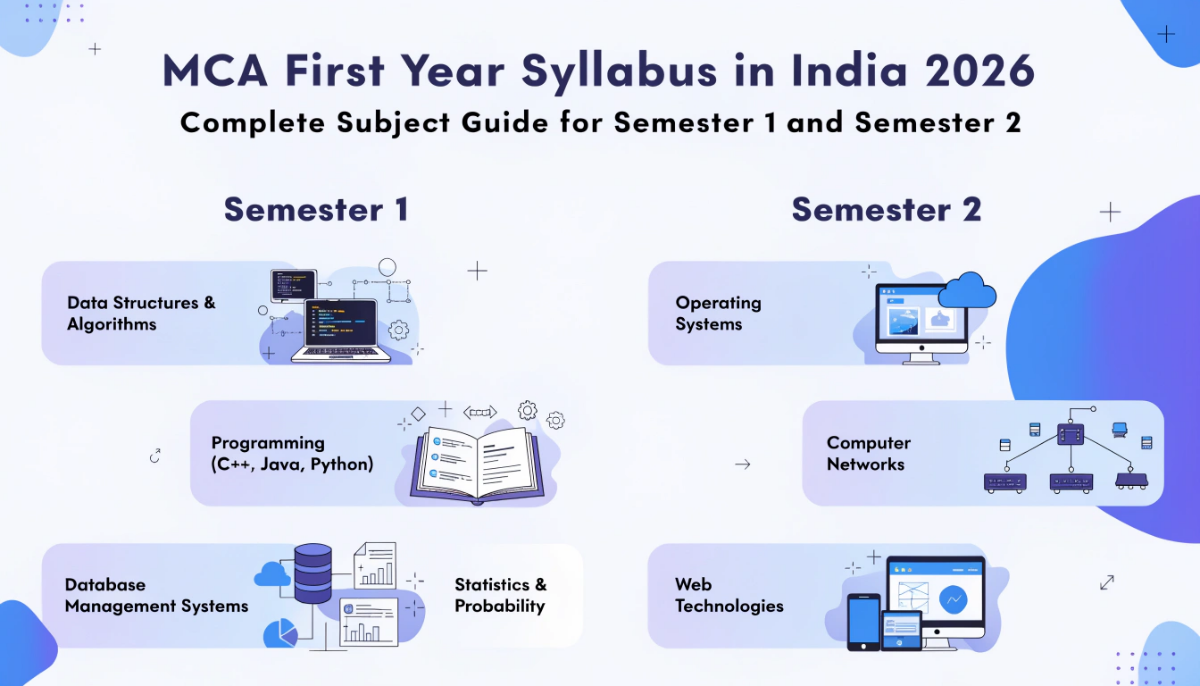
The MCA first year syllabus is where the entire two-year programme is built and if you understand these subjects properly the second year specialisation work becomes significantly easier.The first year covers computer science fundamentals that are compulsory for all students regardless of their undergraduate background and these subjects are what NIMCET, CUET PG and other MCA entrance examinations test students on.
Whether you are a BCA graduate looking to deepen existing knowledge or a BSc Mathematics or BSc IT student entering a computing-heavy environment for the first time, the MCA first year syllabus introduces the same subjects to everyone and expects the same depth by the end of the academic year. This guide covers every subject in the MCA first year syllabus across semester one and semester two in detail including what each subject covers, why it matters for the rest of the programme and how to approach studying it effectively.
Why the First Year Sets the Ceiling for Everything That Follows
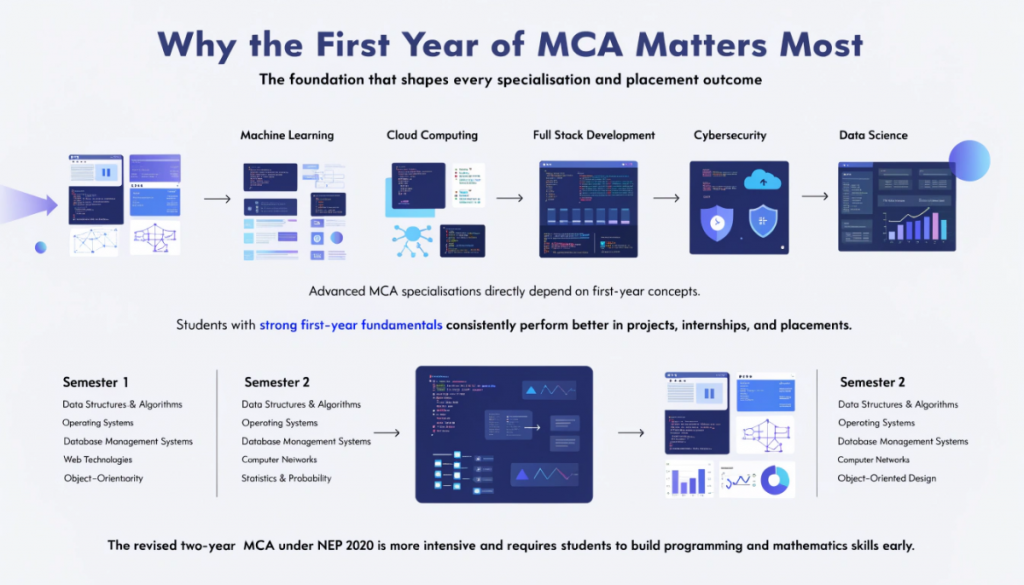
Most MCA students underestimate the importance of the first year. The instinct is to treat semester one and two as hurdles to clear before getting to the interesting specialisation work in year two. That is the wrong way to approach the MCA first year syllabus and it consistently produces students who struggle in year two because their foundations are weak.
Every advanced subject in the second year builds directly on first year content. Machine learning requires the probability and statistics from semester two. Cloud computing requires the operating systems and networking knowledge from semester one and two.
Full stack development requires the database management, web technologies and object-oriented design from the first year. Cybersecurity requires the computer networks, cryptography basics and algorithms from the MCA first year syllabus. The students who perform best in placements are almost always the ones who took the first year seriously rather than memorising for exams and forgetting immediately after.
The MCA first year syllabus under the revised two-year programme introduced by UGC under NEP 2020 is designed to cover what a three-year programme previously covered in year one and part of year two. This compression means the first year is more intensive than it was in the older structure and students entering with gaps in programming or mathematics need to address those gaps early rather than hoping the course will catch them up organically.
Semester One: Every Subject Explained in Detail

Book Your
Free Session
Connect with our experts and get personalised guidance for your career, course selection, and future goals.
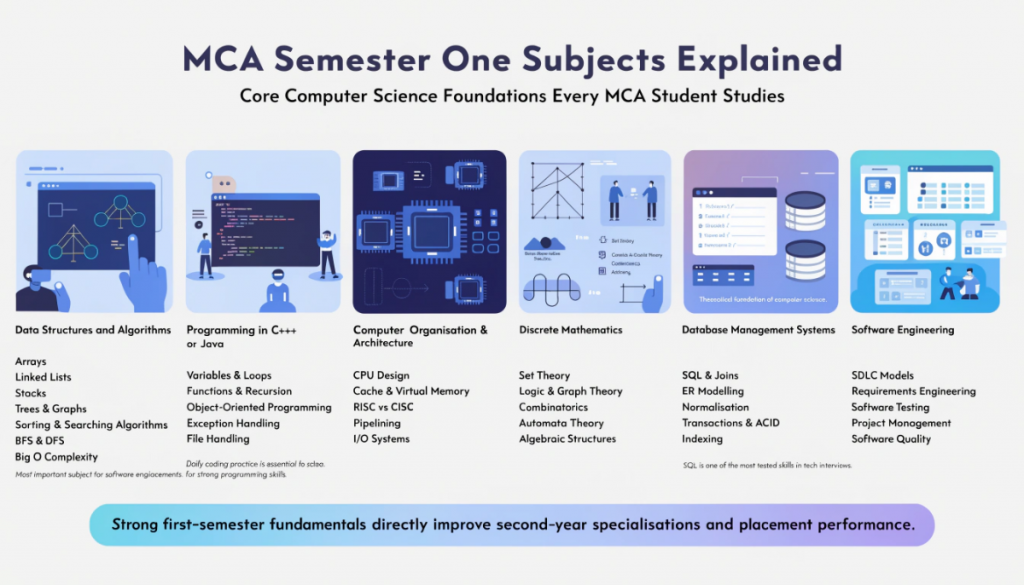
Semester one of the MCA first year syllabus typically covers six to seven core subjects. Here is a detailed breakdown of each subject including what it covers and why it matters.
Data Structures and Algorithms
Data structures and algorithms is the most important and most heavily weighted subject in the entire MCA first year syllabus. It covers:
Linear data structures: arrays, linked lists including singly, doubly and circular variants, stacks and queues with their applications
Non-linear data structures: binary trees, binary search trees, AVL trees, B-trees, heaps and graphs
Sorting algorithms: bubble sort, selection sort, insertion sort, merge sort, quicksort, heap sort and their time and space complexities
Searching algorithms: linear search, binary search and hashing techniques including collision resolution
Graph algorithms: BFS, DFS, Dijkstra’s shortest path, Prim’s and Kruskal’s minimum spanning tree algorithms
Algorithm analysis: Big O notation, best case, worst case and average case complexity and the P vs NP problem introduction
Why it matters: DSA is tested in virtually every software engineering interview in India including campus placements at TCS, Infosys, Wipro, Amazon, Microsoft and every product company. Students who genuinely master DSA in the MCA first year syllabus have a significant placement advantage over those who only studied it superficially for the semester exam. Practice on LeetCode and HackerRank alongside classroom study is strongly recommended for this subject.
Programming in C++ or Python or Java
Most Indian universities that offer MCA choose one primary programming language for the first semester. C++ is used at institutions with a systems programming focus, Python at institutions emphasising data science and modern development and Java at institutions with a software engineering focus. The subject covers:
Fundamental concepts: variables, data types, operators, control structures including loops and conditionals
Functions: parameter passing, recursion, scope and lifetime of variables
Object-oriented programming: classes, objects, constructors, destructors, inheritance, polymorphism including function overloading and overriding and encapsulation
Exception handling: try-catch blocks, custom exception classes and handling runtime errors gracefully
File handling: reading from and writing to files, file streams and serialisation basics
Standard library usage: collections, string manipulation and basic input-output operations
Why it matters: Programming is the practical foundation of everything in the MCA first year syllabus and beyond. Students who only understand programming theoretically without writing actual code consistently struggle with project work in year two. Writing at least one program per day during the first semester regardless of assignment requirements is the single most effective study habit for this subject.
Computer Organisation and Architecture
This subject covers how a computer physically works at the hardware level and how software interacts with hardware. The MCA first year syllabus content in this subject includes:
Digital logic: Boolean algebra, logic gates, combinational circuits including adders, multiplexers and decoders and sequential circuits including flip-flops and registers
CPU design: ALU, control unit, registers, instruction cycle including fetch, decode and execute phases
Memory systems: primary memory, cache memory and its mapping techniques, virtual memory, secondary storage
Instruction set architecture: RISC vs CISC, addressing modes and assembly language basics
Pipelining: pipeline stages, data hazards, control hazards and forwarding techniques
Input and output systems: I/O interfaces, DMA, interrupts and device controllers
Why it matters: Computer organisation provides the context for understanding why programs behave the way they do at a performance level. It is directly relevant to operating systems which follows in the next semester and to cloud computing in year two where understanding virtualisation requires knowledge of hardware abstraction.
Discrete Mathematics
Discrete mathematics is the most theoretical subject in the MCA first year syllabus and it is also the one that students from non-mathematics backgrounds find most challenging. It covers:
Set theory: sets, relations, functions, equivalence relations and partial orders
Logic: propositional logic, truth tables, logical equivalences, predicate logic and quantifiers
Graph theory: types of graphs, trees, spanning trees, Euler and Hamiltonian paths, graph colouring and planarity
Combinatorics: permutations, combinations, pigeonhole principle, inclusion-exclusion principle and generating functions
Algebraic structures: groups, rings, fields and lattices
Formal languages and automata theory: finite automata, regular expressions, context-free grammars and Turing machines introduction
Why it matters: Discrete mathematics is the theoretical foundation of computer science. Automata theory connects directly to compiler design in year two. Graph theory connects to algorithm design. Logic connects to database query optimisation and formal verification. Students who invest genuine effort in discrete mathematics during the MCA first year syllabus find many second-year subjects significantly more intuitive as a result.
Database Management Systems
Database management is one of the most directly practical subjects in the MCA first year syllabus and one of the most consistently tested skills in the job market. It covers:
Relational model: tables, tuples, attributes, domains, primary keys, foreign keys and referential integrity
SQL: DDL commands including CREATE, ALTER and DROP; DML commands including SELECT, INSERT, UPDATE and DELETE; joins including inner, left, right and full outer; subqueries and aggregate functions
Entity-relationship modelling: ER diagrams, entity types, relationship types, cardinality and converting ER diagrams to relational schemas
Normalisation: functional dependencies, first, second and third normal forms and Boyce-Codd Normal Form
Transaction management: ACID properties, concurrency control including locking and timestamp ordering and recovery techniques
Indexing: B-tree indexes, hash indexes and query optimisation basics
Why it matters: SQL is tested in almost every analytics, data science and backend development interview in India. MCA students who develop strong SQL skills during the MCA first year syllabus have a concrete and immediately testable technical skill that employers value from the first day of placement season. Practice with real databases on MySQL or PostgreSQL rather than just studying the theory is essential for this subject.
Software Engineering
Software engineering covers the process of building software systematically rather than just writing code and it is directly relevant to how professional development teams work in Indian IT companies. The content in this subject covers:
Software development life cycle: waterfall, spiral, incremental, RAD and agile models with their advantages and limitations
Requirements engineering: functional and non-functional requirements, use cases, user stories and requirement specification documents
System design: architectural design, detailed design, design principles including modularity, cohesion and coupling
Software testing: unit testing, integration testing, system testing, acceptance testing, black-box and white-box testing techniques
Project management: effort estimation using function point analysis and COCOMO models, scheduling, risk management and configuration management
Software quality: quality attributes, CMM levels and software metrics
Semester Two: Advanced Subjects That Push Technical Depth
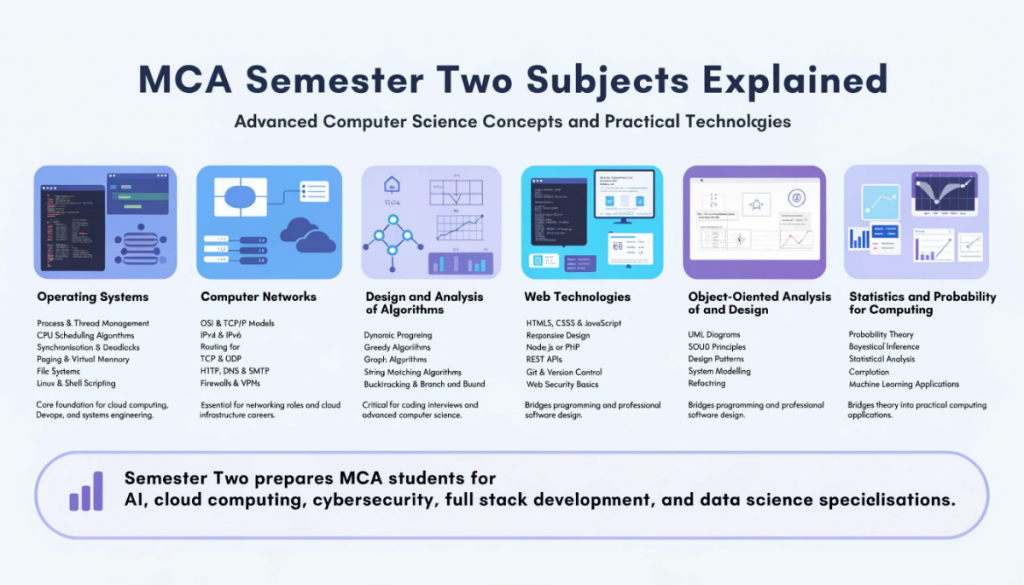
Semester two of the MCA first year syllabus moves into more advanced territory building directly on the foundation of semester one. Here is every subject in detail.
Operating Systems
Operating systems is one of the most conceptually challenging subjects in the MCA first year syllabus and also one of the most important for understanding how modern software systems actually work. It covers:
Process management: processes, threads, process states and transitions, context switching and process scheduling algorithms including FCFS, SJF, round robin and priority scheduling
Synchronisation: race conditions, critical sections, mutex, semaphores, monitors and classic synchronisation problems including producer-consumer, readers-writers and dining philosophers
Deadlock: conditions for deadlock, deadlock prevention, avoidance using Banker’s algorithm, detection and recovery
Memory management: contiguous allocation, paging, segmentation, virtual memory, demand paging and page replacement algorithms including FIFO, LRU and optimal
File systems: file organisation, directory structures, file allocation methods including contiguous, linked and indexed and disk scheduling algorithms
Linux internals: process management, shell scripting basics and system calls
Why it matters: Operating systems knowledge is directly relevant to cloud computing, DevOps and system programming subjects in year two. Students who understand process management and memory management deeply have a much easier time grasping containerisation and virtualisation concepts when they encounter them in cloud subjects later.
Computer Networks
Computer networks is the other major systems subject in semester two and it is directly relevant to both the cybersecurity and cloud computing specialisation tracks. It covers:
Network models: OSI seven-layer model and TCP/IP four-layer model with functions of each layer
Data link layer: framing, error detection using CRC and Hamming codes, flow control and MAC protocols including CSMA/CD and CSMA/CA
Network layer: IP addressing including IPv4 and IPv6, subnetting, CIDR, routing protocols including RIP, OSPF and BGP
Transport layer: TCP and UDP, connection establishment and termination, flow control using sliding window and congestion control
Application layer protocols: HTTP and HTTPS, DNS, FTP, SMTP and POP3, DHCP and SNMP
Network security basics: firewalls, VPNs, SSL/TLS, symmetric and asymmetric encryption introduction and common attack types
Design and Analysis of Algorithms
This subject extends the algorithms content from semester one DSA into more advanced territory and forms the theoretical core of computer science in the MCA first year syllabus. It covers:
Algorithm design paradigms: divide and conquer with examples including merge sort, quicksort and binary search; dynamic programming with examples including longest common subsequence, 0-1 knapsack and matrix chain multiplication; greedy algorithms with examples including activity selection and Huffman coding
Graph algorithms: Dijkstra, Bellman-Ford, Floyd-Warshall for shortest paths; Prim and Kruskal for minimum spanning trees; topological sorting and strongly connected components
String algorithms: KMP algorithm, Rabin-Karp and Boyer-Moore for pattern matching
Computational complexity: P, NP, NP-hard and NP-complete classes, polynomial time reductions and approximation algorithms
Front-end development: HTML5 semantic elements, CSS3 including flexbox, grid and animations, JavaScript fundamentals including DOM manipulation, events and AJAX
Responsive design: media queries, mobile-first design principles and Bootstrap basics
Server-side programming: PHP or Node.js basics, handling form submissions, session management and connecting to a MySQL database from server-side code
REST APIs: HTTP methods, JSON, building and consuming simple REST endpoints
Web security: XSS, SQL injection, CSRF and basic input validation and sanitisation techniques
Version control: Git basics including init, add, commit, push, pull, branching and merging
Backtracking and branch and bound: N-queens problem, subset sum and travelling salesman problem
Web Technologies
Web technologies is the most practically hands-on subject in semester two and one of the most directly job-relevant. It covers:
Object-Oriented Analysis and Design
OOAD bridges the gap between programming concepts learned in semester one and the systematic design of complex software systems. It covers:UML diagrams: use case diagrams, class diagrams, sequence diagrams, activity diagrams, state diagrams and component diagrams
Object-oriented design principles: SOLID principles, DRY, KISS and separation of concerns
Design patterns: creational patterns including factory and singleton; structural patterns including adapter and decorator; behavioural patterns including observer, strategy and command
System modelling: identifying actors, use cases, classes, responsibilities and relationships in a real-world software system
Refactoring: recognising code smells and applying systematic improvements to existing code without changing its behaviour
Statistics and Probability for Computing
This subject is the mathematical foundation for machine learning, data science and research methods in the MCA first year syllabus and it is one that students from non-mathematics backgrounds should take particularly seriously. It covers:Probability theory: sample spaces, events, conditional probability, Bayes theorem and independence
Random variables: discrete and continuous distributions including Bernoulli, binomial, Poisson, uniform, normal and exponential
Statistical inference: point estimation, confidence intervals and hypothesis testing including t-tests, chi-square tests and ANOVA
Regression analysis: simple and multiple linear regression, residual analysis and goodness-of-fit measures
Correlation: Pearson and Spearman correlation coefficients and their interpretations
Applications: how these concepts apply directly to machine learning model evaluation, A/B testing and data analysis
How the MCA First Year Syllabus Varies Across Universities
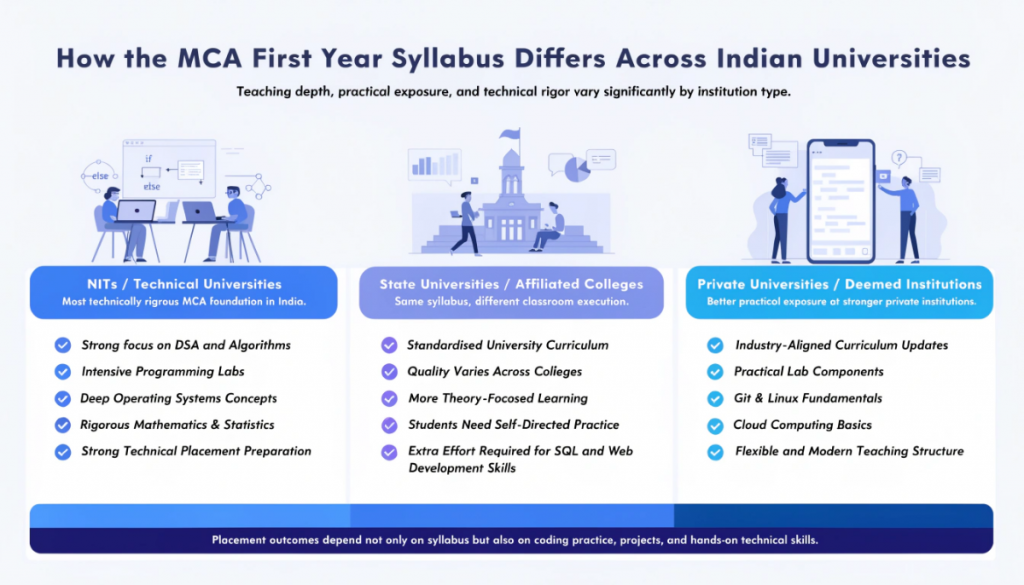
The MCA first year syllabus is not identical across all Indian universities. While the core subjects are broadly consistent there are meaningful differences in depth, programming language choices and practical components that affect how well prepared graduates are for placement.
NITs and Technical Universities
The first year at NITs including NIT Trichy, NIT Warangal and NIT Calicut is among the most rigorous in India. The emphasis is on deep computer science fundamentals particularly in DSA, algorithms and operating systems. Programming is taught more intensively with regular lab assignments requiring substantial coding.
The mathematics component including discrete mathematics and statistics is treated as genuinely important rather than as a box-ticking exercise. Students from NIT MCA programmes enter second-year subjects and placement season with a stronger technical foundation than those from most other institution types.
State Universities and Their Affiliated Colleges
State universities including Delhi University, Pune University, Anna University and Osmania University set the MCA first year syllabus at the university level and all affiliated colleges follow the same curriculum.
The syllabus itself is generally sound but the quality of delivery varies enormously between colleges following identical syllabuses. Students at affiliated colleges need to be more self-directed in their learning using online resources to supplement classroom instruction particularly for practical skills like SQL and web development where hands-on practice matters as much as theory.
Private Universities and Deemed Institutions
Private universities including Manipal, VIT, Amity, NMIMS and SRM offer MCA first year syllabuses that are broadly aligned with the UGC framework but with more flexibility in how subjects are structured and delivered.
Some private universities have updated their first year syllabus faster than state universities to include more industry-relevant content like Git, Linux command line basics and cloud fundamentals even within the core first year subjects. The practical lab components at better-resourced private universities are often stronger than at state-affiliated colleges.
Practical Labs and Projects in the First Year
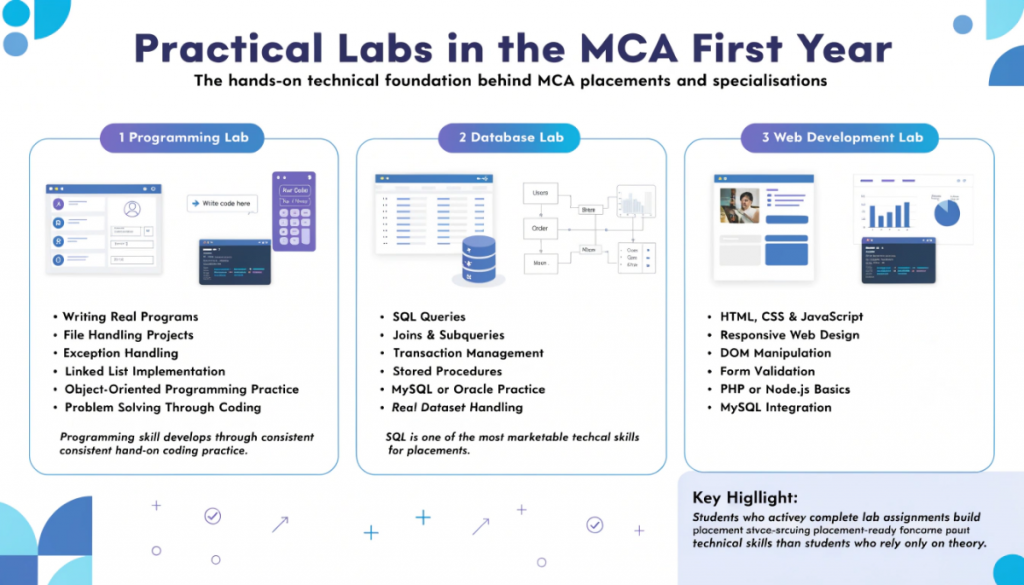
The practical component of the first year is as important as the theory and students who treat lab sessions seriously develop the hands-on skills that theory alone cannot build.
Programming Lab
The programming lab runs alongside the theory programming subject and requires students to implement the concepts covered in lectures. In a strong MCA first year syllabus the programming lab goes beyond reproducing textbook examples and requires students to solve original problems using the concepts they have learned. Building small projects like a student management system using file handling, a simple calculator with exception handling or a basic linked list implementation from scratch are typical lab exercises. The shift from understanding code to writing it independently is where most students need the most practice and the programming lab is where that shift happens.
Database Lab
The database lab requires students to work with an actual DBMS typically MySQL or Oracle and write SQL queries against real datasets rather than just studying syntax on paper. A well-designed MCA first year database lab progresses from simple SELECT statements through complex joins and subqueries to transaction management and stored procedures.
Students who complete the database lab assignments thoroughly develop SQL skills that are directly testable in placement interviews while those who copy lab work without understanding it enter placement season without one of the most marketable technical skills the programme is designed to build.
Web Development Lab
The web technologies lab requires students to build functional web pages and simple web applications using HTML, CSS, JavaScript and basic server-side programming. The most common lab exercises include building a responsive personal portfolio page, creating a form with client-side validation using JavaScript, building a simple todo application with DOM manipulation and creating a basic PHP or Node.js page that reads from a MySQL database. Students who complete these exercises genuinely build the front-end and back-end development skills that form the foundation for the full stack specialisation in year two.
Study Strategy That Actually Works for the First Year
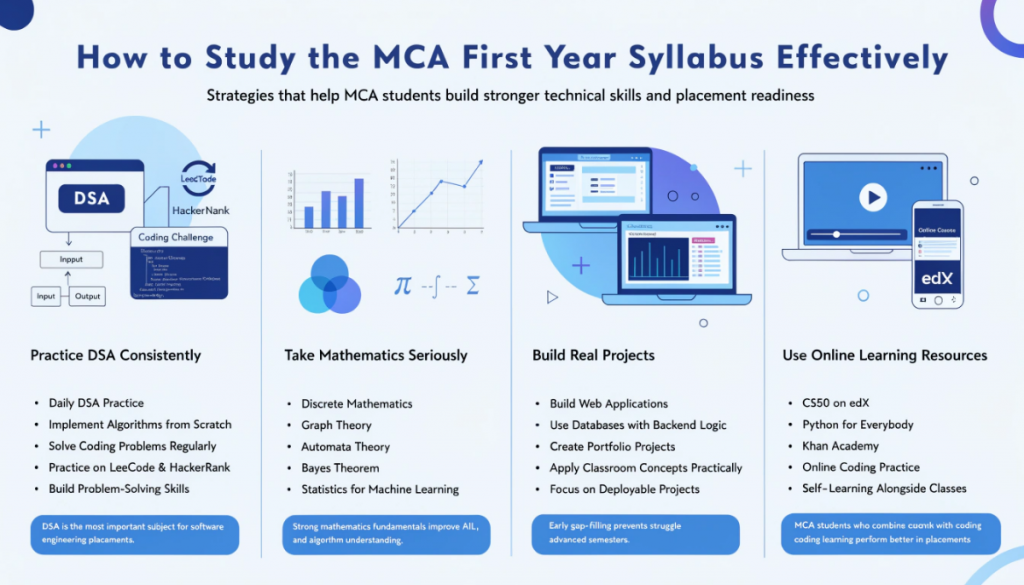
The MCA first year syllabus is intensive and students who approach it without a deliberate study strategy often find themselves overwhelmed by semester-end exam time. Here is what consistently works.
Start with DSA and Never Stop Practising It
Data structures and algorithms is the subject that determines placement outcomes more than any other in the MCA first year syllabus and it requires consistent practice over months rather than intense revision before exams. The recommended approach is to study each data structure and algorithm concept in class, implement it from scratch without reference code the same day, and then solve two to three problems on that concept on LeetCode or HackerRank within the same week.
Students who build this daily practice habit from the first week of semester one consistently outperform those who study DSA theoretically and attempt to build coding fluency only at placement time.
Do Not Ignore Mathematics Subjects
Discrete mathematics and statistics are the two subjects in the MCA first year syllabus that students from programming-heavy backgrounds most commonly underestimate. Both subjects require understanding concepts not just memorising formulas and both are tested directly in GATE CS and in the second-year machine learning and algorithms subjects. Spending extra time on graph theory proofs, automata theory and Bayes theorem applications during semester one and two respectively pays consistent dividends in year two.
Build Actual Projects Alongside Coursework
The single biggest differentiator between MCA graduates who get strong placements and those who struggle is the presence of real projects in their portfolio. The MCA first year syllabus gives you all the building blocks you need to build something meaningful even before the specialisation begins.
A student who finishes semester two having built a full stack web application with a proper database backend, even a simple one, has a portfolio advantage over a student who only has coursework and lab assignments to show. Use the web technologies, database and programming subjects from the first year subjects to build something deployable. The project does not need to be complex. It needs to be real.
Use Online Resources to Fill Gaps Early
The MCA first year syllabus assumes a reasonable foundation in programming and mathematics at entry. Students who have gaps in either area should address them in the first month rather than hoping classroom instruction will catch them up. For programming gaps free resources including CS50 on edX and Python for Everybody on Coursera are specifically well suited to MCA students entering with limited coding experience.
For mathematics gaps Khan Academy’s discrete mathematics and statistics sections cover exactly the prerequisite content that the MCA first year syllabus builds on. Starting these resources in parallel with semester one subjects rather than waiting until exam time is the approach that consistently works.
Conclusion
The MCA first year syllabus in India in 2026 covers data structures and algorithms, programming, computer organisation, discrete mathematics, database management systems and software engineering in semester one and then advances into operating systems, computer networks, design and analysis of algorithms, web technologies, object-oriented design and statistics in semester two.
Every subject in the MCA first year syllabus directly feeds into the second year specialisation subjects and placement preparation and students who build genuine understanding rather than exam-focused memorisation in these two semesters are consistently better placed at the end of the programme. The most important investments to make during the first year are daily DSA practice, real SQL project work and building at least one functioning application that demonstrates what the MCA first year syllabus has actually equipped you to do.

📖 Sources & References
✓ Verified 2026Verified MCA first year syllabus references, programming resources, curriculum frameworks and technical learning materials relevant for 2026 MCA students.
- Shoolini Online MCA Programme Official online MCA programme structure, curriculum overview and postgraduate computer science information
- UGC NEP 2020 Framework Updated postgraduate curriculum and higher education framework guidelines in India
- NIMCET Official Syllabus MCA entrance syllabus covering mathematics, reasoning and computer awareness
- Oracle MySQL Documentation Database management, SQL syntax and transaction management learning resources
- PostgreSQL Documentation Advanced relational database concepts and query optimisation references
- MDN Web Docs HTML, CSS, JavaScript and full stack web development documentation
- LeetCode DSA and coding interview preparation platform for MCA students
- HackerRank Programming, SQL and algorithm problem-solving practice resources
- CS50 by Harvard Foundational computer science and programming concepts for beginners
- Git Documentation Version control, branching and collaborative software development documentation