

Investment banker salary is one of the most discussed compensation packages in finance for a reason — the numbers are genuinely high and the structure of base plus bonus creates significant variation in what individuals actually take home. Whether you are a student targeting investment banking, a professional benchmarking your current pay or someone researching this career, knowing the real verified numbers matters. This guide covers the investment banker salary at every level from analyst to managing director across India, the US and the UK based on data from Glassdoor, Mergers and Inquisitions, Wall Street Prep, PayScale and Prospect Rock Partners updated to early 2026.
How Investment Banking Compensation Actually Works
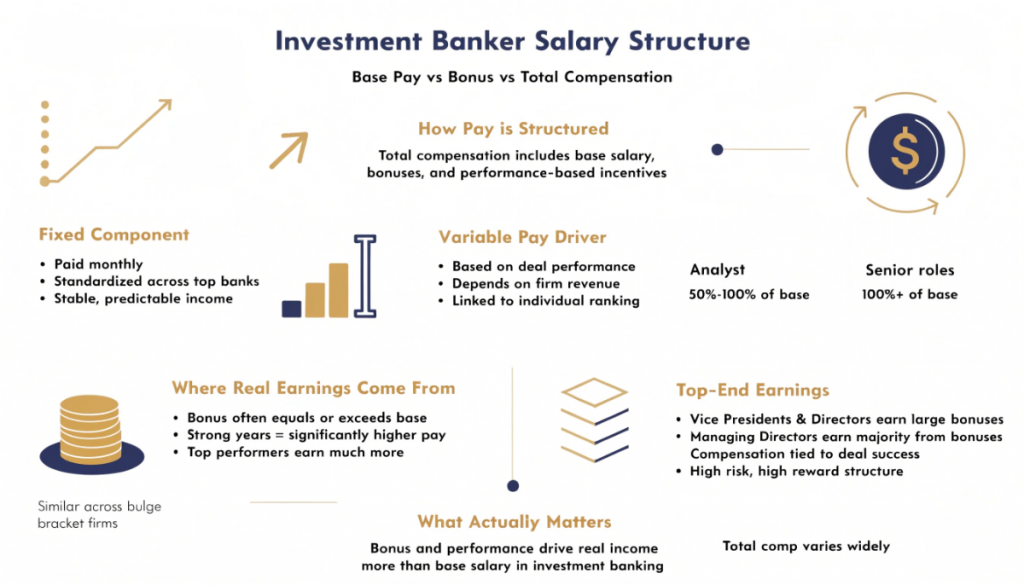
Before looking at investment banker salary figures it is important to understand how the compensation structure works because base salary alone tells only part of the story. Investment banking pay consists of a base salary, a year-end bonus and in some cases signing bonuses, stub bonuses and deferred or stock-based components.
The base salary is the fixed component paid monthly and it is consistent across most bulge bracket banks at the analyst and associate level because firms broadly match each other to stay competitive for talent. The year-end bonus is the variable component and it depends on the firm’s overall financial performance, deal flow, and the individual banker’s ranking within their cohort. At the analyst level bonuses typically run between 50 and 100 percent of base salary at major banks. At the associate and vice president level they can exceed 100 percent of base. Senior bankers at the managing director level earn the largest bonuses which can far exceed their base salary in strong deal years.
This structure means that total investment banker salary varies significantly between a top-ranked analyst and an average-performing one at the same bank and between a strong deal year and a slow one. Understanding both the base and the realistic bonus range is what gives you an accurate picture of actual investment banker salary at any level.
Investment Banker Salary in India, US and UK
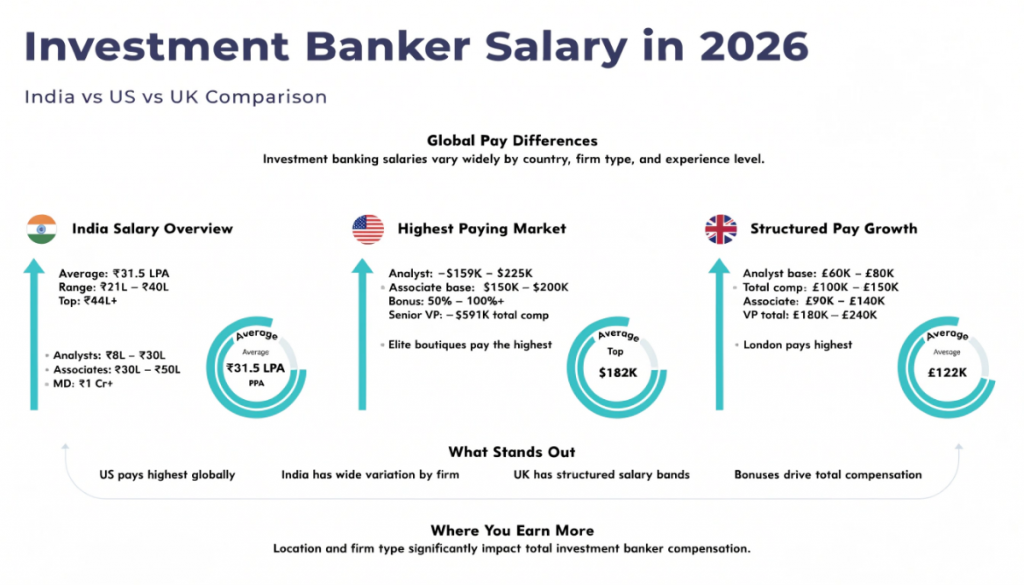
Here are the verified investment banker salary figures across all three markets from the most credible sources available in early 2026.
| Country | Entry / Analyst | Associate Level | Senior (VP / Director) | Top Range / MD | Key Insights |
|---|---|---|---|---|---|
| India |
₹6L – ₹15L Bulge: ₹20L–₹30L |
₹30L – ₹50L Avg: ₹11.5L (Glassdoor) |
₹39L – ₹72L |
₹1Cr – ₹2Cr+ Top: ₹44L+ (base) |
Huge variation by firm. Global banks (JP Morgan, Goldman Sachs) pay significantly more than domestic firms. |
| United States |
$159K – $225K Year 1–2 total comp |
$150K – $200K base +50–100% bonus |
$300K – $591K SVP progression |
$600K+ Elite boutiques pay highest |
Highest global pay. Elite boutiques outperform bulge bracket in bonuses and total compensation. |
| United Kingdom |
£60K – £80K base £100K–£150K total |
£60K – £80K base £90K–£140K total |
£100K – £120K base £180K–£240K total |
£250K+ Top boutiques pay more |
Lower than US but strong globally. London dominates with highest compensation. |
Investment Banker Salary by Level: Analyst to Managing Director
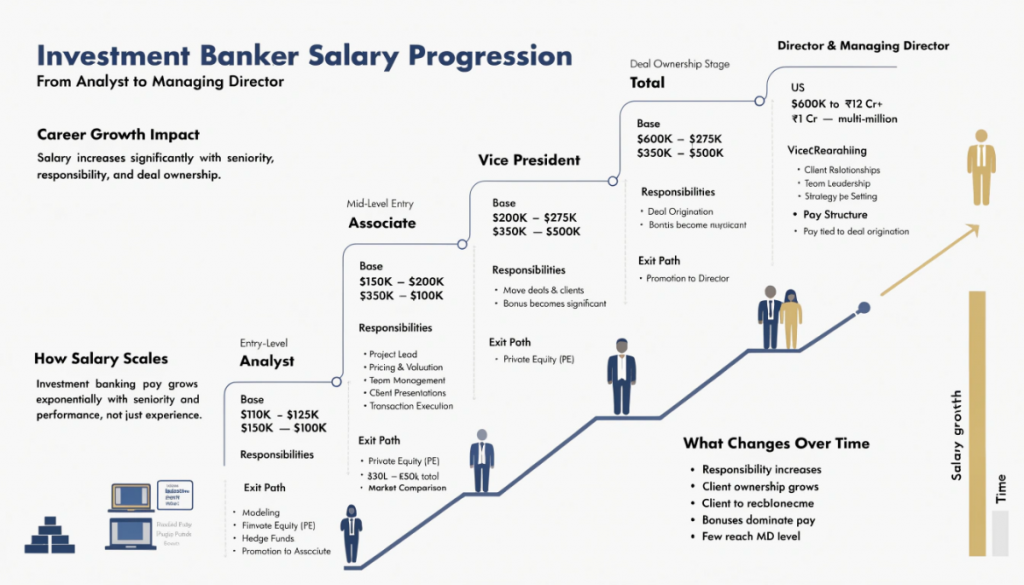
Understanding how the investment banker salary progresses across the career hierarchy is as important as knowing the current market rate at any given level.
Analyst (Years 1 to 3)
The analyst role is the entry point into investment banking and carries the most demanding hours in the entire hierarchy. In the US the analyst investment banker salary involves a base of $110,000 to $125,000 at bulge bracket banks with year-end bonuses adding $50,000 to $100,000 for average to strong performers. Top-ranked analysts at elite boutiques earn bonuses approaching or exceeding 100 percent of base in good deal years. The analyst program typically runs for two to three years after which most analysts either promote to associate or leave for private equity or business school.
Associate (Years 1 to 3)
The associate level is where many MBA graduates enter investment banking and where promoted analysts reach after their program. In the US the associate base salary runs from $150,000 to $200,000 rising in increments across years with bonuses at roughly 50 percent of base at most bulge bracket banks and significantly higher at elite boutiques. In India associate-level investment banker salary ranges from Rs 30 lakh to Rs 50 lakh at global banks. In the UK associates at major banks earn GBP 90,000 to GBP 140,000 in total compensation in year one rising to GBP 120,000 to GBP 150,000 by year two.
Vice President
The vice president level is where investment banker salary starts to reflect genuine client relationships and deal management responsibility. In the US VP base salaries run from $200,000 to $275,000 with total compensation typically in the $350,000 to $500,000 range depending on deal flow and bank type. In the UK VP investment banker salary involves GBP 100,000 to GBP 120,000 in base with 50 to 100 percent bonus potential giving total compensation of GBP 180,000 to GBP 240,000. Carry and deferred compensation start to become a more meaningful part of the package at this level.
Director and Managing Director
At the director and managing director level the investment banker salary becomes heavily dependent on individual deal origination and client relationship strength. MDs who can consistently bring in mandates are among the highest paid professionals in any market. In the US total MD compensation at major banks ranges from $600,000 to several million dollars in strong years. In India MDs at global banks earn Rs 1 crore to Rs 2 crore or more in base with bonuses adding substantially. The career path to MD in investment banking typically takes ten or more years and is reached by a small fraction of those who start as analysts.
What Pushes an Investment Banker Salary Higher
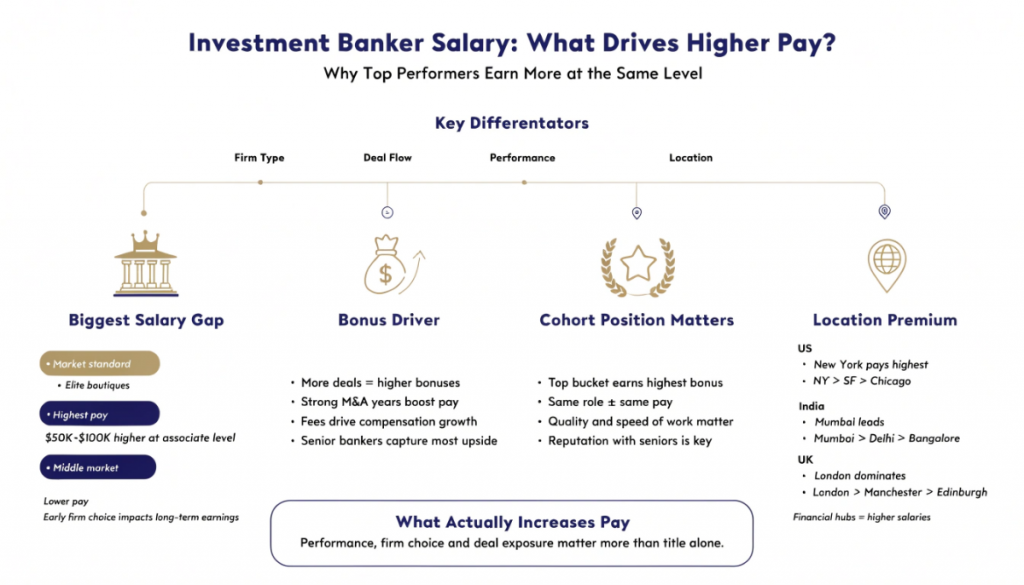
Within the investment banker salary range at any given level specific factors consistently separate those earning at the top from those at the median.
Firm Type: Bulge Bracket vs Elite Boutique vs Middle Market
The type of firm you work for is the most direct driver of investment banker salary beyond seniority. In the US bulge bracket banks like Goldman Sachs, JP Morgan, Morgan Stanley, Bank of America and Citi set the market standard at the analyst and associate level. Elite boutiques like Evercore, Lazard, Centerview and Perella Weinberg Partners often pay $50,000 to $100,000 above bulge bracket rates at the associate level and pay bonuses in 100 percent cash rather than deferred stock. Middle market banks pay less than both. The choice of firm at the analyst stage sets the baseline investment banker salary for the entire career.
Deal Flow and Revenue Generation
Bonus size in investment banking is ultimately tied to deal volume and fee generation. Years with strong M&A activity and active capital markets tend to produce larger bonuses. According to Mergers and Inquisitions March 2026 data, M&A deal volumes globally rose approximately 40 to 50 percent in 2025 but investment banking fees rose only 10 to 20 percent meaning junior investment banker salary grew only around 5 percent despite the stronger deal environment. Senior bankers with established client relationships and origination ability captured most of the upside in that year.
Performance Ranking Within the Cohort
At every level investment banker salary is heavily influenced by where an individual ranks within their cohort. Banks typically bucket analysts and associates into categories from top to bottom and bonuses vary significantly between buckets. A top-ranked first-year analyst at a bulge bracket bank earns noticeably more than a middle-ranked peer at the same firm in the same year. Delivering high-quality work consistently, managing tight timelines and building a reputation for reliability with senior bankers are the practical factors that determine bucket placement.
Geography
Location within a market also affects investment banker salary. In the US New York pays the highest packages with San Francisco and Chicago broadly comparable. In India Mumbai is the primary investment banking hub and pays above what other cities offer for equivalent roles. In the UK London pays significantly more than any other city and at the bulge bracket analyst level the London investment banker salary follows the standard firm-wide base structure.
Core Skills That Every Investment Banker Needs
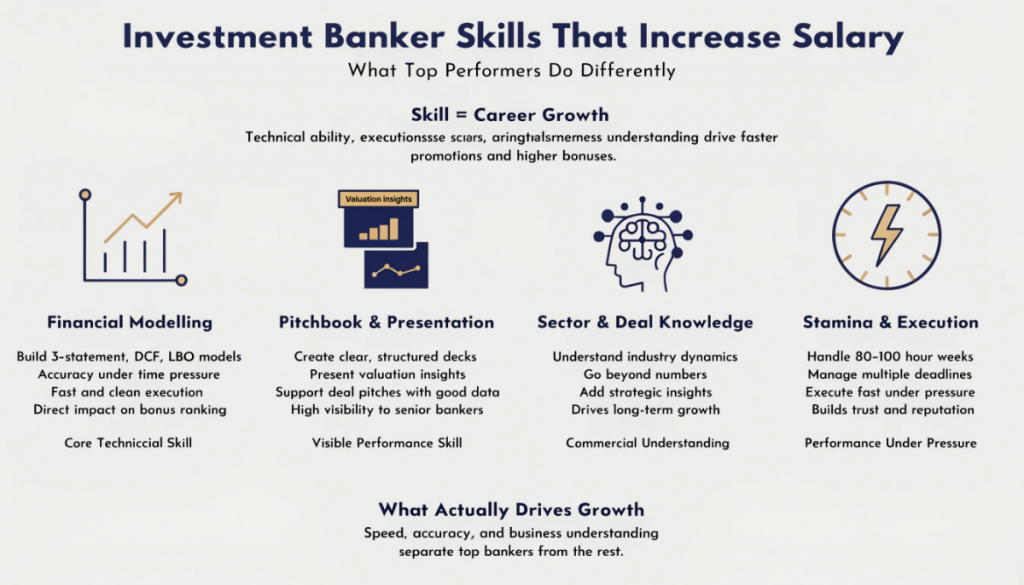
Building the right skill set determines how effective you are and how quickly you advance. These are the skills that matter most in practice.
Financial Modelling and Valuation
Financial modelling is the foundational technical skill of investment banking. This means building fully integrated three-statement models, DCF models, LBO models and merger models from scratch accurately and efficiently. Analysts who can model quickly and cleanly with minimal errors under time pressure are significantly more productive and valuable to their teams. The ability to build a crisp model at 2am before a pitch deadline without making mistakes is what senior bankers look for and it directly determines bucket placement which in turn determines the bonus component of investment banker salary.
Pitchbook and Presentation Quality
Investment banking pitchbooks are the primary tool for winning mandates and they need to be analytically rigorous and visually clear simultaneously. Analysts who can structure a pitchbook logically, present valuation analyses compellingly and anticipate the questions a client will ask are considerably more useful than those who can only fill in templates. This presentation skill develops with practice and it is one of the most visible demonstrations of competence to senior bankers who evaluate analysts for promotion and bonus allocation.
Sector and Deal Knowledge
Developing genuine knowledge of the sector you cover whether it is technology, healthcare, energy or consumer goods significantly increases your value as an investment banker. Clients and deal counterparties notice when an analyst understands the strategic logic of a transaction at a business level rather than just mechanically running the numbers. This commercial understanding is what separates bankers who advance quickly from those who stay technical. It also enables the conversations that eventually lead to deal origination at senior levels where the investment banker salary premium is most significant.
Stamina and Execution Under Pressure
Investment banking is genuinely demanding in terms of hours and intensity. Analysts at bulge bracket banks regularly work 80 to 100 hours per week during active deal periods. The ability to maintain quality while managing multiple workstreams under tight deadlines is not just a soft skill but a real competitive differentiator in a field where errors in financial documents carry serious consequences. Bankers who demonstrate consistent reliability under pressure are the ones who accumulate the trust and reputation that drives faster advancement and stronger investment banker salary growth over time.
Certifications and Qualifications That Strengthen an Investment Banking Profile
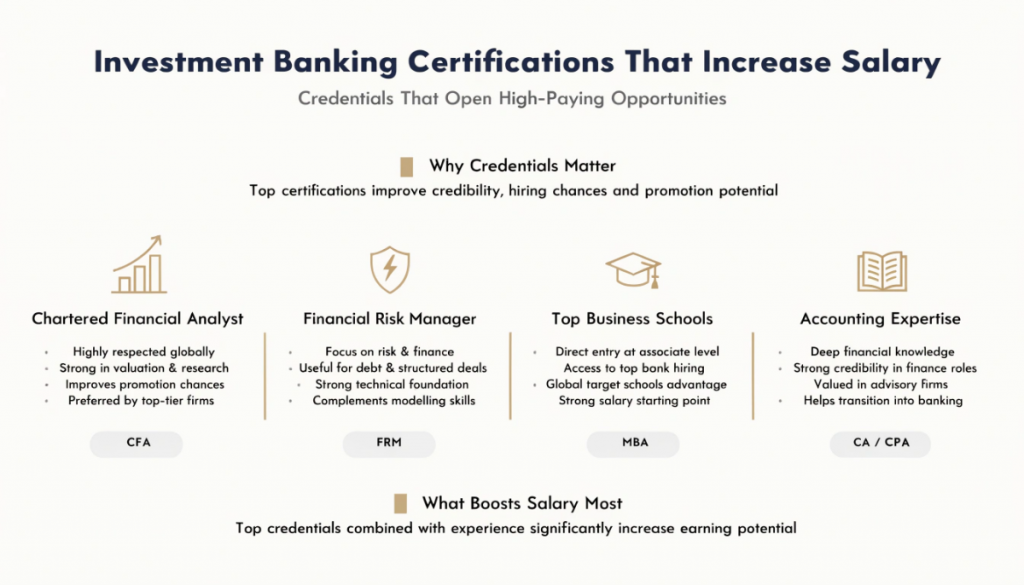
The right credentials add credibility and in some cases open doors that experience alone cannot.
Chartered Financial Analyst (CFA)
The CFA designation from the CFA Institute is highly respected in investment banking and particularly valuable for analysts and associates who want to build credibility in equity research, credit analysis and investment valuation. According to amity online and multiple India-based investment banking guides, the CFA certification directly supports a stronger investment banker salary by increasing promotion potential and making candidates more competitive for roles at top-tier firms. The CFA charterholder designation signals depth of financial knowledge that employers value particularly at firms with research-oriented practices.
Financial Risk Manager (FRM)
The FRM certification from GARP covers credit risk, market risk, operational risk and risk management frameworks in depth. For investment bankers who work on debt capital markets, leveraged finance or structured finance transactions the FRM provides a rigorous technical foundation that complements the financial modelling skills developed on the job. In India several investment banking career guides including amity online and pw.live specifically list the FRM alongside the CFA as certifications that directly improve investment banker salary prospects.
MBA from a Target Business School
An MBA from a top-tier business school is one of the most direct routes into investment banking at the associate level globally. In the US target schools include Wharton, Harvard, Columbia, NYU Stern, Booth and Kellogg. In the UK Oxford Said, London Business School and Imperial Business School are the primary feeders. In India IIM Ahmedabad, IIM Bangalore, IIM Calcutta and ISB Hyderabad are the primary target programs. An MBA from these institutions opens doors to the full-time associate recruiting programs at major investment banks and sets the baseline for a competitive associate-level investment banker salary from day one.
Chartered Accountant (CA) and CPA
In India the Chartered Accountant qualification is a highly respected credential for professionals entering investment banking, particularly in areas that require deep accounting and financial statement expertise. The CA designation signals analytical rigour and technical depth and is specifically valued by domestic investment banks and advisory firms. In the US the CPA serves a similar function for those transitioning from accounting or audit into corporate finance and investment banking roles. Both credentials support a stronger investment banker salary at mid-level roles where technical financial expertise is a key differentiator.
Conclusion
Investment banker salary is structured as base plus bonus and the bonus component is what creates the most significant variation in what professionals actually earn. Based on verified 2026 data the average investment banker salary in India is Rs 31.5 lakh nationally with global bank analysts earning Rs 20 lakh to Rs 30 lakh and MDs earning Rs 1 crore or more. In the US Year 1 analyst total compensation is approximately $159,000 with elite boutique associates earning $300,000 to $400,000 in strong years. In the UK first-year analyst total compensation ranges from GBP 100,000 to GBP 150,000 at major banks with elite boutiques paying higher.
Choosing the right firm type, delivering consistently strong work that earns top bucket placement and earning respected credentials like the CFA or an MBA from a target school are the three most reliable ways to build investment banker salary above the market average at every career stage.

Book Your
Free Session
Connect with our experts and get personalised guidance for your career, course selection, and future goals.

📖 Sources & References
✓ Verified 2026Verified investment banker salary benchmarks, bonus structures, certifications and compensation trends across India, US and UK for 2026.
- Glassdoor India Investment banker salary trends across Indian banks, global firms and advisory companies
- Glassdoor US US compensation benchmarks including analyst, associate and VP level investment banking salaries
- Glassdoor UK London and UK investment banking salary benchmarks and bonus trends
- Mergers & Inquisitions Detailed breakdown of investment banking compensation by level and firm type
- Wall Street Prep Investment banking salary structure including bonuses and compensation progression
- Prospect Rock Partners Investment banking recruiting and compensation insights across global markets
- CFA Institute CFA certification guidance and finance career insights relevant to investment banking
- GARP FRM Certification Financial Risk Manager certification details for banking and capital markets professionals
- Corporate Finance Institute Financial modelling and valuation training used by aspiring investment bankers globally
- PayScale Market salary benchmarks and compensation analysis for investment banking professionals