


Credit analyst salary is consistently above the national average across most job markets and the role sits at the centre of how banks, NBFCs, rating agencies and fintech lenders manage financial risk. If you are entering this career or already working in credit analysis and want to know whether your pay is competitive, this guide gives you the actual verified numbers. Credit analyst salary varies meaningfully based on experience level, employer type, city and specialisation. This guide covers data from Glassdoor, PayScale, Indeed and Salary.com from early 2026 across India, the United States and the United Kingdom so you can benchmark your position clearly.
What a Credit Analyst Does and Why It Pays Well
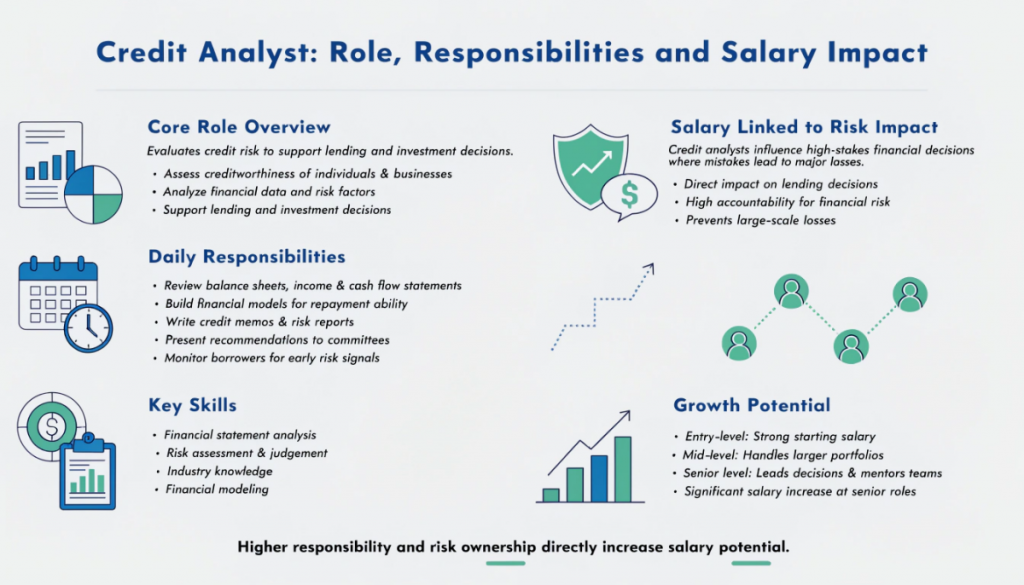
A credit analyst evaluates the creditworthiness of individuals, businesses or financial instruments to help lenders and investors make informed decisions about extending credit or making investments. The role requires a combination of financial statement analysis, industry knowledge and risk judgement which is why it consistently earns above the national average in every major market.
On a day-to-day basis a credit analyst reviews balance sheets, income statements and cash flow statements, builds financial models to assess a borrower’s ability to repay, writes credit memos summarising their findings and presents recommendations to credit committees or portfolio managers. They also monitor existing borrowers for signs of financial deterioration and flag early warning indicators before problems escalate into defaults.
The credit analyst salary reflects the risk consequences of this work. A credit analyst who misses a key risk factor can cost a bank or fund tens of millions of dollars in write-offs. That accountability to commercial outcomes is what keeps the credit analyst salary consistently above average even for professionals at the early stages of their career. At the senior level where analysts manage larger portfolios, lead credit decisions independently and mentor junior staff, the pay jumps significantly.
Credit Analyst Salary in India, US and UK
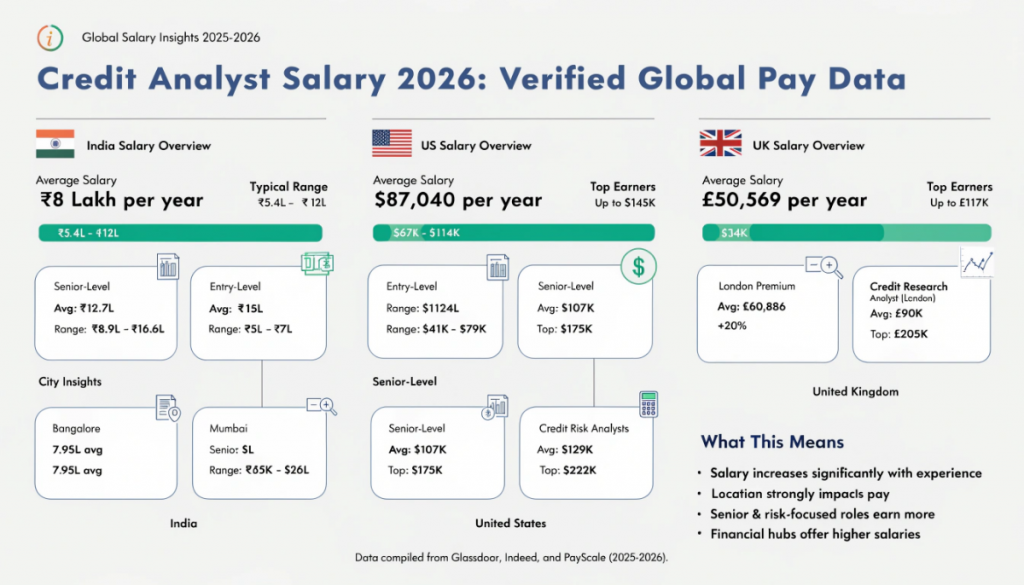
Here are the verified credit analyst salary figures across all three markets based on Glassdoor, Indeed and PayScale data from early 2026.
| Country | Average Salary | Entry / Base Range | Senior / Top Range | Key Insights |
|---|---|---|---|---|
| India | ₹8L |
₹5L – ₹12L Entry: ₹5L – ₹7L |
₹8.9L – ₹16.62L Top: ₹17.81L | Senior Top: ₹22.09L |
Mumbai offers strongest pay. Bangalore (~₹7.95L avg) is a major hub. Higher salaries in banks, NBFCs and rating agencies. |
| United States | $87,040 |
$41K – $114K Entry: $41K – $79K |
$83K – $139K Top: $145K | Risk roles: $222K+ |
Strong growth into credit risk roles. Top employers include Blackstone, Meta and Bain Capital. |
| United Kingdom | £50,569 | £34,914 – £76,554 |
£60K – £88K (London) Top: £117K | Research roles: £205K+ |
London pays ~20% higher. Strong upside in credit research roles and financial institutions. |
What Pushes a Credit Analyst Salary Higher
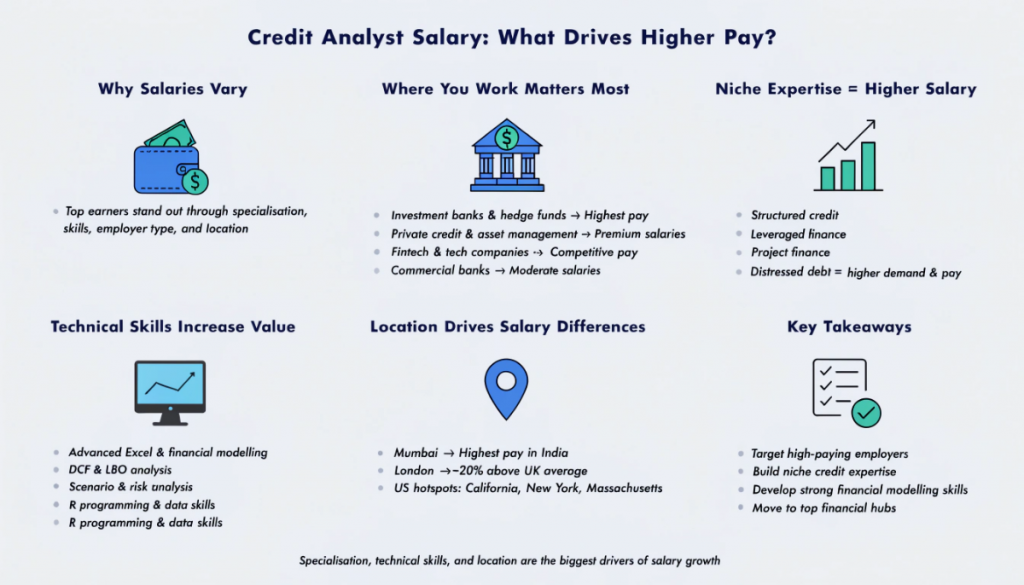
Within the credit analyst salary range there are specific factors that consistently separate professionals earning at the top end from those near the median. These are the ones worth focusing on.
Type of Employer and Sector
The type of employer is the single biggest driver of credit analyst salary variation at the same experience level. Credit analysts at global investment banks, private credit funds, hedge funds and rating agencies earn significantly more than those at regional commercial banks or consumer lending companies. In the US the Information Technology sector pays credit analysts a median of $83,869 according to Glassdoor March 2026 data reflecting the fintech and payments companies that sit within that category. Credit risk analysts at top asset management firms in London can earn GBP 90,000 or more even at the mid-level which is well above the national average for the role.
Specialisation Within Credit
Credit analysis covers a wide spectrum from consumer credit scoring to leveraged buyout credit to sovereign debt analysis. The more complex and specialised the credit work the higher the credit analyst salary. Professionals who develop expertise in structured credit, leveraged finance, project finance or distressed debt occupy a niche where there are fewer qualified analysts and consistent demand from banks and funds who pay significantly above the general credit analyst salary benchmark to hire people with that background.
Financial Modelling and Technical Skills
Credit analysts who can build robust financial models from scratch rather than filling in templates are significantly more valuable. Advanced Excel modelling, DCF analysis, LBO modelling and scenario analysis are the technical skills that hiring managers specifically look for when assessing whether a credit analyst justifies a higher credit analyst salary offer. Glassdoor notes that unique skills like R programming and critical thinking can further support a stronger pay position when negotiating. Professionals who combine strong technical skills with solid credit judgement consistently sit at the upper end of the credit analyst salary range at every career stage.
Location
Location has a direct and measurable impact on credit analyst salary. In India Mumbai consistently offers the strongest packages for credit professionals because of its density of financial institutions. In the UK London pays 20 percent above the national average for this role according to Glassdoor data. In the US states like California, New York and Massachusetts consistently lead on credit analyst salary with Salary.com March 2026 data showing District of Columbia at $64,323, California at $64,079 and Massachusetts at $63,225 for entry level credit analysts. At the senior level these location premiums become even more pronounced.
Core Skills That Build a Stronger Credit Analyst Career
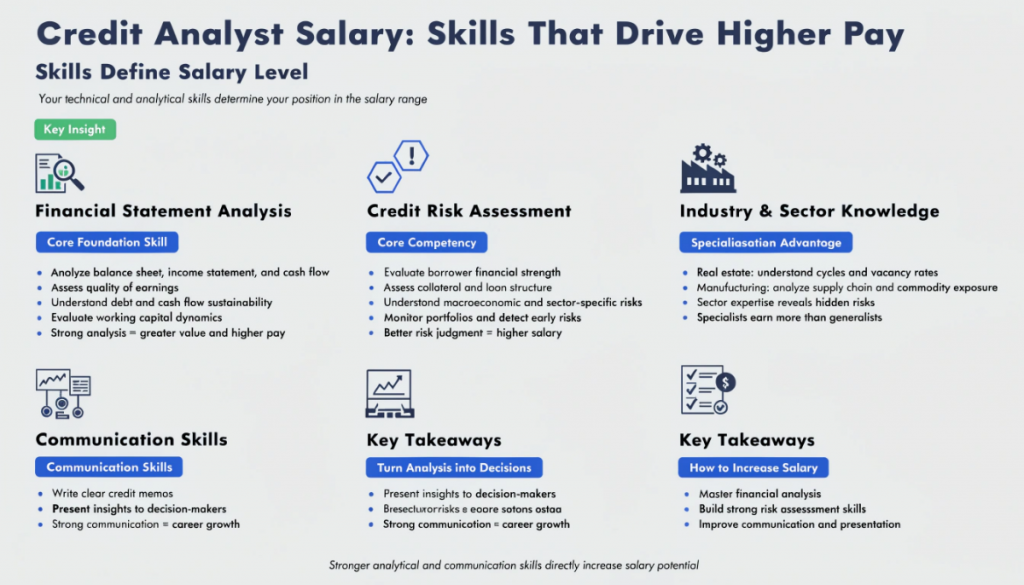
Building the right skill set determines where you sit in the credit analyst salary range at any given experience level. Here are the skills that matter most.
Financial Statement Analysis
Reading and interpreting financial statements accurately is the foundation of every credit analyst’s work. This means going beyond the headline numbers to understand the quality of earnings, the sustainability of cash flows, the real debt burden including off-balance-sheet items and the working capital dynamics of a business. Credit analysts who can do this quickly and accurately for companies across different industries and accounting standards are consistently at the stronger end of the credit analyst salary scale because this skill is harder to develop than it looks.
Credit Risk Assessment and Portfolio Monitoring
Understanding how to assess credit risk systematically is the core competency the role demands. This means building a structured view of a borrower’s financial strength, the quality and enforceability of collateral, the covenant structure of a loan and the macro and sector risks that could affect repayment. Ongoing portfolio monitoring and early warning identification are equally important because the credit analyst salary at most institutions rewards not just the initial underwriting decision but the ongoing quality of portfolio management over time.
Industry and Sector Knowledge
Credit analysts who develop deep knowledge of specific sectors are more valuable than generalists because sector expertise allows them to identify risks that are not visible from the financial statements alone. A credit analyst covering real estate needs to understand property cycles, vacancy rates and cap rate movements. One covering manufacturing needs to understand supply chain risk and commodity price exposure. This sector specialisation consistently supports a stronger credit analyst salary particularly when moving into senior or principal analyst roles at banks and credit funds.
Written and Verbal Communication
A credit analyst who can write a clear and concise credit memo and present a recommendation confidently to a credit committee is far more useful than one who does the analysis perfectly but struggles to communicate it. The written credit memo is the primary output of the role and the quality of that document directly reflects the analyst’s ability to organise complex information into a structured argument. Developing strong written communication is one of the more underrated ways to advance a credit analyst salary and career because it makes the value of the analytical work visible to decision makers.
Industries That Pay the Highest Credit Analyst Salary
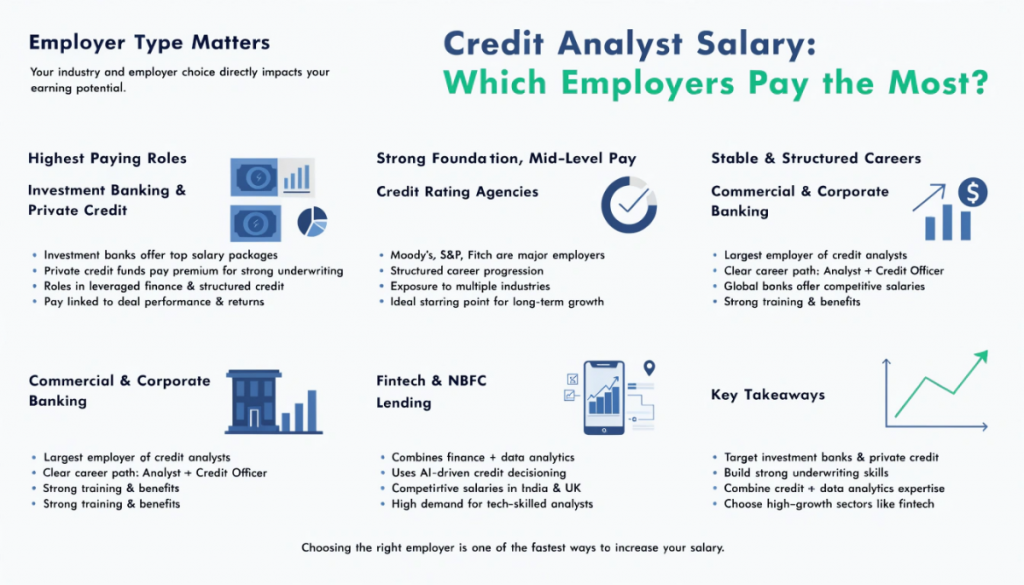
Not all employers offer the same credit analyst salary. The industry and employer type you choose has a significant and lasting impact on your earning potential.
Investment Banking and Private Credit
Investment banks and private credit funds pay the highest credit analyst salary packages globally. At major investment banks the structured finance, leveraged finance and credit trading desks hire analysts at starting packages that far exceed commercial banking. Private credit funds that lend directly to mid-market companies have grown significantly since 2020 and they pay premium credit analyst salary packages to attract analysts with strong underwriting skills because the quality of their lending decisions is directly tied to their fund returns.
Credit Rating Agencies
Rating agencies like Moody’s, S&P and Fitch employ large numbers of credit analysts and offer a structured career path with consistent progression. The credit analyst salary at rating agencies sits in the middle of the market but the breadth of sector exposure and the methodological rigour of the work makes these roles an excellent foundation for a career in credit. Many senior professionals at banks and funds spent their early years at a rating agency building the analytical framework that defines their approach to credit throughout their career.
Commercial and Corporate Banking
Commercial banks and corporate lending teams are the largest employers of credit analysts across every market. The credit analyst salary at commercial banks is consistent and the career path is well defined from analyst to associate to credit officer. Large multinational banks including HSBC, Standard Chartered and Barclays in the UK and JPMorgan, Wells Fargo and Citibank in the US pay competitive credit analyst salary packages at every level with additional benefits and structured training programmes.
Fintech and NBFC Lending
Fintech companies and non-banking financial companies have created a new and growing category of employment for credit analysts. These employers combine the credit analysis fundamentals with data science and algorithmic credit decisioning tools which creates a more technically oriented version of the role. The credit analyst salary at well-funded fintech companies in India and the UK is increasingly competitive with traditional banks particularly for professionals who combine conventional credit skills with data analytics capability.
Certifications That Strengthen a Credit Analyst Profile and Salary
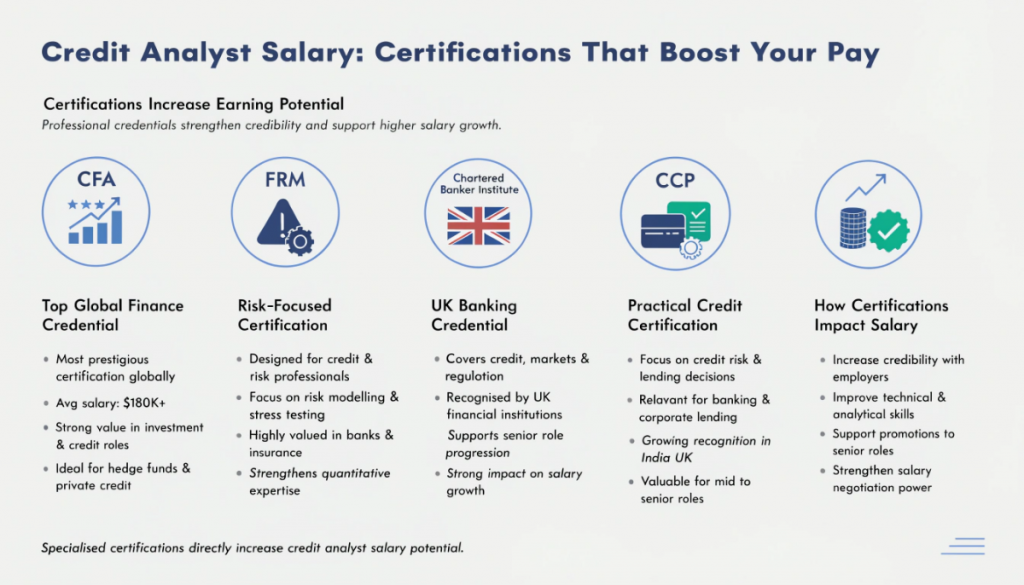
The right certifications add credibility to a credit analyst profile and directly support a stronger credit analyst salary in both hiring and promotion conversations.
Chartered Financial Analyst (CFA)
The CFA designation from the CFA Institute is the most prestigious credential in the investment analysis and credit profession globally. According to CFA Institute data, CFA charterholders earn an average of $180,000 per year which is well above the standard credit analyst salary at most levels. The credential is particularly valuable for credit analysts working in or targeting investment management, hedge funds and private credit where the depth of financial analysis required closely mirrors the CFA curriculum. Glassdoor notes the CFA pushes median total compensation to approximately $187,000.
Financial Risk Manager (FRM)
The FRM certification from GARP is specifically designed for credit and market risk professionals and is highly valued at banks, insurance companies and risk management consultancies. For credit analysts whose work focuses heavily on credit risk modelling, portfolio risk and stress testing the FRM credential strengthens the credit analyst salary case considerably. It signals that the analyst understands risk at a quantitative and systemic level beyond what standard credit analysis training covers.
Chartered Banker Institute Qualification
In the United Kingdom the Chartered Banker Institute qualification is specifically recommended by Glassdoor for credit analysts targeting senior roles at investment firms and asset management companies. It covers credit analysis, financial markets and banking regulation in depth and is recognised by UK financial services employers as a mark of professional seriousness. Holding this alongside relevant experience supports a stronger credit analyst salary particularly when moving into senior or director level credit roles at UK banks and funds.
Certified Credit Professional (CCP)
The Certified Credit Professional qualification from the Credit Management Foundation covers credit risk assessment, financial analysis and lending decisions in practical depth. It is relevant for credit analysts working in commercial banking and corporate lending environments and is increasingly recognised by employers in India and the UK. Adding the CCP to a profile that includes hands-on credit analysis experience gives a clear professional signal that supports a stronger credit analyst salary at the mid to senior career stage.
Conclusion
Credit analyst salary is solid across every major market and grows meaningfully with specialisation, sector expertise and demonstrated risk judgement. Based on verified 2026 data from Glassdoor, Indeed and PayScale, the average credit analyst salary in India is Rs 8 lakh per year nationally with senior professionals averaging Rs 12.7 lakh and top earners reaching Rs 22 lakh. In the US the average is $87,040 with senior analysts averaging $107,101. In the UK the national average is GBP 50,569 with London averaging GBP 60,886. Choosing a high-paying employer type, building deep sector expertise and earning a credential like the CFA or FRM are the three most reliable ways to push a credit analyst salary above the market average at any career stage.

Book Your
Free Session
Connect with our experts and get personalised guidance for your career, course selection, and future goals.

📖 Sources & References
✓ Verified 2026Verified Credit Analyst salary insights across India, US and UK based on 2026 compensation data from banking, risk management, fintech and investment sectors.
- India Glassdoor Avg ₹8L | Senior credit analysts and risk professionals earn ₹16L–₹22L+
- India PayScale Financial modelling and risk assessment skills strongly influence compensation
- Indeed India Credit analyst salary trends across banking, NBFCs and lending institutions
- US Glassdoor Avg $87K | Credit risk and investment sector professionals exceed $145K annually
- US Salary.com Credit analysis and risk management compensation benchmarks by state and experience
- UK Glassdoor Avg £50K+ | London credit analysts earn significantly above UK national average
- CFA Institute Global CFA charter salary insights and investment analysis career guidance
- GARP – FRM Certification Financial Risk Manager certification valued in credit risk and banking careers
- Chartered Banker Institute Professional banking qualification supporting credit and risk management careers
- Credit Management Foundation Certified Credit Professional qualification focused on lending and credit assessment