

The Digital Analyst career is becoming one of the most attractive paths in today’s data-driven business environment. Every company running campaigns, managing a website, or selling online is collecting enormous amounts of data every single day. However, many businesses still struggle to understand what that data actually means. This is exactly where professionals in a Digital Analyst career add value by turning raw numbers into clear insights that help businesses grow.
In addition to being highly valuable, the Digital Analyst career also offers strong salary potential and steady demand across multiple industries. If you are considering this path, this guide explains everything you need to know including what the job involves, the skills required, salary expectations, and long-term career growth.
What Is a Digital Analyst Career?
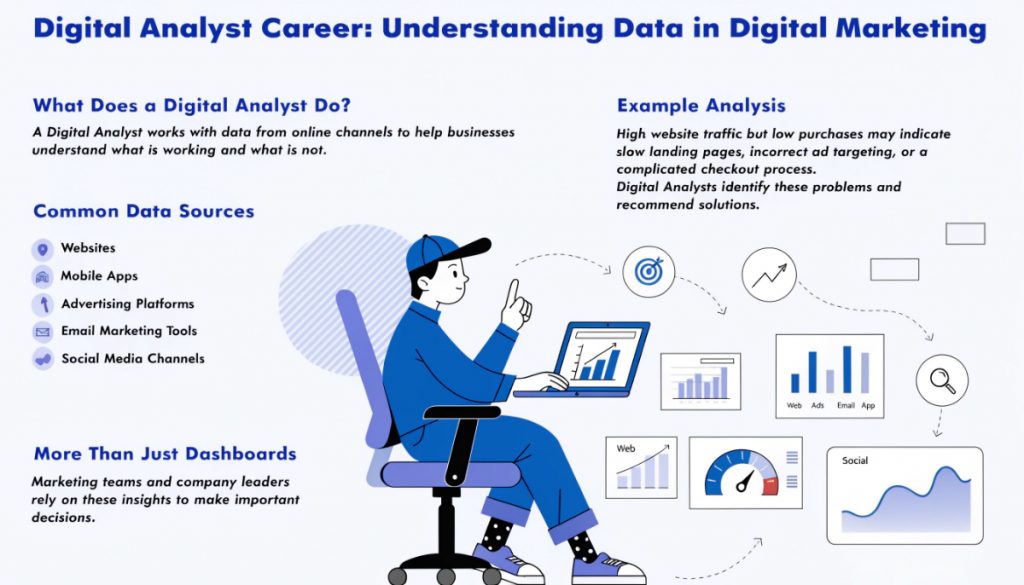
A Digital Analyst is a professional who works with data generated through online channels to help businesses understand what is working and what is not. In a typical Digital Analyst career, data sources include websites, mobile apps, advertising platforms, email marketing tools, and social media channels.
However, the job goes far beyond simply reading dashboards. A successful Digital Analyst must dig into the numbers, uncover patterns, and explain the story behind the data. Because of this, marketing teams, product managers, and company leadership often rely on insights from a Digital Analyst career before making important decisions.
For example, imagine a company running paid ads that generate a lot of website traffic but very few purchases. A professional working in a Digital Analyst career would analyze user behavior to identify where the problem occurs. Perhaps the landing page loads too slowly, the targeting is incorrect, or the checkout process has friction that causes users to abandon the purchase.
Finding these issues and recommending solutions is what makes the Digital Analyst career so valuable to modern businesses.
Key Responsibilities in a Digital Analyst Career
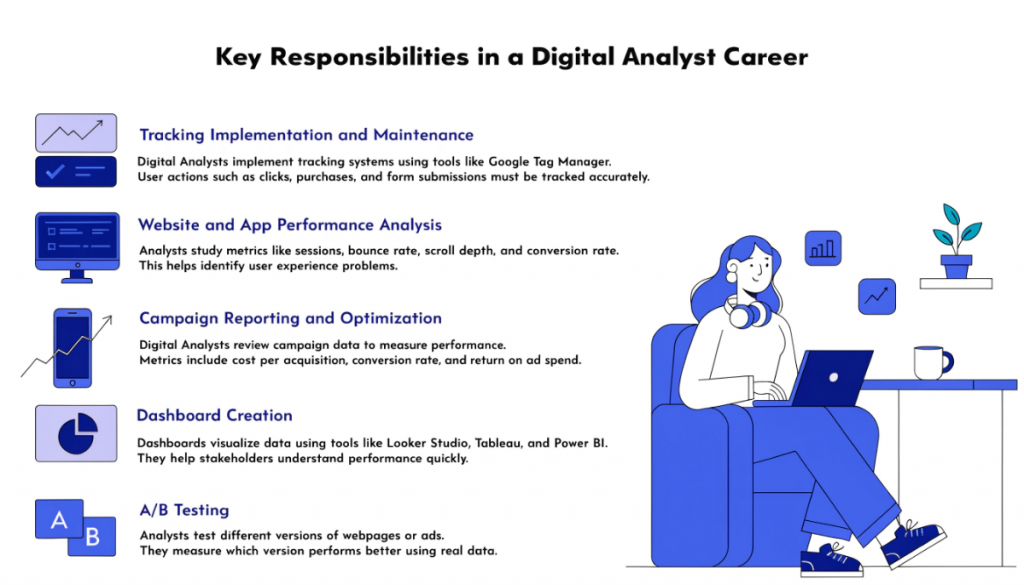
While responsibilities can vary depending on the organization, most professionals working in a Digital Analyst career handle a similar set of core tasks. Their primary goal is to analyze digital data, identify patterns in user behavior, and help businesses make better decisions based on those insights. A Digital Analyst works closely with marketing teams, product managers, and business leaders to ensure that data is not just collected but also interpreted correctly. By understanding what the data is showing, analysts help companies improve marketing performance, optimize user experience, and increase conversions across digital platforms.
Tracking Implementation and Maintenance
Reliable analysis always starts with reliable data collection. Because of this, one of the most important responsibilities in a Digital Analyst career is implementing and maintaining proper tracking systems across websites and applications. Most organizations use tools like Google Tag Manager to manage their tracking tags efficiently. These tags record user interactions such as button clicks, form submissions, product purchases, downloads, and other important events.
A Digital Analyst ensures that all important user actions are being tracked correctly. If tracking is incomplete or broken, the data becomes unreliable and the reports generated from that data can lead to incorrect business decisions. Maintaining accurate tracking infrastructure is therefore a critical responsibility in this role.
Website and App Performance Analysis
Another major responsibility in a Digital Analyst career is analyzing how users interact with a company’s website or mobile application. Analysts carefully examine metrics such as sessions, bounce rate, scroll depth, time spent on page, and conversion rate to understand user behavior.
Through this analysis, a Digital Analyst can identify areas where users may be facing difficulties. For example, a high bounce rate may indicate that the landing page is not relevant to visitors or that it loads too slowly. By identifying these issues, analysts can recommend improvements that help businesses create a smoother and more effective user experience.
Campaign Reporting and Optimization
Digital marketing campaigns generate large amounts of data, and analyzing this data is a key responsibility in a Digital Analyst career. Analysts regularly review campaign performance across different marketing platforms to understand which campaigns are performing well and which ones need improvement.
They measure important metrics such as traffic quality, cost per acquisition, conversion rate, and return on ad spend. Instead of just presenting numbers, a Digital Analyst interprets the data and provides insights that help marketing teams refine their strategies, improve targeting, and use their budgets more effectively.
Dashboard Creation
Organizations often rely on dashboards to monitor their digital performance. As a result, professionals in a Digital Analyst career frequently build and maintain dashboards using data visualization tools like Looker Studio, Tableau, or Power BI.
These dashboards bring together data from multiple sources and present it in a clear and visual format. Stakeholders can quickly understand performance trends without needing to analyze raw data themselves. A well-designed dashboard helps teams make faster and more confident decisions.
A/B Testing
Testing is another essential part of a Digital Analyst career. When businesses want to improve the performance of their websites or campaigns, analysts design and monitor A/B tests.
In an A/B test, two versions of a webpage, advertisement, or design element are shown to different groups of users. The Digital Analyst then measures which version performs better based on metrics such as click-through rate or conversion rate.
After collecting sufficient data, the analyst evaluates the results and recommends the version that delivers the best performance. This approach allows companies to continuously improve their digital platforms using real data rather than assumptions.
Skills Required for a Successful Digital Analyst Career
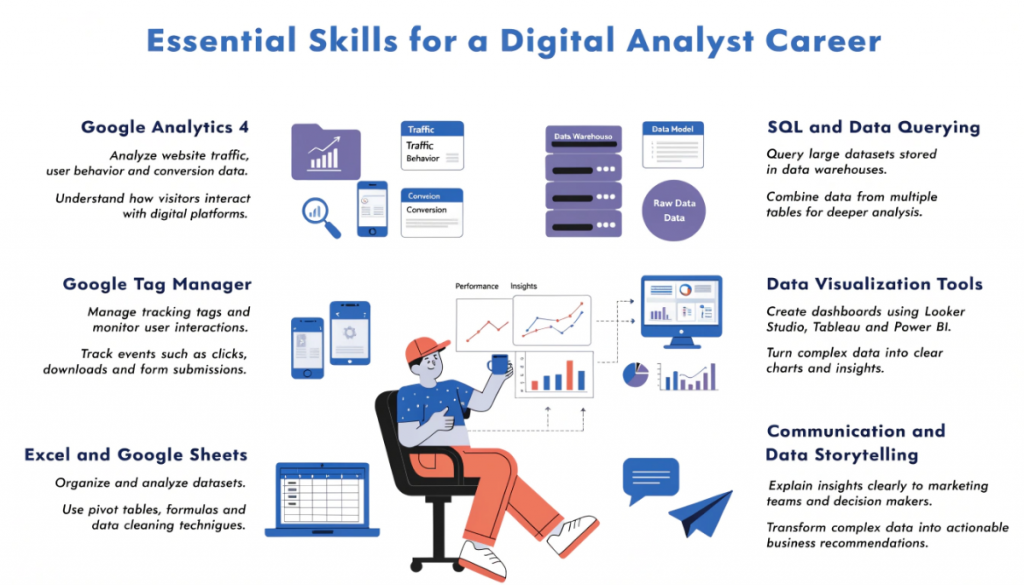
To succeed in a Digital Analyst career, you need a strong combination of technical knowledge and communication skills. While technical tools help you collect and analyze data, communication skills allow you to explain your insights clearly to teams that may not have a technical background. A successful Digital Analyst is not only comfortable working with data but also capable of translating complex numbers into meaningful recommendations that businesses can act on.
Google Analytics 4
Google Analytics is one of the most important tools used in a Digital Analyst career. It helps analysts understand how users interact with websites and digital platforms. Learning how to configure events, track conversions, analyze traffic sources, and interpret user behavior is essential for anyone starting a Digital Analyst career.
By using this tool effectively, analysts can measure marketing performance, identify which channels drive the most traffic, and understand how visitors move through a website. These insights help businesses improve their digital strategies and optimize their online presence.
Google Tag Manager
Google Tag Manager plays a crucial role in managing tracking systems across websites and applications. In a Digital Analyst career, this tool allows analysts to add and manage tracking tags without constantly relying on developers.
Through Google Tag Manager, analysts can implement event tracking, configure analytics tools, and ensure that user interactions such as clicks, downloads, or form submissions are recorded accurately. Having strong knowledge of this platform makes a Digital Analyst more efficient and capable of managing complex tracking setups independently.
SQL and Data Querying
SQL is a valuable skill that can significantly strengthen a Digital Analyst career. Many organizations store their data in large data warehouses, and SQL allows analysts to query this data directly.
With SQL, analysts can retrieve specific datasets, combine information from different tables, and perform deeper analysis beyond what standard analytics dashboards provide. This ability enables professionals in a Digital Analyst career to uncover more detailed insights and deliver more accurate data-driven recommendations.
Data Visualization
Analyzing data is only part of the job. Presenting that data clearly is equally important in a Digital Analyst career. Data visualization tools help transform complex datasets into charts, graphs, and dashboards that are easy for stakeholders to understand.
Tools like Looker Studio, Tableau, and Power BI allow analysts to create interactive dashboards that display key performance indicators and trends. Effective data visualization ensures that decision-makers can quickly grasp important insights without needing to interpret raw numbers themselves.
Excel and Google Sheets
Even with the availability of advanced analytics platforms, spreadsheet tools such as Excel and Google Sheets remain an important part of a Digital Analyst career. These tools are widely used for data organization, quick analysis, and reporting tasks.
Skills like pivot tables, formulas, conditional formatting, and data cleaning are used regularly when preparing datasets for analysis. Spreadsheets also help analysts perform quick calculations or explore data before moving it into more advanced analytics tools.
Communication and Data Storytelling
Technical expertise alone is not enough to succeed in a Digital Analyst career. One of the most valuable abilities is the skill of communicating insights clearly and effectively.
Analysts must be able to explain their findings to marketing teams, product managers, and company leaders who may not have a technical background. Instead of presenting complicated data, a good Digital Analyst focuses on telling a clear story that explains what the data means and what actions should be taken next.
Strong communication and data storytelling skills ensure that insights are understood and actually used to guide business decisions.
Digital Analyst Salary: What to Expect
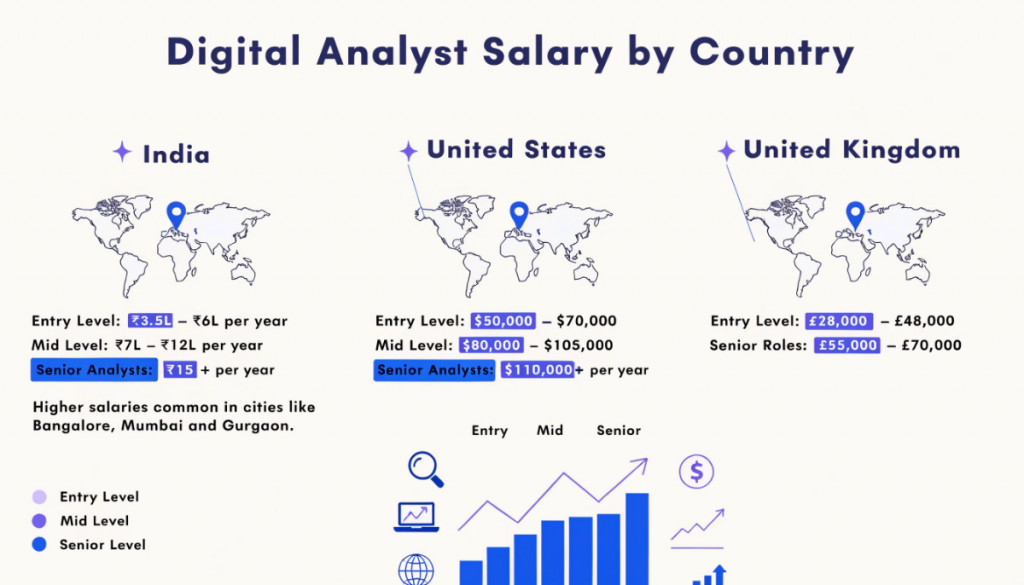
| Country | Entry-Level Salary | Mid-Level Salary | Senior-Level Salary |
|---|---|---|---|
| India | ₹3.5L – ₹6L | ₹7L – ₹12L | ₹15L+ |
| United States | $50,000 – $70,000 | $80,000 – $105,000 | $110,000+ |
| United Kingdom | £28,000 – £48,000 | £38,000 – £55,000 | £55,000 – £70,000 |
Digital Analyst vs Data Analyst: Understanding the Difference
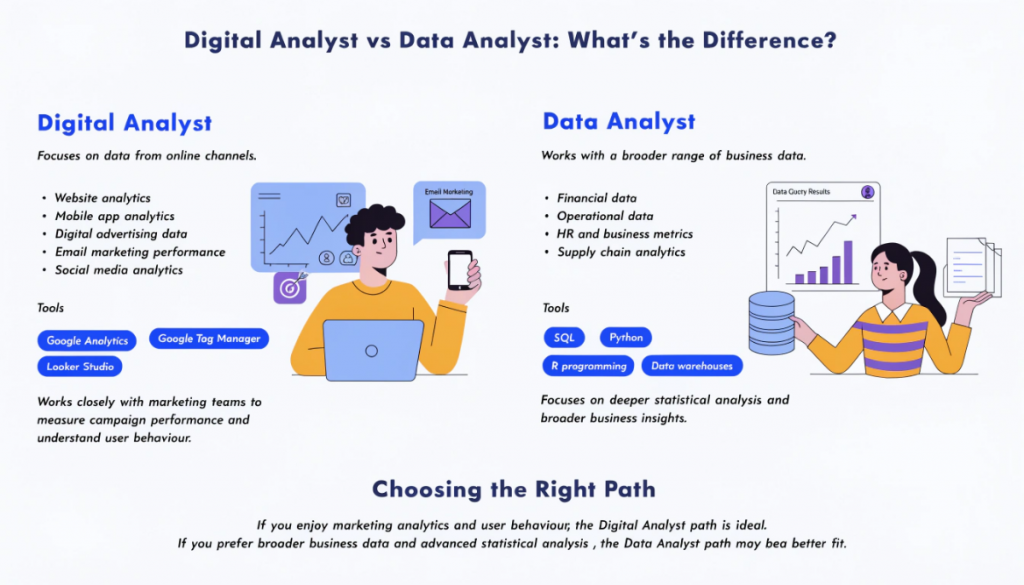
These two titles get mixed up frequently so it is worth drawing a clear line between them.
A Digital Analyst focuses specifically on data coming from online channels. For instance, websites, apps, digital ads, email campaigns and social platforms are the primary sources. As a result, this work connects directly to marketing performance and online user behaviour. Tools like Google Analytics, Google Tag Manager and Looker Studio are central to how this role operates.
In contrast, a Data Analyst works across a much broader range of data types that can include finance, operations, HR and supply chain. Unlike a Digital Analyst, this role has no connection to marketing channels and often involves deeper statistical methods, Python or R programming and more complex database work.
In summary, if you enjoy marketing, user behaviour and campaign measurement then the Digital Analyst path is a natural fit. On the other hand, if you prefer a purely analytical environment without the marketing connection then the broader Data Analyst route may suit you better.
Growth in a Digital Analyst Career
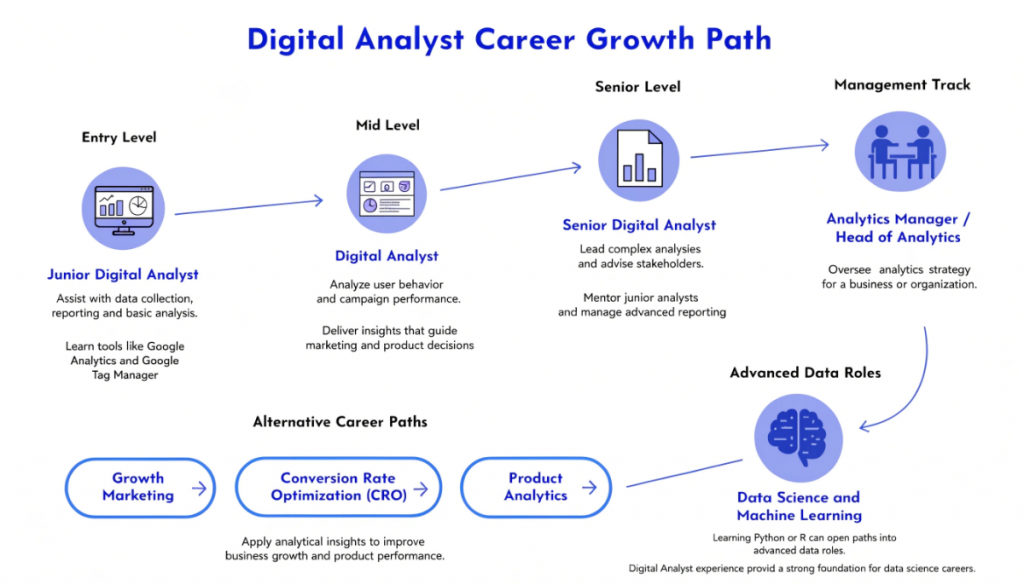
One of the most appealing aspects of Digital Analyst career is that it offers multiple clear directions for growth. You are certainly not stuck in one lane.
Initially, the progression moves from Junior Digital Analyst to Digital Analyst to Senior Digital Analyst over roughly four to six years. At the senior level you are running complex analyses independently, advising stakeholders and often guiding junior team members.
From there, two main paths open up. On one hand, the management track leads to Analytics Manager or Head of Analytics where you own the data strategy for an entire business unit. On the other hand, some professionals move sideways into growth marketing, conversion rate optimisation or product analytics where they use their analytical skills in a broader strategic context.
Additionally, those who invest in learning Python or R often transition into Data Science or Machine Learning roles over time. The analytical habits developed throughout a Digital Analyst career transfer very well to that kind of advanced work. As a result, the Digital Analyst role is not just a destination but also a strong launchpad for several other high-value career paths.
Conclusion
A Digital Analyst career is practical, well-paid, and in high demand across industries. You don’t need a computer science degree—what matters is understanding analytics tools, asking the right questions, and clearly communicating insights.
To get started, learn Google Analytics 4 and Google Tag Manager, build a hands-on project, and pick up basic SQL. Creating a strong portfolio you can confidently discuss in interviews will significantly improve your chances of landing your first role.
The field continues to evolve with new tools and privacy changes, but professionals who stay curious and keep learning will always have an edge. Strong fundamentals in analysis and communication remain timeless.

Book Your
Free Session
Connect with our experts and get personalised guidance for your career, course selection, and future goals.

📖 Sources & References
✓ Verified 2026Verified Digital Analyst career insights including skills, tools, salary trends and growth data across global markets (2026).
- Glassdoor India Avg ₹4L–₹10L | Senior roles ₹12L+
- PayScale Salary trends based on experience and industry demand
- Indeed Career Guide Role overview, responsibilities and career path insights
- Google Analytics 4 Core tool used for web and app data analysis
- Google Tag Manager Tracking implementation and event management system
- Looker Studio Dashboard creation and data visualization platform
- Tableau Advanced analytics and visualization tool
- Microsoft Power BI Business intelligence dashboards and reporting
- Coursera Analytics Courses Skill development for analytics and data interpretation
- HubSpot Analytics Guide Marketing analytics concepts and real-world applications