

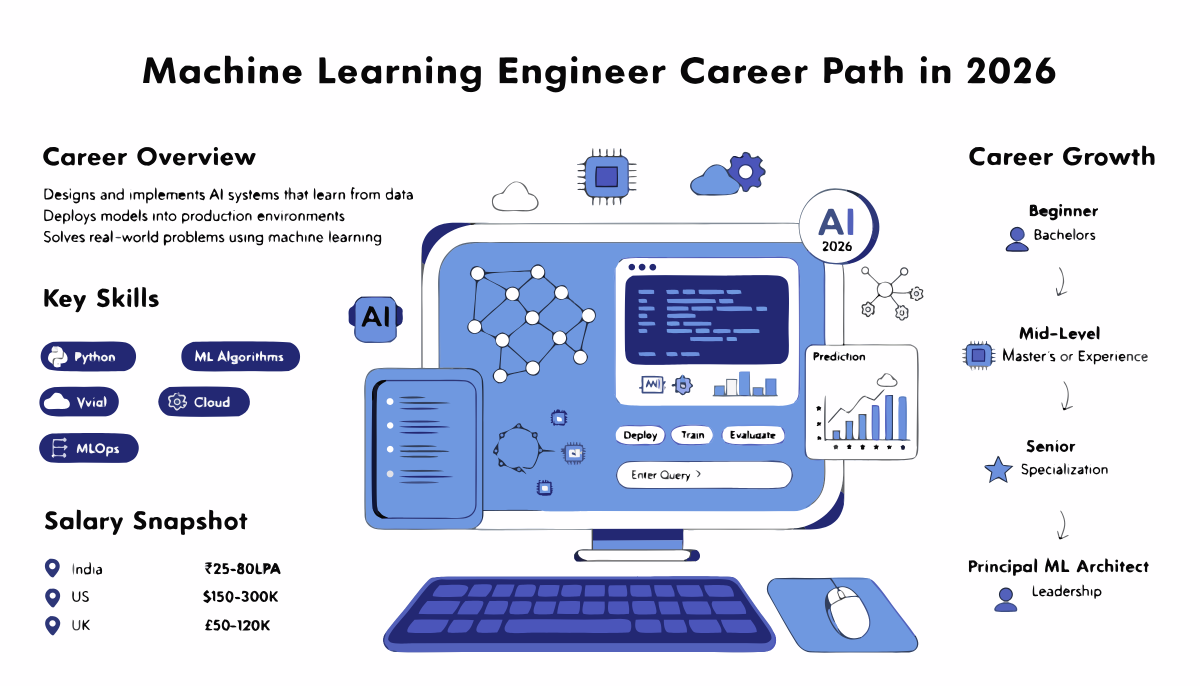
A machine learning engineer career is one of the smartest choices you can make in technology right now. Every major industry from healthcare and finance to retail and automotive is pouring money into AI systems and they all need skilled engineers to build, deploy and maintain them. If you enjoy writing code and working with data, a machine learning engineer career gives you the perfect combination of technical challenge and financial reward. The demand for this role is growing faster than universities and bootcamps can supply qualified candidates which means opportunities continue to open up at every level. This guide covers everything you need to know to understand, plan and successfully pursue a machine learning engineer career in 2026.
What Is a Machine Learning Engineer Career All About?
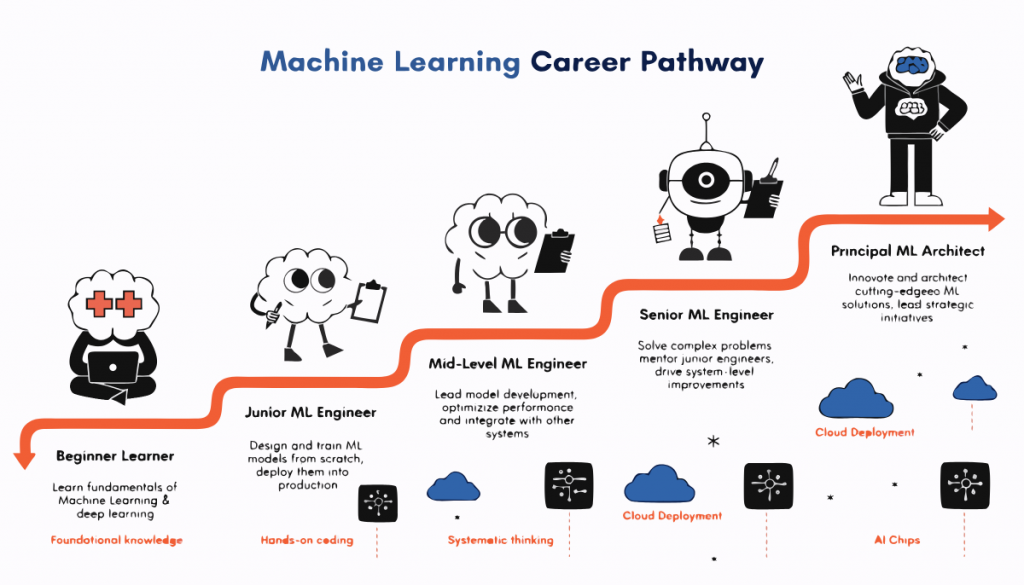
Before committing to a machine learning engineer career, it helps to understand what the role actually involves on a daily basis. A machine learning engineer is a software professional who designs, builds and deploys systems that allow computers to learn from data and make accurate predictions without being manually programmed for every new situation.
The machine learning engineer career sits at the crossover point between software engineering and data science. Unlike a data scientist who focuses mainly on exploring data and building analytical models, a machine learning engineer is responsible for taking those models and making them work reliably in live production environments where they serve real users at scale.
To put this in everyday terms, when a streaming platform recommends a show you actually enjoy or a bank detects a fraudulent transaction within milliseconds, a professional in a machine learning engineer career built and deployed the system behind that experience. The technical work is demanding but the impact shows up in products that millions of people use every day.
A machine learning engineer career exists across organisations of all sizes. At large technology firms you might specialise in one narrow domain. At a startup you might own the full machine learning stack from data ingestion through to model deployment. Either way the core responsibilities of a machine learning engineer career remain consistent across most companies and industries.
Key Responsibilities of a Machine Learning Engineer
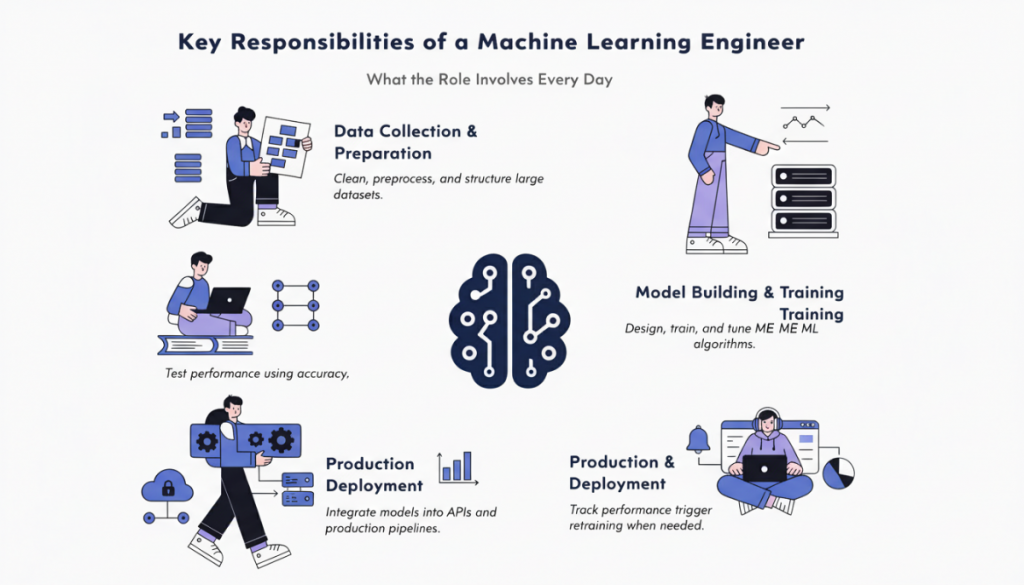
The day to day work in a machine learning engineer career covers a wide range of tasks. Nevertheless, most roles share a consistent set of core responsibilities that define what the job actually involves at any company.
Data Collection and Preparation
Before any model can learn, it needs well-structured data to work with. A professional in a machine learning engineer career works closely with data engineers and analysts to identify the right data sources, clean errors, handle missing values and transform raw information into formats that machine learning algorithms can process effectively. In practice this preparation phase consumes the majority of time on most projects because poor data quality leads directly to poor model performance.
Building and Training Machine Learning Models
Once the data is prepared, the machine learning engineer selects the right algorithm for the problem at hand. This could be a regression model for predicting a number, a classification model for sorting records into categories or a deep learning architecture for handling images, audio or text. Training involves running multiple experiments, tuning hyperparameters and measuring performance across different configurations until the model meets the required accuracy standard for the use case.
Evaluating and Testing Model Performance
After training, a key responsibility in a machine learning engineer career is checking whether the model actually performs well under realistic conditions. This includes measuring accuracy, precision, recall and F1 score, testing the model against held-out datasets and identifying edge cases where it fails unexpectedly. A model that performs well in controlled experiments but breaks under real-world traffic is a costly problem and catching those issues before deployment is central to the role.
Deploying Models to Production Systems
Taking a trained model and integrating it into a live product or internal system is one of the most technically demanding parts of a machine learning engineer career. This involves building REST APIs that expose model predictions, creating reliable data pipelines that feed the model real-time inputs and ensuring the entire system handles production traffic without performance degradation. Strong software engineering skills become absolutely essential at this stage of the work.
Monitoring and Retraining Deployed Models
Models do not stay accurate forever after deployment. As user behaviour evolves or the real world changes, a deployed model’s performance can drift downward over time. Therefore, an important ongoing responsibility in a machine learning engineer career involves setting up monitoring dashboards that track key performance indicators and triggering automated retraining workflows when model accuracy falls below acceptable thresholds.
Skills You Must Build for a Successful Machine Learning Engineer Career
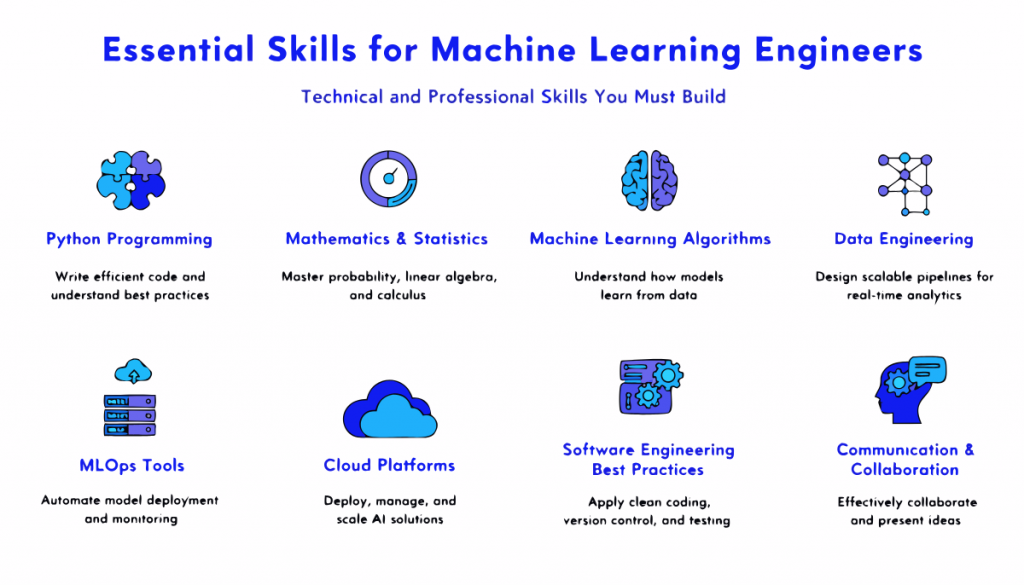
A machine learning engineer career demands a combination of mathematical understanding, strong programming ability and solid software engineering practices. Furthermore, communication skills matter more than most people expect when they first enter this field. Here is a detailed breakdown of everything you need to develop.
Python Programming
Python is the core language of every machine learning engineer career. You must write clean and efficient Python code for data processing, model training and production deployment. Key libraries include NumPy and Pandas for data manipulation, Scikit-learn for classical machine learning algorithms and TensorFlow or PyTorch for deep learning. In addition to Python, working knowledge of SQL for querying structured databases is expected in almost every machine learning engineer career role regardless of industry or seniority level.
Mathematics and Statistics
The technical foundation of a machine learning engineer career is built on mathematics. You need a working understanding of linear algebra for handling matrices and vectors, calculus for understanding how gradient descent trains neural networks and probability and statistics for evaluating model performance and designing valid experiments. You do not need a research-level mathematics background but you do need enough depth to understand why an algorithm behaves a certain way and how to fix it when results fall short of expectations.
Machine Learning Algorithms
A well-rounded machine learning engineer career requires understanding a broad range of algorithms and knowing when each one is appropriate for a given problem. Supervised learning methods including linear regression, decision trees, random forests and support vector machines cover the majority of business use cases. Unsupervised techniques like K-means clustering and principal component analysis handle exploratory tasks. Additionally, deep learning architectures including convolutional neural networks for image processing and transformer models for language tasks are increasingly required across most modern machine learning engineer career positions.
Data Engineering and Pipeline Development
Building production-ready machine learning systems requires understanding how data flows through an entire system from source to prediction. Consequently, professionals in a machine learning engineer career need to work with data pipelines, understand distributed processing tools like Apache Spark for large-scale datasets and write efficient SQL queries for structured data retrieval. Familiarity with cloud data warehouses like BigQuery, Snowflake or Amazon Redshift adds significant practical value in most company environments today.
MLOps and Model Deployment Tools
Managing models at production scale requires its own specific toolset. A machine learning engineer career demands knowledge of Docker for containerising models with all their dependencies, Kubernetes for managing containers at scale and MLflow or Kubeflow for tracking experiments and managing model versions across the development lifecycle. Cloud-specific platforms like AWS SageMaker, Google Vertex AI and Azure Machine Learning Studio provide end to end infrastructure for training, deploying and monitoring models in enterprise environments.
Cloud Platform Knowledge
Most organisations run their machine learning infrastructure on one of the three major cloud providers. Therefore, practical experience with AWS, Google Cloud or Microsoft Azure is essential for any machine learning engineer career. Understanding how to provision GPU compute for model training, store datasets efficiently and serve model predictions at scale on these platforms makes you productive from day one and significantly more valuable as your experience grows.
Software Engineering Best Practices
A machine learning engineer career is fundamentally a software engineering career with machine learning specialisation layered on top. This means using Git for version control, writing unit and integration tests for your code, following code review processes and structuring projects in a way that teammates can understand and maintain without your constant presence. These practices become increasingly important in larger teams where multiple engineers contribute to shared codebases and production reliability is non-negotiable.
Communication and Cross-Functional Collaboration
In practice a machine learning engineer career involves regular collaboration with product managers, business analysts, data engineers and non-technical stakeholders. Explaining model behaviour, trade-offs and limitations in plain language is something you will do in meetings, written documents and presentations on a regular basis. Consequently, developing strong communication habits is just as strategically important as writing high quality code throughout your machine learning engineer career.
Salary in Machine Learning Engineer Career : What You Can Realistically Earn
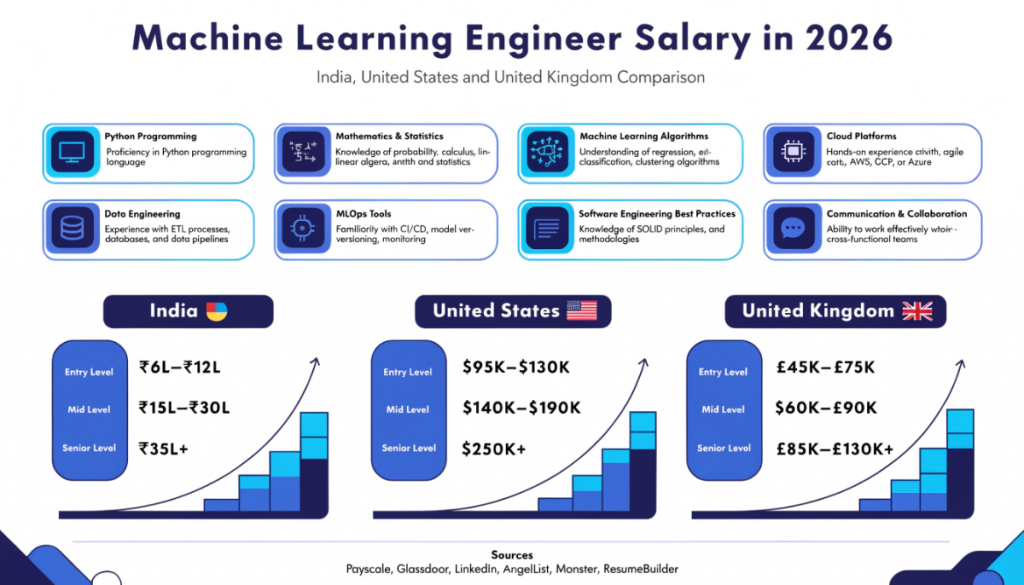
The Machine Learning Engineer career is known for offering some of the highest salaries in the technology industry. Moreover, demand for qualified engineers continues to outpace the available supply which keeps compensation strong across every major market.
| Country | Entry Level Salary | Mid-Level Salary | Senior / Top Range | Key Insights |
|---|---|---|---|---|
| India | ₹6L – ₹12L |
₹15L – ₹30L 2–4 years experience |
₹35L+ Principal/staff roles go much higher with stock |
Bangalore, Hyderabad and Pune offer strongest salaries. Product firms and funded startups pay highest. |
| United States | $95K – $130K |
$140K – $190K 3–6 years experience |
$250K+ total comp Including equity + bonuses |
San Francisco, Seattle and New York lead compensation. Still strong outside major tech hubs. |
| United Kingdom | £45K – £75K |
£60K – £90K Typical mid-career progression |
£85K – £130K+ Higher for NLP / Computer Vision specialists |
London dominates pay. AI specialists in LLMs and deep learning command premium packages. |
Certifications That Strengthen Your Machine Learning Engineer Career
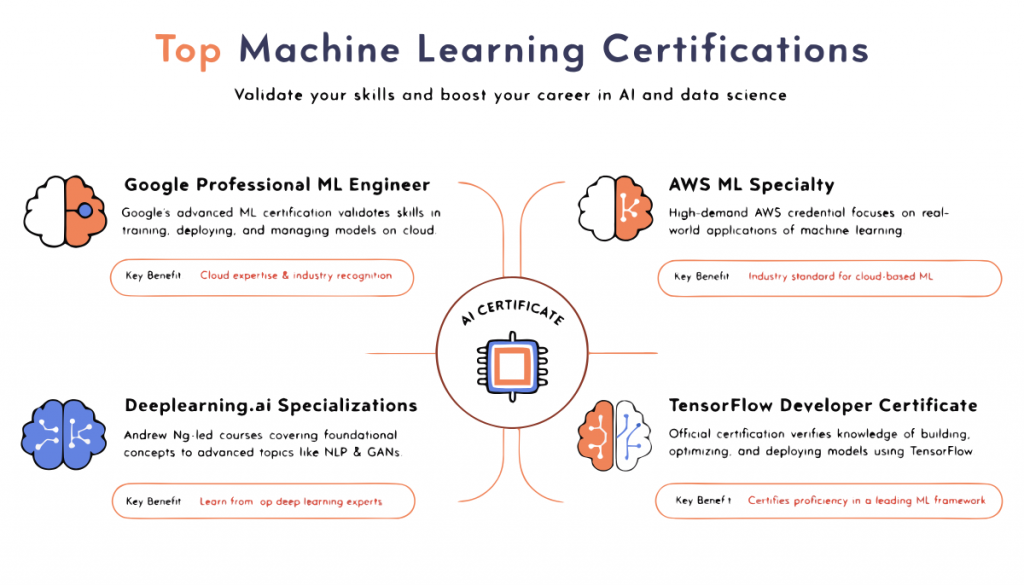
While hands-on experience always carries more weight than certificates, the right certifications can accelerate a machine learning engineer career by establishing credibility with hiring managers and forcing structured learning of topics that self-taught engineers frequently skip.
Google Professional Machine Learning Engineer Certification
This is one of the most respected credentials available for a practising professional in a machine learning engineer career. It validates your ability to design, build and productionise models using Google Cloud infrastructure. Preparing for this exam also forces you to engage with practical MLOps concepts that are genuinely important for a production-focused machine learning engineer career but that many engineers learn only after making expensive mistakes in live systems.
AWS Certified Machine Learning Specialty
This certification covers machine learning on AWS including SageMaker, data engineering workflows and model deployment at scale. Given how many companies run their production infrastructure on AWS, this credential has strong practical value for anyone building a machine learning engineer career in an enterprise technology environment.
Deeplearning.ai Specialisations on Coursera
The Machine Learning Specialisation and Deep Learning Specialisation from deeplearning.ai carry significant weight in the industry. The curriculum aligns closely with what a machine learning engineer career actually requires on the job and the programs are recognised and respected by technical hiring teams globally even though they are not formal certifications in the traditional institutional sense.
TensorFlow Developer Certificate
Google’s TensorFlow Developer Certificate validates your ability to build and train neural networks effectively. It is particularly useful early in a machine learning engineer career when you want to demonstrate concrete competence with deep learning frameworks to employers who need confidence that you can contribute to production model development from your first week on the job.
Conclusion
A machine learning engineer career combines technical depth, genuine real-world impact and some of the strongest compensation available anywhere in the technology industry today. It is not the easiest career to enter but the path is well defined and every step of preparation compounds meaningfully on the one before it.
Start by building your mathematics and Python foundations solidly. Then work through structured learning programs, build real projects that you can show to employers and specifically invest time in learning how to deploy and monitor models in production. Those focused steps will develop the kind of well-rounded profile that hiring managers actively look for when filling machine learning engineer career openings.
The demand for skilled professionals in a machine learning engineer career shows no sign of slowing down in 2026. If anything it continues to accelerate as more companies discover how much value well-built intelligent systems can deliver across every part of their business. Committing to this path now puts you in an excellent position for a long, well-compensated and genuinely impactful career ahead.