
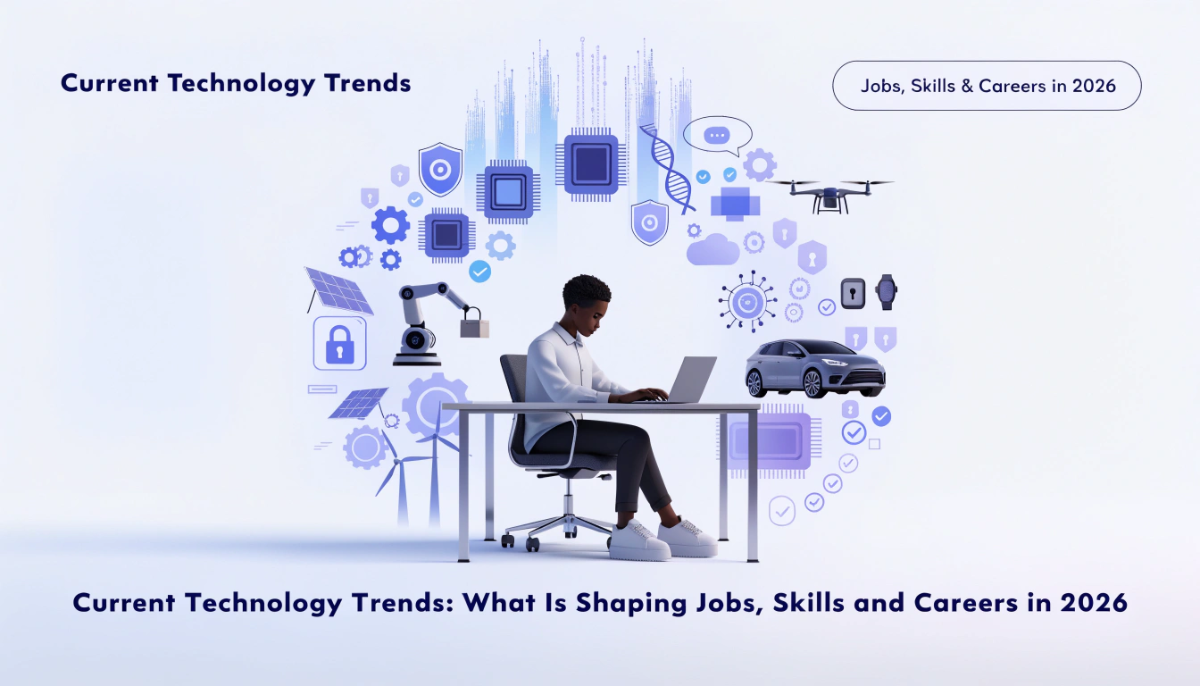
Technology news moves so fast that it is hard to tell which changes actually matter. Some trends are loud for a few months and then disappear. Others quietly change how companies hire and build and compete. This blog breaks down the current technology trends that are showing up in real investment and real job listings. We look at AI and computing and security and robotics and healthcare. We also cover which skills these trends reward and how a degree can help you prepare.
Current Technology Trends in Artificial Intelligence
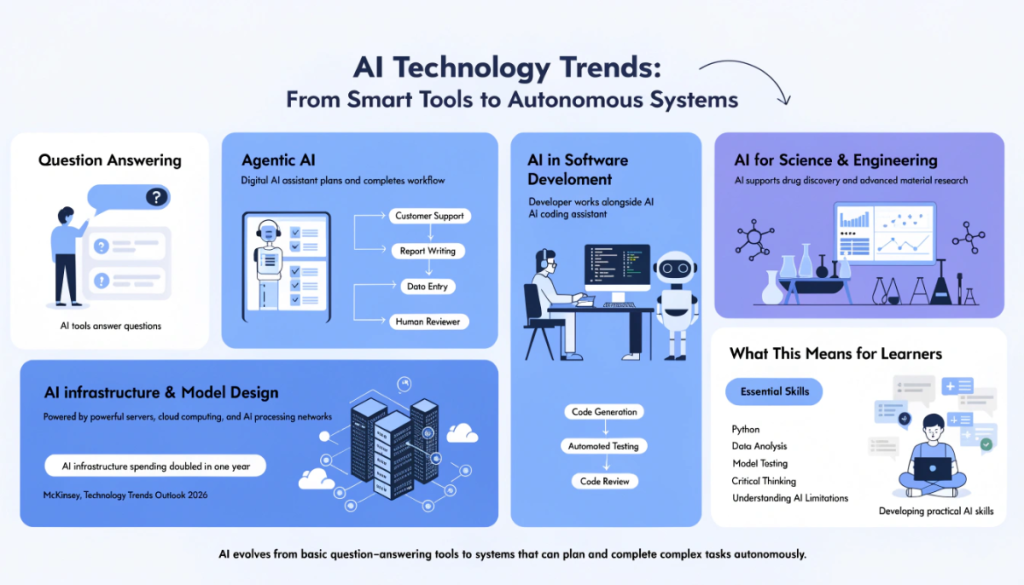
AI is still the biggest of the current technology trends. What has changed is the kind of AI that businesses are building. Early tools answered questions and wrote text. The newer wave completes whole tasks on its own.
Agentic AI
- Agentic AI refers to systems that plan and carry out several steps of a task without constant human input, which means they act more like a junior assistant than a search box.
- Companies are testing agents for work such as customer support and report writing and data entry, so skills in designing and checking these workflows are in demand.
- Humans still review the results, which means judgement and domain knowledge matter even more than before.
AI in Software Development
- Developers now use AI tools to write and test code faster, so a single engineer can produce far more than a few years ago.
- Speed brings a new problem because code can be produced faster than teams can review and secure it, which makes testing and code review skills more valuable.
- Among current technology trends this one changes entry level jobs most directly, since beginners must show deeper understanding than simply typing code.
AI for Science and Engineering
- Researchers use AI to suggest drug candidates and new materials in a fraction of the usual time.
- The real world still slows things down because lab tests and clinical trials take years, so AI speeds up the start of the process and not the whole journey.
AI Infrastructure and Model Design
Behind every AI product sits a huge amount of hardware and software. According to the McKinsey Technology Trends Outlook 2026 spending on AI infrastructure doubled in a single year. Running trained models for users is also becoming a bigger workload than training them. That shift is pushing companies to rethink how they build their systems and where they spend money.
What This Means for Learners
You do not need to build a giant model to work in AI. Most jobs involve using and testing and connecting existing tools. Strong Python and data skills and a clear understanding of how models fail will keep you useful as the tools change.
Current Technology Trends in Computing, Chips and Connectivity
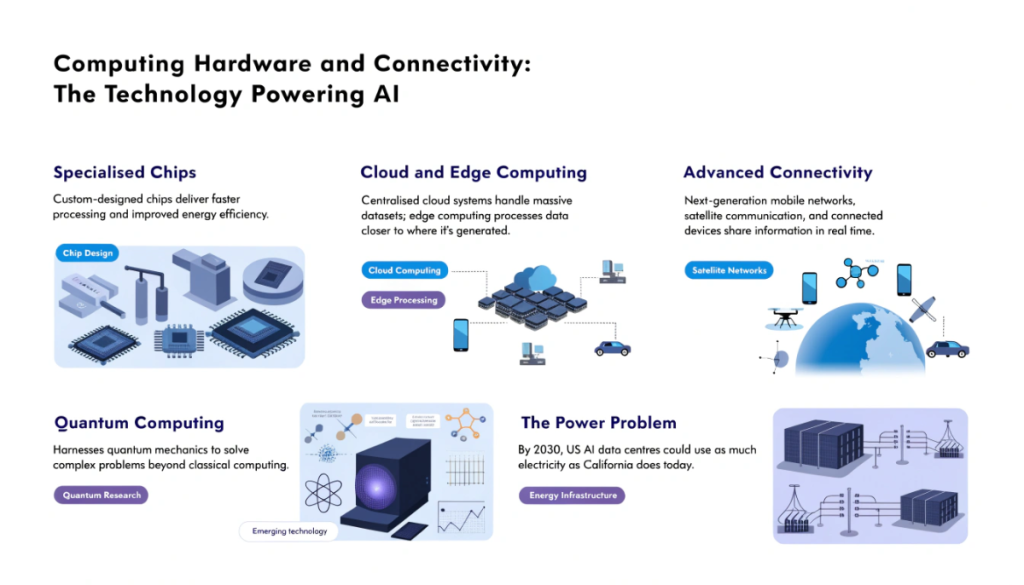
AI needs powerful machines and fast networks. That makes computing hardware and connectivity an important part of the current technology trends.
Specialised Chips
- General purpose chips are giving way to chips designed for specific AI tasks, which means more output for less power and cost.
- Large technology companies increasingly design their own chips with semiconductor partners, so demand for chip design and hardware engineering skills is growing.
Cloud and Edge Computing
- Cloud computing has matured and most companies already use it, so cloud skills are now a basic expectation for many technical roles.
- Edge computing processes data close to where it is created, such as inside a factory machine or a phone, which reduces delay and saves bandwidth.
Advanced Connectivity
- Faster mobile networks and satellite links help connect devices and remote areas, so more sensors and machines can share data in real time.
- Large numbers of satellites are being launched, which opens new jobs in space technology and communication.
Quantum Computing
- Quantum computers are still early but progress is steady. Companies are exploring them for problems that normal computers struggle with.
- For most graduates this is a field to watch and not a job market yet, though research roles are growing.
The Power Problem
One of the less discussed current technology trends is energy. Data centres need huge amounts of electricity. The same industry report notes that US data centres running AI could use as much power by 2030 as California does today. Building power lines and substations takes much longer than building a data centre. This is why energy and grid technology is drawing so much investment and hiring.
Current Technology Trends in Cybersecurity and Trust
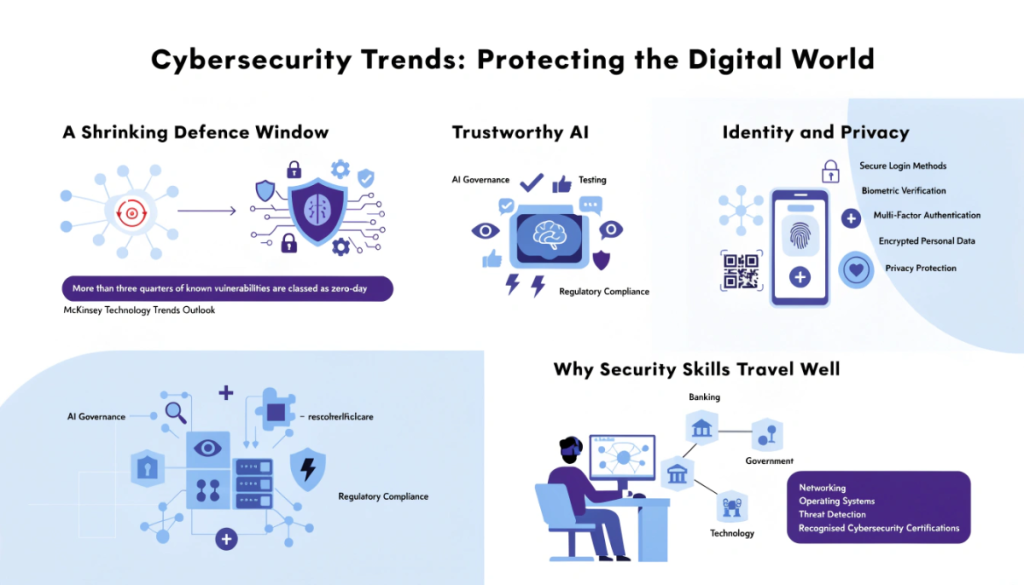
As technology grows more powerful the risks grow with it. Security has become one of the most important current technology trends because every new system is also a new target.
A Shrinking Defence Window
- Attackers now use AI to find and exploit weaknesses faster, so defenders have less time to react than in the past.
- The McKinsey outlook reports that more than three quarters of known vulnerabilities are classed as zero day, which means attackers already had an exploit when the flaw became public.
- Security teams are also using AI to find and fix problems faster, so the work is a race that both sides run with the same tools.
Trustworthy AI
- Companies must show that their AI systems are safe and fair and explainable, which means roles in AI governance and testing are appearing.
- Regulators in many countries are writing new rules, so knowledge of privacy and compliance adds real value to a technical profile.
Identity and Privacy
- Strong login methods and identity checks are becoming standard, since stolen passwords remain one of the most common ways in.
- Privacy laws push companies to handle personal data carefully, which creates steady demand for data protection roles.
Why Security Skills Travel Well
Security skills are needed in every industry. A graduate with networking and operating system knowledge and a recognised certification can find work in banks and hospitals and government bodies and technology firms. That broad demand is why cybersecurity keeps appearing in lists of current technology trends year after year.
Current Technology Trends in Robotics, Mobility and Immersive Tech
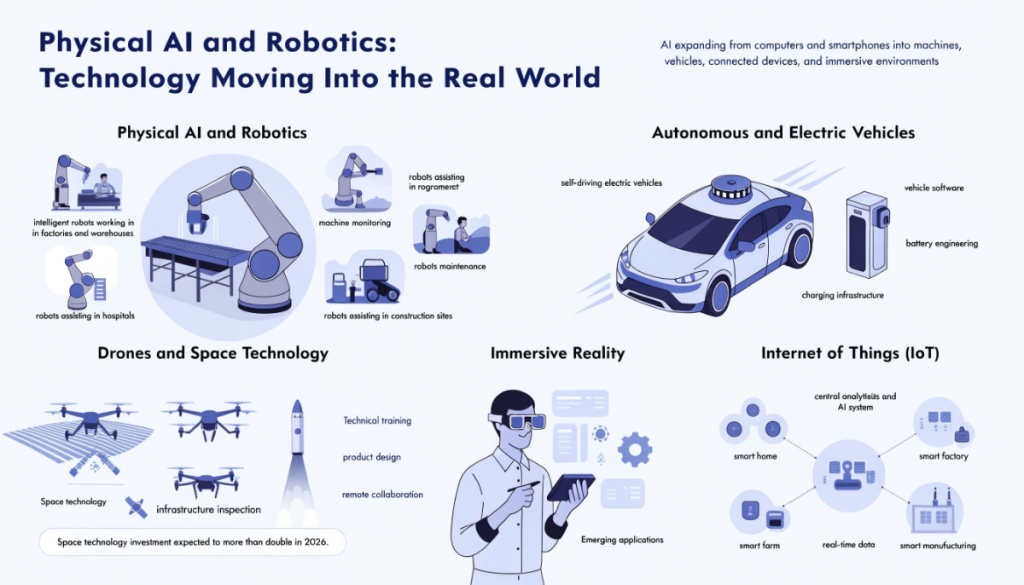
The newest shift in the current technology trends is that AI is moving off the screen and into the physical world.
Physical AI and Robotics
- Robots are being trained to learn their surroundings and handle varied tasks instead of repeating one movement, which means they can work in less controlled places.
- Factories and warehouses lead adoption because the economics are clearest there, but hospitals and farms and construction sites are next in line.
- Some factories already run with very few people on the floor, so jobs shift toward monitoring and maintaining machines and programming them.
Autonomous and Electric Vehicles
- Self driving features are advancing step by step, with trials in controlled areas before wider use.
- Electric vehicles keep growing and need batteries and charging networks and software, so engineering and software roles grow together.
Drones and Space Technology
- Drones are used for delivery and farming and inspection, which creates roles in operation and data analysis.
- Investment in space technology is rising quickly. The McKinsey outlook lists it among trends expected to see investment more than double in 2026.
Immersive Reality
- Headsets and smart glasses now respond to the person wearing them and to the world around them, which means training and design and remote work are early use cases.
- Adoption is still early compared with AI, so it is worth learning about but not worth betting your whole career on yet.
Internet of Things
Connected sensors in homes and farms and factories keep producing data. That data feeds analytics and AI tools. Graduates who understand both devices and data are well placed for roles in smart manufacturing and smart city projects.
Current Technology Trends in Healthcare, Energy and Sustainability
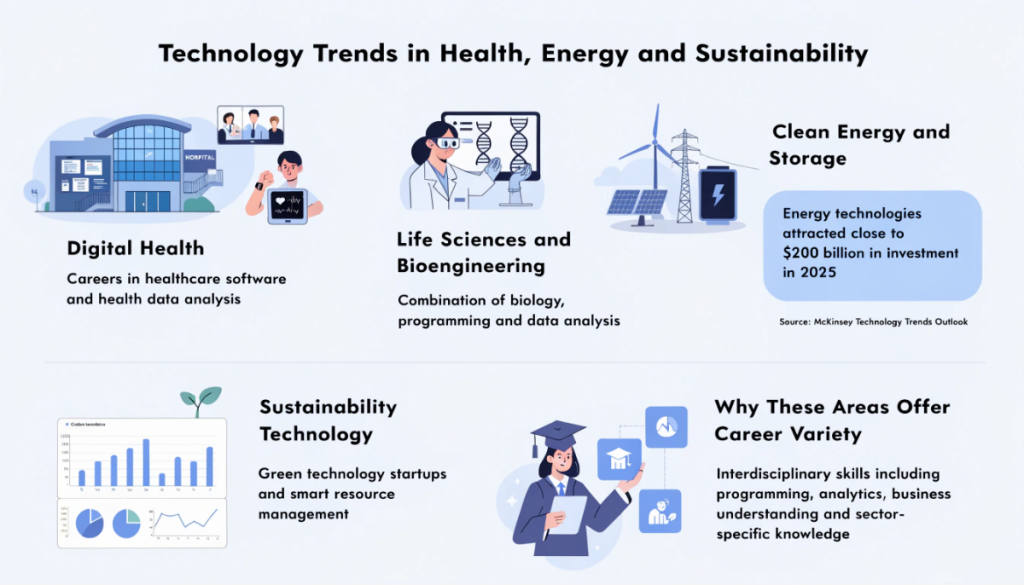
Some of the most useful current technology trends are the ones that deal with health and power and the environment. They also create jobs that mix technical skills with other fields.
Digital Health
- Hospitals use software for records and scheduling and remote consultations, so they hire developers and data analysts alongside doctors.
- Wearable devices track heart rate and sleep and activity, which produces health data that apps and researchers can study.
Life Sciences and Bioengineering
- Advances in genomics and diagnostics and new therapies are speeding up, helped by AI tools that study large biological datasets.
- Careers here mix biology with data skills, so graduates who can code and understand biology are rare and valued.
Clean Energy and Storage
- The McKinsey outlook says energy technologies drew close to 200 billion dollars in investment in 2025, which makes it one of the largest areas of funding.
- Solar and wind and batteries and smart grids all need software and data work, so energy is not only a job market for engineers.
Sustainability Technology
- Companies use data tools to track emissions and manage resources, which creates roles in sustainability analytics.
- Green technology startups often need people who can combine technical skill with business sense.
Why These Areas Offer Career Variety
If you do not want a pure software career then these fields offer a different path. They need people who can connect technology with real problems in health or energy or farming. A computing degree plus some knowledge of one such field makes a strong and less crowded profile.
How Current Technology Trends Affect Careers and Learning
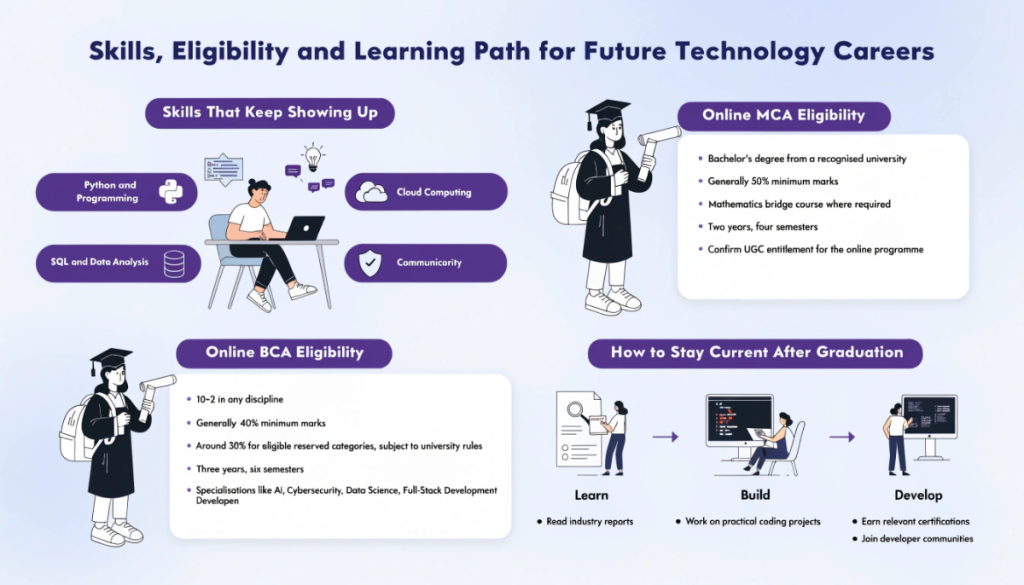
Reading about current technology trends is useful but only if it changes what you learn. The sections above point to a few skills that appear again and again.
Skills That Keep Showing Up
- Programming in Python and one other language, because almost every trend relies on code.
- Data handling with SQL and analysis tools, since AI and IoT and analytics all depend on good data.
- Cloud and security basics, which employers now expect from most technical hires.
- Clear communication, because teams must explain technical choices to managers and customers.
Eligibility for an Online BCA
An online BCA is a good starting point for school leavers who want to work with current technology trends. A candidate generally needs to have passed 10+2 in any discipline with at least 40 percent marks. Candidates from reserved categories such as SC and ST and OBC and EWS often get a relaxation to about 35 percent. International applicants are usually expected to have around 60 percent marks. The program runs for three years across six semesters and many offer tracks such as artificial intelligence and cyber security and data science and full stack development.
Eligibility for an Online MCA
An online MCA suits graduates who want deeper technical skills. A candidate generally needs a bachelor’s degree in any discipline from a recognised university with at least 50 percent marks. International applicants are usually expected to have around 60 percent marks. Students who did not study mathematics at 10+2 or graduation level are asked to complete a bridge course. The program runs for two years across four semesters. Always confirm that the program is approved by UGC for the online mode so the degree is valid for jobs and further study.
How to Stay Current After You Graduate
- Follow one or two reliable industry reports each year, so you can separate real shifts from short lived hype.
- Build small projects with new tools, because hands on practice teaches more than reading.
- Add a certification when a trend matches your goal, since employers can see exactly what you learned.
- Join online communities of developers and analysts, which keeps you close to real discussions and openings.
Conclusion
The current technology trends share one pattern. AI is spreading into every field and it is also moving into the physical world through robots and vehicles and connected devices. Security and energy and chips are the supporting pillars that decide how far this growth can go. For students and working professionals the best response is steady skill building and not panic. Pick one or two areas that interest you and learn the basics well. Build projects and keep learning as the tools change. That habit will serve you much better than chasing every new headline.
Sources & References
✓ Verified 2026The following sources provide further information on the technology developments discussed in this article, including artificial intelligence, computing infrastructure, cybersecurity, robotics, digital health, energy systems and the skills needed for emerging technology careers.

Book Your
Free Session
Connect with our experts and get personalised guidance for your career, course selection, and future goals.