
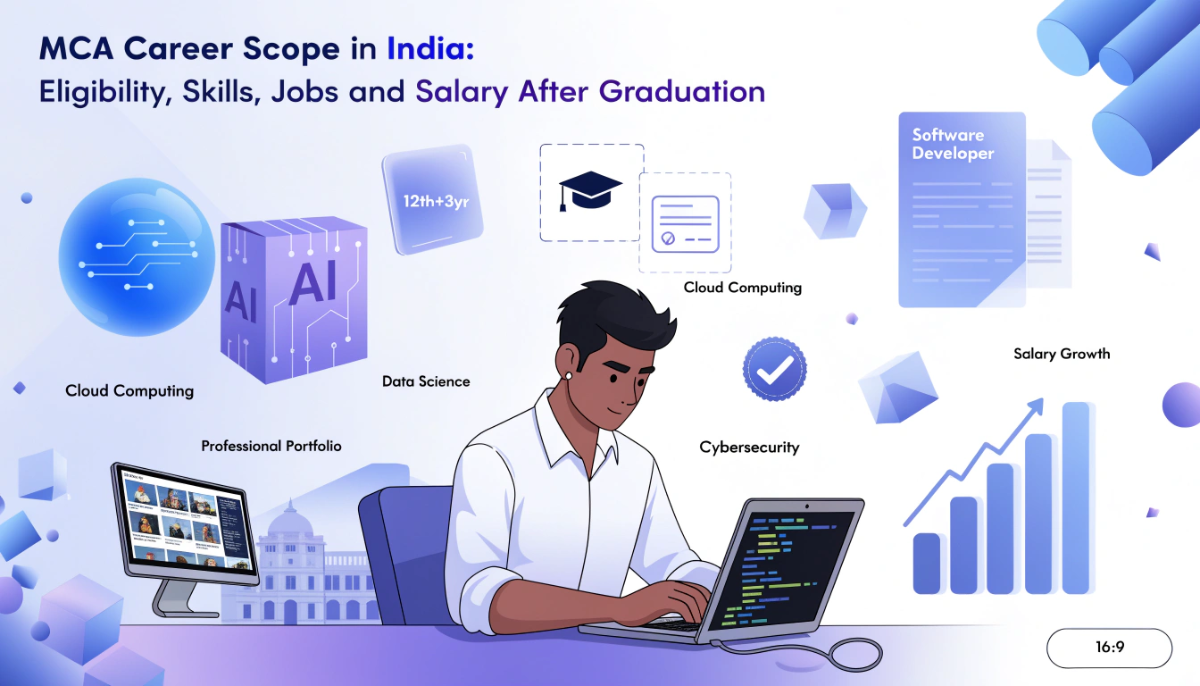
MCA career scope is a question many graduates ask before they commit two years and a fee to the degree. The short answer is that a Master of Computer Applications opens doors to software, data, AI, cloud and security roles across almost every industry. Fresher pay commonly sits between 3 and 8 LPA and it grows quickly with skills and experience. This blog explains the MCA career scope in plain terms, from eligibility and subjects to jobs and salary. You will also see which skills matter most and how an online MCA fits in. Read on to decide if this degree matches your goals.
MCA Career Scope in India: Is the Degree Still Worth It?
Yes, the MCA career scope in India is still strong and the reason is simple. Almost every company now runs on software. Banks, hospitals, shops, schools and government offices all need people who can build and maintain digital systems. A Master of Computer Applications trains you for exactly that kind of work.
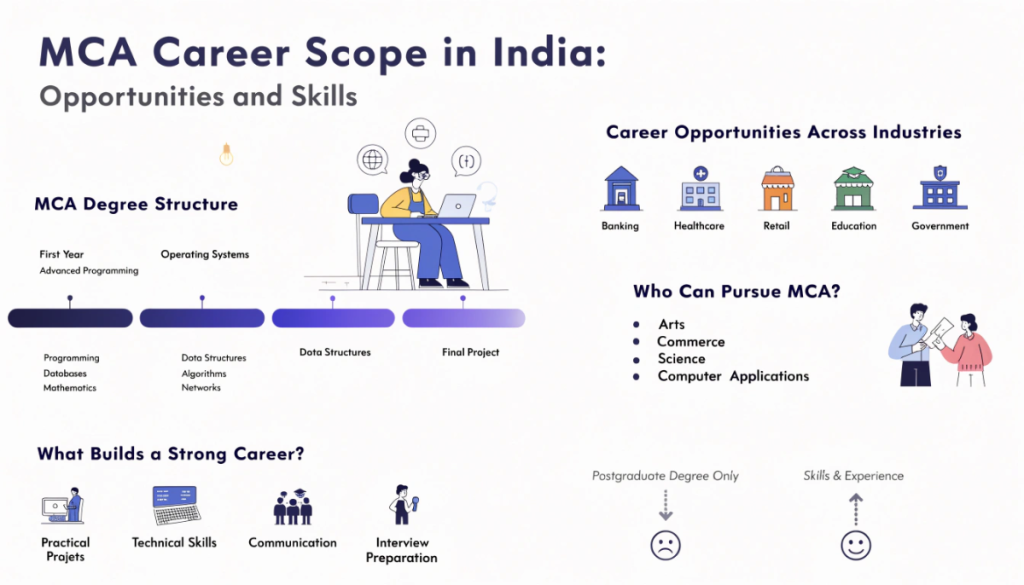
MCA is a two year postgraduate degree in computer applications. Most programs split it into four semesters. The first year builds your base in programming, databases and mathematics. The second year goes deeper into advanced programming, operating systems and a specialisation of your choice. You finish with a project that shows what you can build.
What makes the MCA career scope wide is who can enter the field. You do not need a computer science background in most cases. Graduates from commerce, science and arts can all apply as long as they meet the basic rules covered in the next section. This makes MCA a practical route for people who want to move into IT without starting over with a second bachelor’s degree.
The degree also fits people who already have a BCA or a BSc in computer science. For them it adds depth and a postgraduate qualification that many mid level and senior roles prefer. It is also a requirement if you ever want to teach at a college or pursue a research degree.
A quick reality check though. The degree alone does not decide your salary. Your skills and projects and communication decide it. Two MCA graduates from the same batch can earn very different packages because one built real projects and practised interviews while the other relied only on marks. The MCA career scope is wide but you have to build the profile that matches it.
Who Can Take an MCA? Eligibility Rules in Simple Words
Eligibility is where most students get confused so it helps to go through the rules one by one. These are the criteria followed by most online and regular MCA programs in India. Always confirm the final details with the admission team before applying.
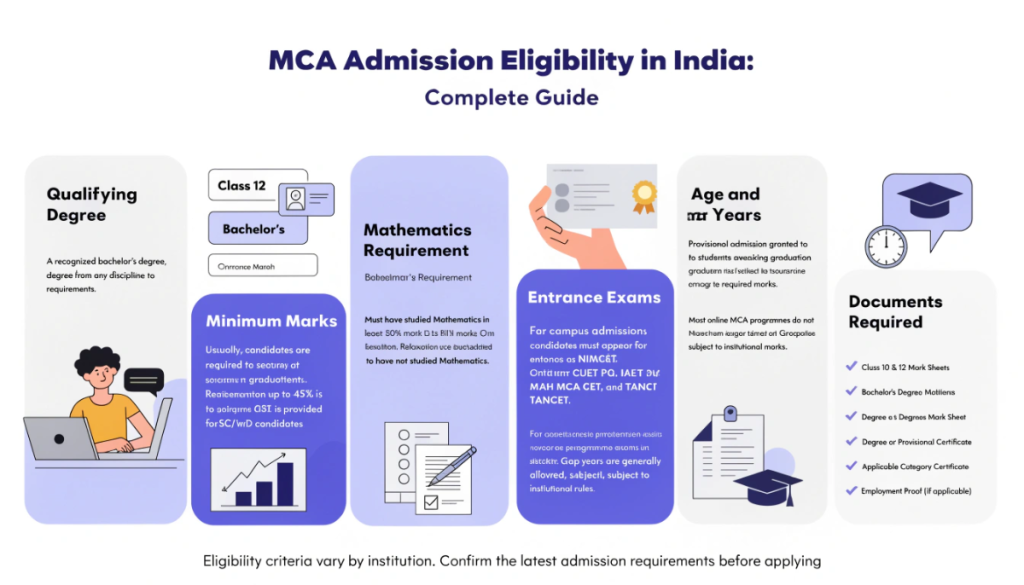
Qualifying degree. You need a bachelor’s degree from a recognised institution. Any discipline is accepted by many programs. A three year diploma after Class 10 does not count on its own unless you also complete a full bachelor’s degree.
Minimum marks. The common requirement is 50 percent in your bachelor’s degree. Many institutions relax this to 45 percent for SC, ST and OBC candidates. Some top campus programs ask for 55 to 60 percent. International students are usually asked for 60 percent.
Mathematics requirement. This is the rule people miss. If you studied Mathematics in Class 12 or in your bachelor’s degree you are fine. If you did not you will normally have to complete a compulsory bridge course in Mathematics. Many online programs include this bridge course so you can still join and catch up.
Entrance exams. On campus programs often admit through tests such as NIMCET, CUET PG or state exams like MAH MCA CET and TANCET. Online programs usually admit based on your qualifying degree marks and do not ask for an entrance exam. This is one reason the online route suits working professionals and people who missed the exam cycle.
Final year students. You can apply while you are still in your last year. Admission is provisional and it gets cancelled if your final result falls below the required percentage.
Age and gap years. Most online programs have no upper age limit. A gap year does not usually affect eligibility although some institutions may ask for a self declaration.
Documents. Keep these ready: Class 10 and Class 12 mark sheets, all semester mark sheets of your bachelor’s degree, the degree certificate or provisional certificate, a government photo ID and a category or other certificate if it applies to you. Working professionals can add employment proof if the program accepts it.
What You Study in an MCA and Where Each Subject Leads
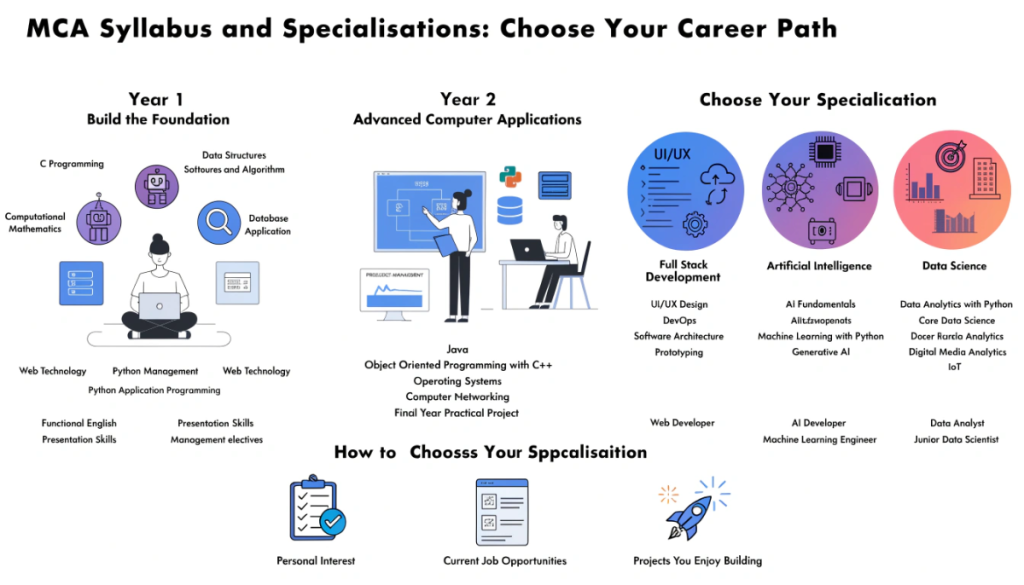
The syllabus shapes your MCA career scope more than people realise. Each subject maps to a type of job so it helps to know what you are signing up for.
Year one gives you the foundation. You learn problem solving with C, data structures and algorithms, computational mathematics, database management and web technology. Python application programming is also part of this stage. These subjects are what technical interviews test first so take them seriously. Most programs also include functional English and a few open electives such as presentation skills or principles of management. They look small on paper but they improve how you speak and write at work.
Year two moves into advanced work. Expect Java programming, object oriented programming with C++ and operating system concepts. Computer networking is often offered as an elective. The year ends with a project where you build something real. Treat the project as the main piece of evidence for your resume.
Specialisations decide your direction. In the later semesters you usually pick a track. Three common ones are Full Stack development, Artificial Intelligence and Data Science.
The Full Stack track covers UX and UI design, DevOps, software architecture and prototyping. It leads to web developer, software engineer and product engineering roles.
The Artificial Intelligence track covers AI fundamentals, machine learning with Python and generative AI. It leads to machine learning engineer and AI developer roles. This is one of the fastest growing parts of the MCA career scope right now.
The Data Science track covers data analytics with Python, core data science, digital media analytics and IoT with data science. It leads to data analyst and junior data scientist roles.
Pick your track using two questions. What kind of work would you enjoy for the next five years and where are the openings you can see in job listings today. If you are unsure choose the track that matches the project you enjoyed building the most.
Jobs After MCA and What They Pay
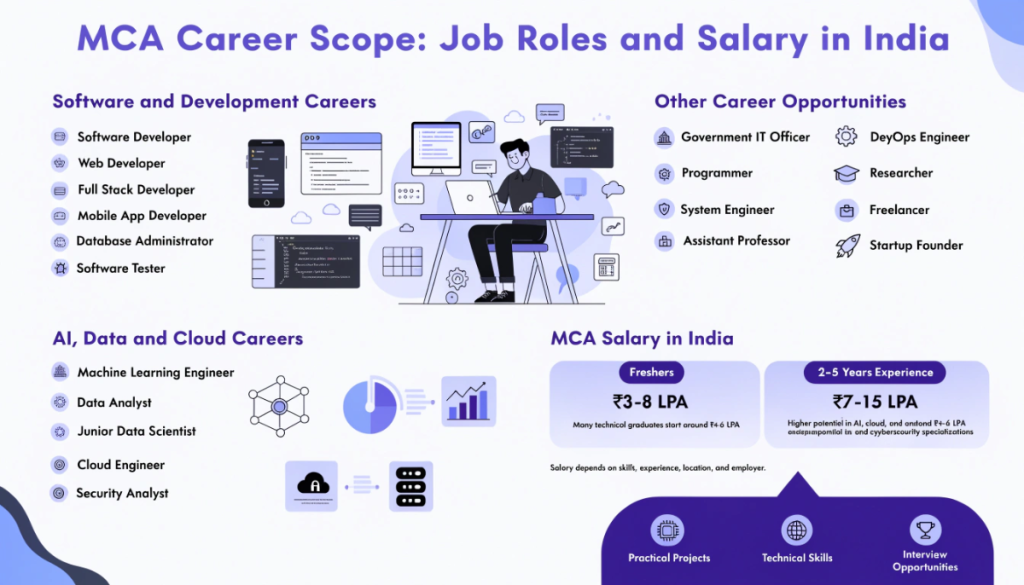
This is the part everyone wants to see. Here are the main roles open to MCA graduates grouped by the kind of work. Salary figures are indicative yearly ranges in LPA based on commonly reported market data. Your offer will depend on your skills and the employer.
Software side. Software developer, web developer, full stack developer, mobile app developer, database administrator, system analyst, software tester and technical support engineer all fall here. These are the most common first jobs for graduates and they form the core of the MCA career scope.
AI, data and cloud side. Machine learning engineer, data analyst, junior data scientist, cloud engineer, DevOps engineer and security analyst belong to this group. These roles need stronger skills but they also tend to pay more as you gain experience.
Other paths. Many graduates join government departments or public sector units as IT officers, programmers or system engineers. Some become assistant professors after clearing UGC NET. Others go for research or a doctoral degree and a good number start freelancing or build their own startup.
Fresher salary. Most reports put fresher pay at around 3 to 8 LPA. Many technical freshers begin near 4 to 6 LPA. Graduates with strong projects and good interview skills can land at the higher end of that range.
With experience. After two to five years many developers move to 7 to 15 LPA. Specialists in AI, cloud and security can earn considerably more once they have a solid track record.
Keep in mind that location and company type change these numbers. Product companies and global tech centres usually pay above the average while smaller firms may pay less at the start. Do not judge an offer only by the first year salary. Look at the learning you get and the growth path for the next three years.
Industries and Skills That Decide Your MCA Career Scope
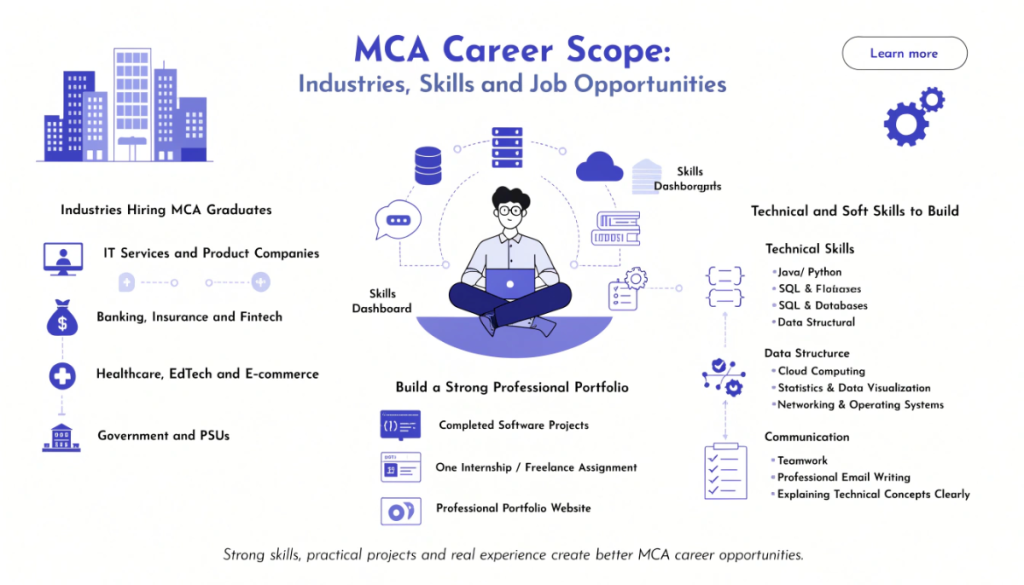
Another reason the MCA career scope stays strong is the number of industries that hire for it. You are not limited to IT companies.
IT services and product companies hire the largest share of MCA graduates. They need developers, testers and analysts in large numbers every year.
Banks, insurance firms and fintech companies run heavy software systems and always look for people who understand databases, security and application development.
Healthcare, education technology and e commerce are growing users of software and data. They hire for apps, analytics and system support.
Government agencies and public sector units recruit IT staff through exams and direct hiring. These jobs offer stability and a clear career ladder.
Now the skills. Employers across these industries keep asking for the same basics. Learn one main programming language well such as Java or Python and practise problems on it regularly. Get comfortable with databases and SQL. Understand data structures because interviews begin there. Learn version control and basic cloud tools. For data roles add statistics and a visualisation tool. For security roles add networking and operating system knowledge.
Soft skills matter as much as technical ones. Being able to explain your code in simple language and write a clear email and work in a team will set you apart. Recruiters notice this quickly in interviews and group tasks.
Finally build a portfolio. Three solid projects hosted online and one internship or freelance task will do more for you than a long list of certificates. This is the single most useful step to raise your MCA career scope while you are still studying.
Doing an MCA Online: What Changes and What Stays the Same
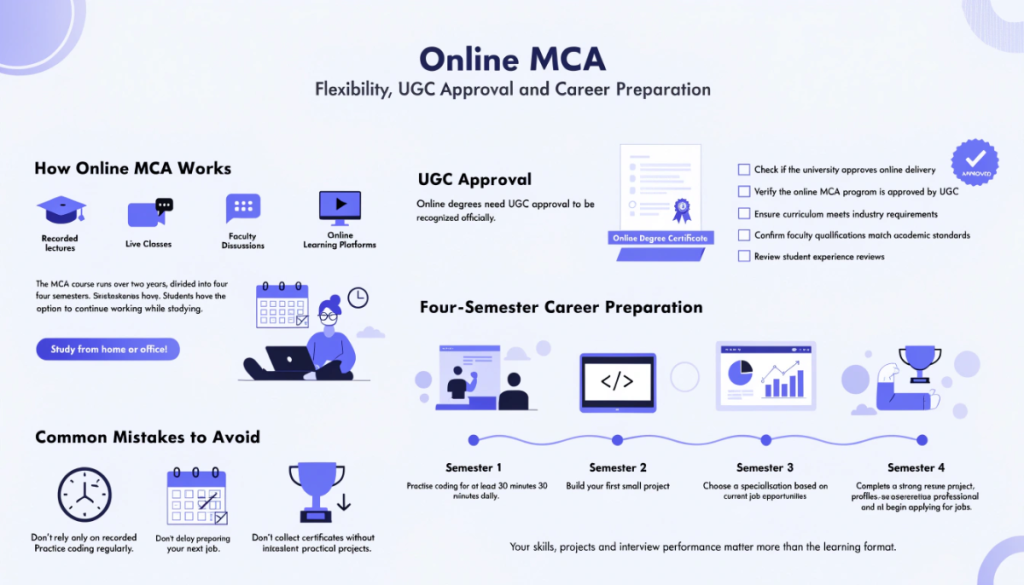
An online MCA has become a common choice for working people and for students who want flexibility. It follows the same two year and four semester structure as a regular program. You learn through a learning platform with recorded material and live sessions and discussion forums where you can talk to faculty.
What changes is how you manage your time. You can study from anywhere and keep your job or income while you earn the degree. This makes the MCA career scope accessible to people who could not leave work for two years.
What stays the same is what employers look at. They check your skills and projects and how well you perform in interviews. The format of your degree matters far less than what you can actually do. So the effort you put into practice is the deciding factor.
Before you enrol check one thing carefully. Make sure the program is approved for online delivery by the UGC and that the degree is treated as equal to a regular one under the UGC notification. This protects you when you apply for government jobs or higher studies.
Here is a simple plan to get the most out of the program. In the first semester practise coding every day even if it is only for thirty minutes. By the second semester pick up your first small project. In the third semester choose your specialisation based on real job listings. In the final semester make your project the centrepiece of your resume and start applying early. Join mock interviews and keep your profile updated on professional networks.
Avoid the common mistakes. Do not rely only on recorded lectures without practising. Do not postpone job preparation until the last month. Do not collect certificates without building anything. Each of these slows down your progress and weakens your MCA career scope in the eyes of recruiters.
Conclusion
An online MCA has become a common choice for working people and for students who want flexibility. It follows the same two year and four semester structure as a regular program. You learn through a learning platform with recorded material and live sessions and discussion forums where you can talk to faculty.
What changes is how you manage your time. You can study from anywhere and keep your job or income while you earn the degree. This makes the MCA career scope accessible to people who could not leave work for two years.
What stays the same is what employers look at. They check your skills and projects and how well you perform in interviews. The format of your degree matters far less than what you can actually do. So the effort you put into practice is the deciding factor.
Before you enrol check one thing carefully. Make sure the program is approved for online delivery by the UGC and that the degree is treated as equal to a regular one under the UGC notification. This protects you when you apply for government jobs or higher studies.
Here is a simple plan to get the most out of the program. In the first semester practise coding every day even if it is only for thirty minutes. By the second semester pick up your first small project. In the third semester choose your specialisation based on real job listings. In the final semester make your project the centrepiece of your resume and start applying early. Join mock interviews and keep your profile updated on professional networks.
Avoid the common mistakes. Do not rely only on recorded lectures without practising. Do not postpone job preparation until the last month. Do not collect certificates without building anything. Each of these slows down your progress and weakens your MCA career scope in the eyes of recruiters.
Sources & References
✓ Verified 2026Explore these official education, examination and technology resources for information on MCA eligibility, entrance exams, online degree recognition, programming skills and career opportunities.

Book Your
Free Session
Connect with our experts and get personalised guidance for your career, course selection, and future goals.