

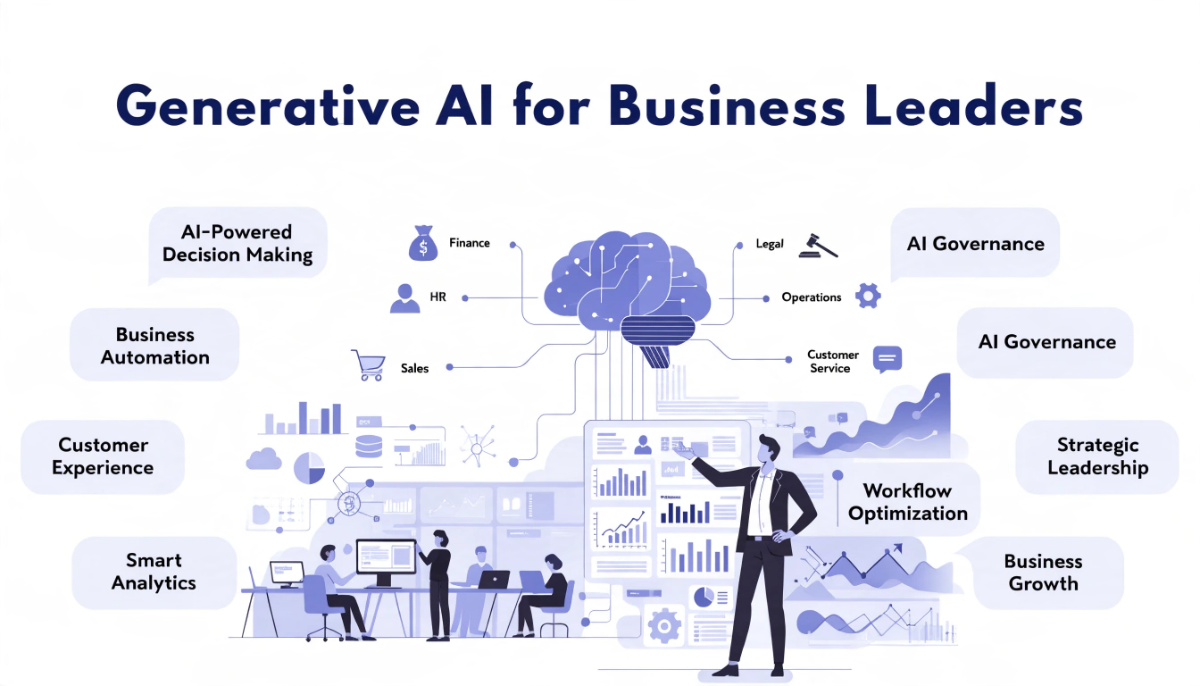
Generative AI for business leaders is no longer an optional topic to explore at some point in the future. In 2026 it is deciding which companies gain competitive advantages in speed, cost and decision quality and which ones fall behind while debating whether the timing is right.
The leaders who are getting real results from generative AI are not the ones with the biggest technology budgets but the ones who started by identifying one specific, high-volume business problem and applied generative AI to solve that problem before scaling.
This blog covers what generative AI for business leaders actually involves at a practical level, where the documented ROI is coming from across functions, what the risks are that boards are not discussing often enough and how to build the leadership capabilities to govern and scale generative AI in your organisation rather than just sponsor it from a distance.
What Generative AI for Business Leaders Actually Means in 2026
There is still a gap between how generative AI is discussed at the leadership level and what it actually does inside a business. Here is the grounded picture:
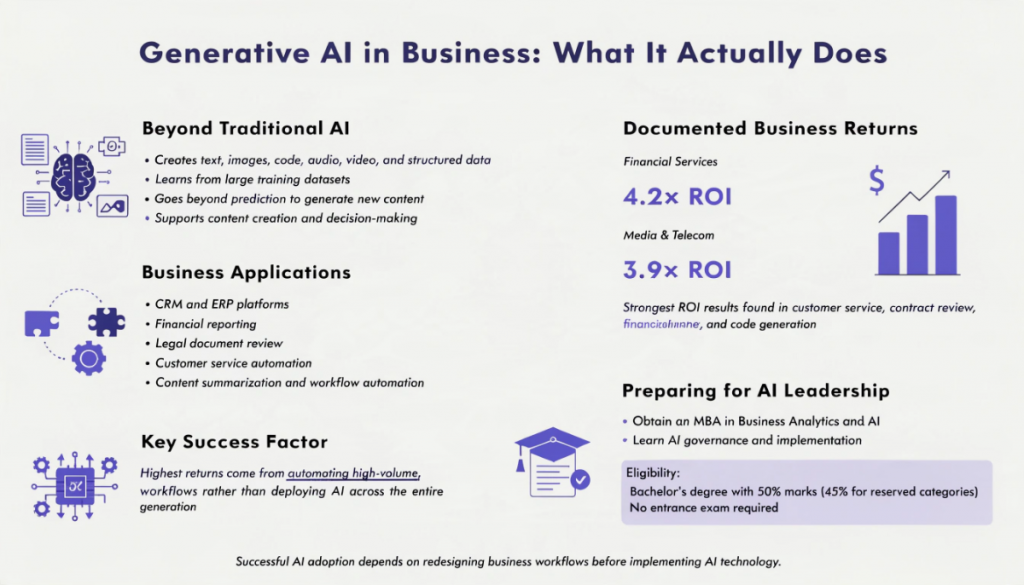
Generative AI refers to AI systems that can create new content, including text, images, code, audio, video and structured data, based on patterns learned from large training datasets, which is fundamentally different from older AI systems that only classified or predicted from existing data
For business leaders, generative AI is not a single tool but a category of capability that can be embedded into almost any workflow where the task involves producing, summarising, transforming or responding to content at scale
In 2026 generative AI is embedded infrastructure inside products that business leaders already use daily including CRM systems, ERP platforms, legal review tools, financial reporting dashboards and customer service platforms, rather than a standalone application that employees switch to separately
The companies generating real financial returns from generative AI for business leaders have one thing in common: they identified a specific, high-volume, repeatable workflow first and built a focused application around that workflow rather than deploying a general-purpose tool across the entire organisation and hoping adoption would follow
McKinsey State of AI 2026 research confirms that organisations seeing real returns from generative AI were twice as likely to have redesigned the workflow before selecting a model, which means the business design decision matters more than the technology selection for most use cases
Financial services organisations report the strongest documented ROI from generative AI at 4.2 times investment, followed by media and telecom at 3.9 times, with the highest returns consistently appearing in functions that have the largest volume of repetitive, structured tasks such as customer service, contract review, financial reporting and code generation
For professionals building the skills to lead this shift, an MBA in Business Analytics and AI provides the qualification needed to govern and implement generative AI at the organisational level, with eligibility requiring a bachelor’s degree in any stream with 50% marks and 45% for reserved category candidates, and no entrance exam required
Generative AI for Business Leaders: What It Does to Customer-Facing Operations
Customer-facing functions were the first place generative AI delivered measurable business results and in 2026 the depth of impact has grown well beyond basic chatbots. Here is what the picture looks like:
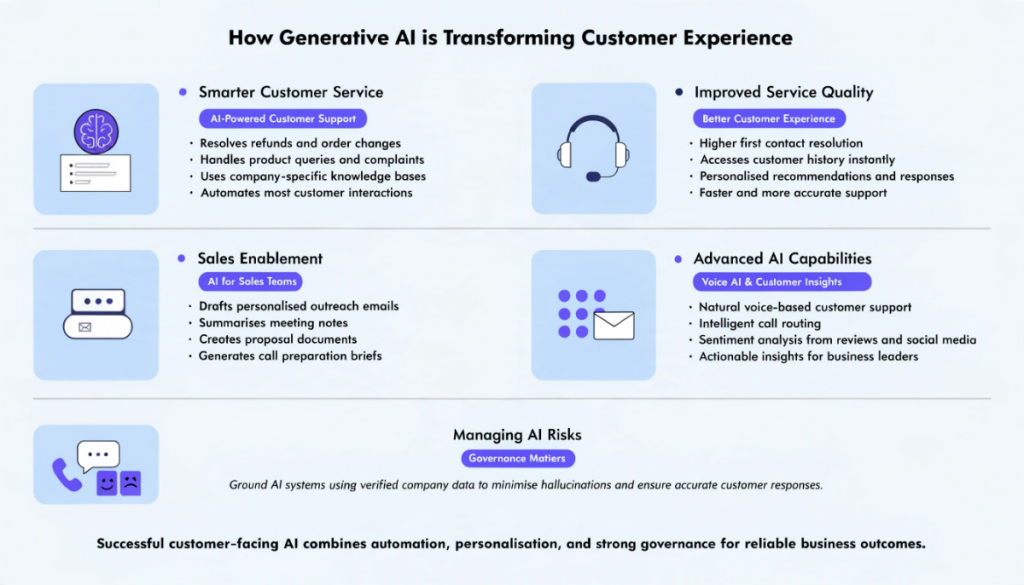
AI-powered customer service systems using large language models connected to company-specific knowledge bases are resolving full customer service conversations autonomously including refunds, order changes, complaint resolution and product queries without human agent involvement for the majority of interactions
First contact resolution rates, which measure how often a customer issue is resolved in a single interaction, have improved significantly at organisations that deployed generative AI in customer service because the system can access full customer history, policy documentation and product data simultaneously in a way a human agent switching between screens cannot
Personalisation at scale is now a practical reality for businesses using generative AI, with systems dynamically generating individual product recommendations, email content, promotional offers and support responses tailored to each customer’s specific history and behaviour rather than sending the same message to everyone
Sales enablement has been transformed by generative AI tools that draft personalised outreach emails, generate call preparation briefs, summarise prior meeting notes and create proposal documents in minutes rather than hours, which increases the time sales professionals can spend in actual customer conversations
Voice AI systems integrated into customer service channels are handling inbound calls, qualifying customer needs, routing to the right department and resolving standard queries in natural spoken language, which is particularly relevant for Indian businesses where phone remains a primary customer service channel alongside WhatsApp
Sentiment analysis powered by generative AI processes thousands of customer reviews, support tickets and social media mentions to surface structured insights about what customers love and what they complain about, which feeds directly into product and service improvement decisions at the leadership level
The governance issue business leaders need to address in customer-facing generative AI is hallucination risk, where the model generates a plausible-sounding but factually incorrect response, which makes domain-specific grounding of the model in verified company data a non-negotiable architectural requirement rather than an optional improvement
Where Generative AI for Business Leaders Delivers in Internal Operations
Beyond customer service, generative AI for business leaders is delivering measurable results inside the organisation across legal, finance, HR and software development. Here is the breakdown:
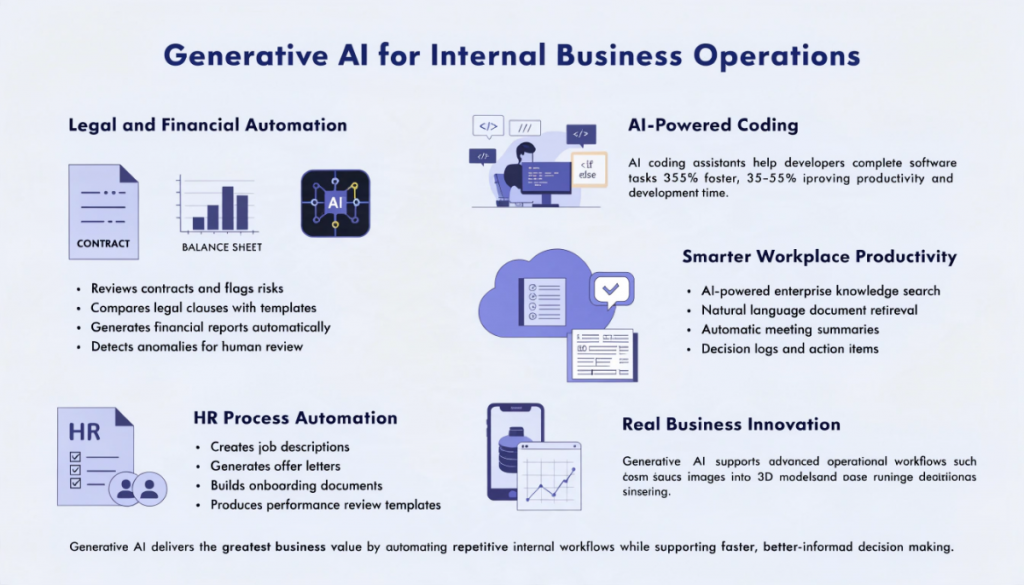
Contract review and legal document analysis is one of the highest-ROI internal use cases for generative AI in 2026, with systems that can review a 50-page contract, flag non-standard clauses, compare against template terms and produce a risk summary in minutes rather than the hours a junior legal team member would require
Financial report generation has been transformed at organisations where generative AI pulls data from multiple source systems, produces formatted management accounts with narrative commentary and flags anomalies for human review, compressing a process that previously took days into something that runs overnight
Code generation and software development acceleration is one of the most extensively documented generative AI use cases for businesses, with developer productivity studies from 2025 and 2026 consistently showing that developers using AI coding assistants complete tasks 35 to 55 percent faster than those working without them
HR document generation including job descriptions, offer letters, performance review templates and onboarding documentation is being automated at scale using generative AI, freeing HR teams from document assembly work to focus on the relationship-intensive parts of people management that benefit from human engagement
Internal knowledge management is being transformed by retrieval-augmented generation systems that allow employees to query the organisation’s entire document repository in natural language and receive accurate summarised answers rather than searching through folders manually or waiting for a colleague to remember where a file is stored
Meeting summarisation and action item extraction is a generative AI application that has achieved high adoption across organisations in 2026 because the productivity benefit is immediate and visible, with tools automatically producing structured meeting notes, decision logs and follow-up task lists without requiring anyone to manually write them up
BMW used generative AI built on Vertex AI and Gemini to convert 2D product images into 3D models and run large-scale distribution simulations, which represents the kind of domain-specific operational application that generates large financial returns but rarely appears in the mainstream AI conversation because it does not fit a simple narrative
The Strategy Questions Generative AI Forces Business Leaders to Answer
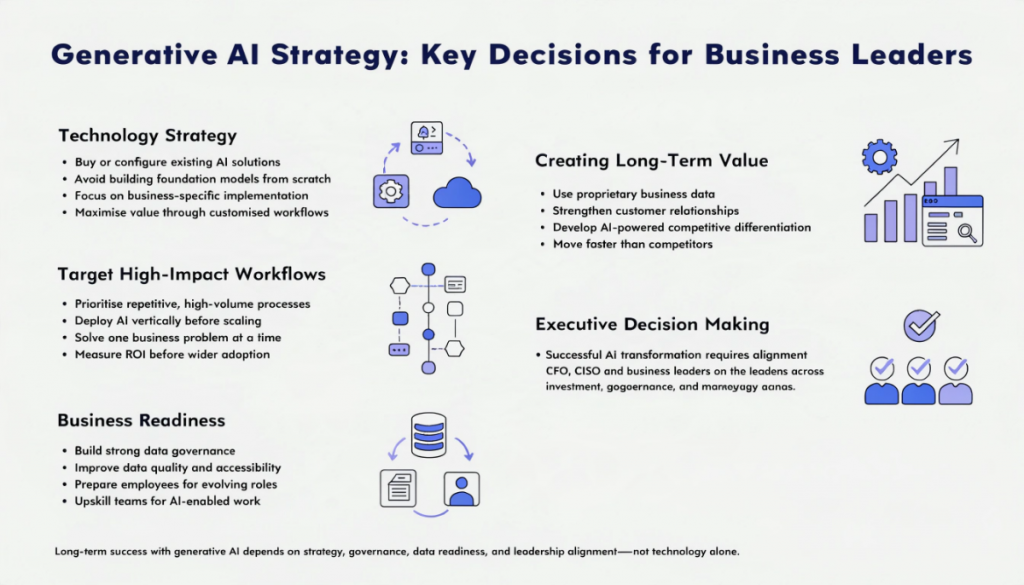
Generative AI for business leaders is as much a strategy question as a technology question. Here are the decisions that leadership teams cannot avoid:
Build versus buy is the first real question, and in 2026 the answer for most organisations is buy or configure rather than build from scratch, since foundational model development requires resources that only a handful of global technology companies can sustain, and most business value comes from applying existing models to specific business data and workflows
The most important strategic decision is not which model to use but which workflow to target first, since the highest-ROI generative AI deployments are all vertical rather than horizontal, meaning they apply the technology to a specific, high-volume business process rather than distributing a general tool across all employees and waiting for usage to emerge
Data readiness is a strategic prerequisite that most leadership discussions underweight, since a generative AI system is only as useful as the quality and accessibility of the business data it is grounded in, and organisations that have not structured their data governance before selecting a model consistently report lower returns than those that did
Workforce strategy is a leadership responsibility that generative AI makes urgent, since roles that consist primarily of content assembly, report writing, data entry and template-based document generation are being compressed across industries, and leadership teams that do not actively plan for the resulting role evolution will face workforce disruption rather than workforce transformation
Competitive positioning through generative AI is temporary if the capability is generic, since any competitor can access the same foundational models, which means the sustainable advantage comes from applying generative AI to proprietary workflows, proprietary data or proprietary customer relationships that competitors cannot replicate even with the same tools
The scenario planning question that boards should be asking is not what happens if we adopt generative AI slowly but what happens to our market position if our top three competitors adopt it decisively in the next 12 months, since the speed of competitive displacement in industries with high content or knowledge work intensity has accelerated significantly in 2026
Leadership alignment on generative AI strategy matters more than any individual technical decision because misalignment between the CEO, CFO, CISO and business unit heads on risk tolerance, investment timeline and governance standards is the most common reason generative AI initiatives stall after a successful pilot
Risks Generative AI Creates That Business Leaders Must Govern
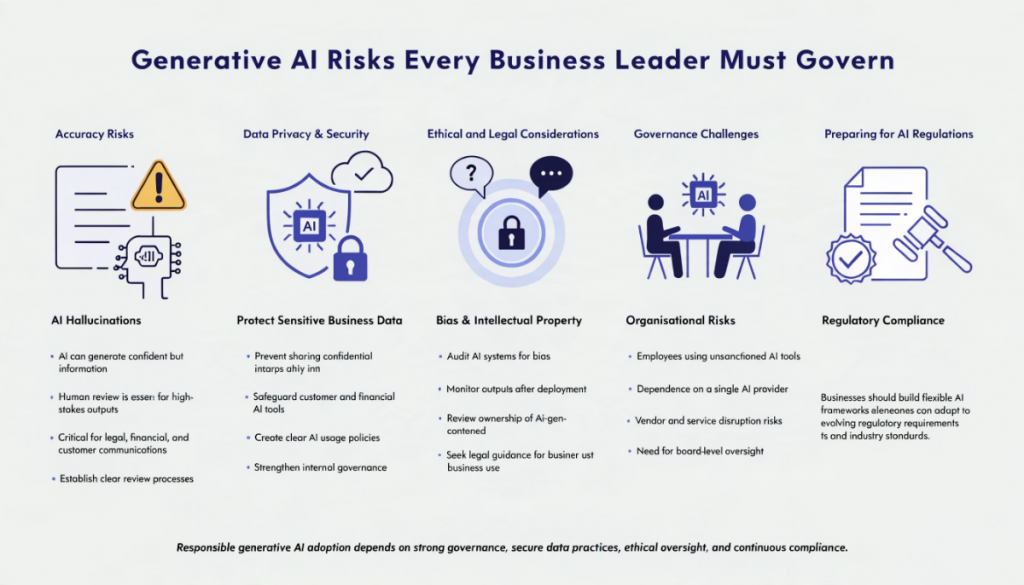
The risk conversation around generative AI for business leaders is often either too general or too technical to be actionable. Here is what actually needs to be governed:
Hallucination is the most operationally significant risk for most businesses, where the model generates content that sounds accurate and is presented with confidence but is factually wrong, which makes human review of high-stakes outputs such as legal documents, financial summaries and customer-facing communications a non-negotiable governance requirement
Data privacy and confidentiality risk arises when employees input sensitive business data including customer personally identifiable information, financial projections or unreleased product plans into public AI tools, which in 2026 remains the single most common governance failure at organisations that have deployed generative AI without a clear acceptable use policy
Bias at scale is a risk that generative AI amplifies rather than introduces, since models trained on biased data reproduce that bias across every output they generate, which means a model used for HR document generation, customer communication or pricing recommendations needs to be audited for bias before deployment and monitored after it
Intellectual property ownership of AI-generated content remains legally unsettled in most jurisdictions including India, which means business leaders approving the use of generative AI to create marketing copy, product designs, software code or research outputs need legal guidance on IP ownership before deploying at scale
The governance gap that most boards are not discussing is that frontline employees are already using unsanctioned AI tools faster than leadership can formally approve and secure them, which means the absence of a generative AI policy does not mean your organisation is not using generative AI but means it is using it without oversight
Model dependency and vendor concentration risk has emerged as a board-level concern in 2026 as organisations that have deeply integrated a single AI provider’s models into critical workflows have limited negotiating leverage if that provider changes pricing, modifies capabilities or experiences a service disruption
Regulatory compliance risk is growing as multiple jurisdictions including the European Union have enacted AI governance frameworks and India is developing its own AI regulatory approach, which means generative AI deployments that are compliant today may require structural changes in response to regulation that is still being written
How to Build a Generative AI Roadmap That Actually Gets Implemented
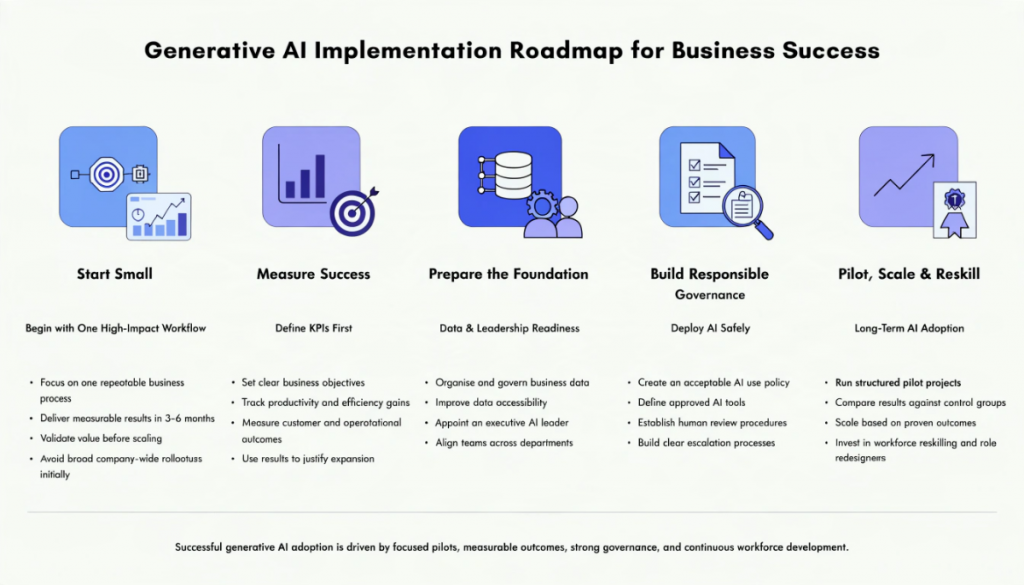
The difference between organisations that have a generative AI strategy on paper and those that have one working in production comes down to how they build and execute the roadmap. Here is what the implementations that work have in common:
Start with one specific, high-volume, repeatable workflow rather than a company-wide transformation initiative, since a narrow focused deployment generates measurable results within three to six months while a broad initiative rarely generates evidence of value within the same timeframe and often loses leadership support before it does
Define the success metric before selecting the technology, since knowing exactly what a 30 percent reduction in contract review time or a 25 percent improvement in first contact resolution rate looks like makes it possible to evaluate whether the deployment is working and to make the investment case for scaling
Get data ready first because McKinsey’s research across the organisations generating real generative AI returns consistently shows that data readiness, including structured storage, clean labelling, accessible retrieval and governance documentation, matters more to outcomes than model selection for most business use cases
Designate a generative AI lead at the senior executive level, not in an IT function alone, since the cross-functional decisions that generative AI implementation requires around workforce roles, risk tolerance, customer communication policy and legal exposure need authority that sits above any single department
Build an acceptable use policy before deployment reaches scale, specifying which tools employees are authorised to use, what data they are permitted to input, how outputs must be reviewed for high-stakes applications and what the escalation path is when an AI output is wrong or causes harm
Run a structured pilot with a defined duration, a control group for comparison and a pre-agreed evaluation framework before committing to full deployment, since the pilot evidence is what allows leadership to make confident decisions about scaling rather than committing larger budgets based on vendor claims alone
Plan for the workforce transition that generative AI will require in roles that are most directly affected by automation, since the organisations that handle this transition proactively through reskilling, role redesign and transparent communication about what is changing retain talent and maintain morale far better than those that announce changes after the deployment is complete
Conclusion
Generative AI for business leaders in 2026 is a set of decisions, not a single technology choice. The decision about which workflow to target first matters more than which model to use. The decision about data readiness matters more than the deployment timeline.
The decision about governance and acceptable use policy matters more than the vendor relationship. And the decision about whether to build leadership capability internally or continue relying entirely on technology teams to explain what is happening matters most of all, since generative AI has moved from a technical specialty to a general management responsibility.
The organisations that are getting real returns have leaders who understand enough to ask the right questions, design the right incentives and hold the organisation accountable for measurable results. That is the leadership capability that generative AI for business leaders actually requires in 2026 and building it is no longer optional.

Book Your
Free Session
Connect with our experts and get personalised guidance for your career, course selection, and future goals.
📖 Sources & References
✓ Verified 2026Verified generative AI adoption, enterprise AI strategy, business leadership, governance frameworks and organisational transformation insights based on recognised educational and industry sources.
- McKinsey & Company State of AI research, generative AI adoption, enterprise ROI and business transformation studies
- World Economic Forum Future of Jobs, AI governance, leadership transformation and workforce readiness reports
- Deloitte Insights Enterprise AI strategy, governance, digital transformation and executive leadership research
- IBM Institute for Business Value Generative AI implementation, business value creation and organisational performance insights
- Google Cloud Enterprise generative AI, Vertex AI, Gemini applications and business transformation resources
- Microsoft AI Generative AI adoption, Copilot for business, productivity and enterprise AI solutions
- NASSCOM India's AI ecosystem, enterprise adoption, digital innovation and workforce transformation reports
- Ministry of Electronics & IT (MeitY) National AI initiatives, digital governance, technology policy and innovation ecosystem
- Shoolini Online Business Analytics and AI programmes, leadership education, admission guidance and career resources
- UGC India Recognition of higher education programmes, online learning regulations and academic quality standards