


BBA Finance is one of the most chosen specialisations in the BBA programme across India and it is driven by one clear reality: every business needs professionals who understand how money is raised, allocated, invested and managed.
The specialisation covers financial accounting, corporate finance, investment analysis, banking, derivatives and taxation giving students a comprehensive foundation across every major finance domain.
If you are deciding whether the BBA Finance track is right for you or want to know exactly which subjects you will study this guide covers the complete subject breakdown year by year, the certifications that complement the degree and the specific roles and salary ranges BBA Finance graduates realistically target in India in 2026.
Why BBA Finance Is the Most Demanding BBA Specialisation
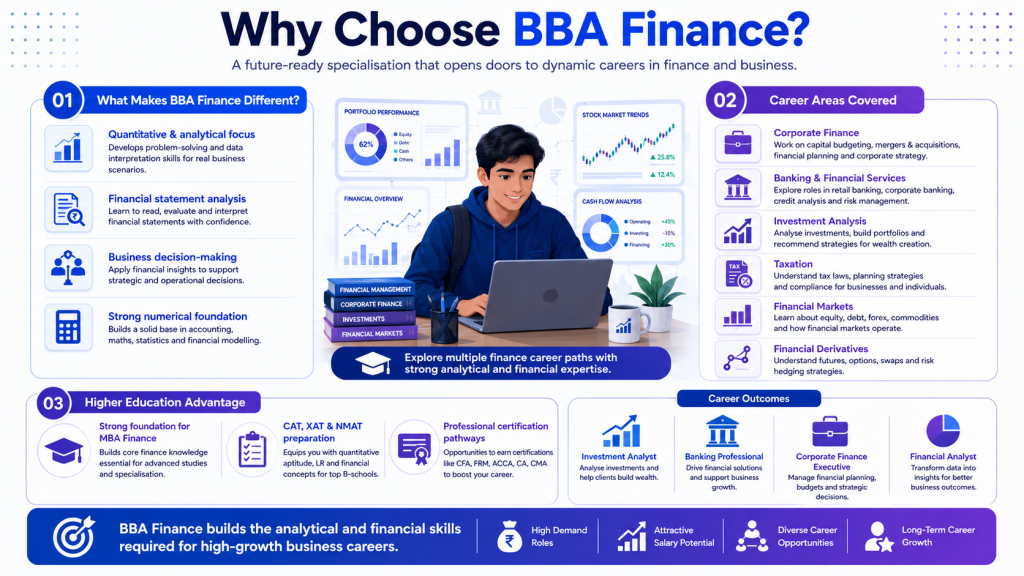
Among all BBA specialisation tracks Finance is the most quantitative and the most directly connected to professional certification pathways.
While Marketing relies on consumer insight and HR leans on people management, BBA Finance requires genuine comfort with numbers, financial statements and mathematical concepts. That technical demand is also what makes it commercially valuable in ways that general management degrees cannot replicate.
BBA Finance is specifically the right choice for students drawn to capital markets, investment analysis, banking or corporate treasury. It is also the most natural BBA pathway into MBA Finance because the subjects covered directly overlap with the foundational content tested in CAT, XAT and NMAT and with the core curriculum of first-year MBA Finance at IIMs and other top B-schools.
One important clarification: BBA Finance is not just about stock markets. The specialisation spans six distinct domains including financial accounting, corporate finance, investment analysis, banking, taxation and financial derivatives and each leads to a different career track. Understanding what BBA Finance covers across all three years is what allows students to choose electives strategically and target the specific Finance career they actually want.
Year One: The Quantitative and Accounting Foundation
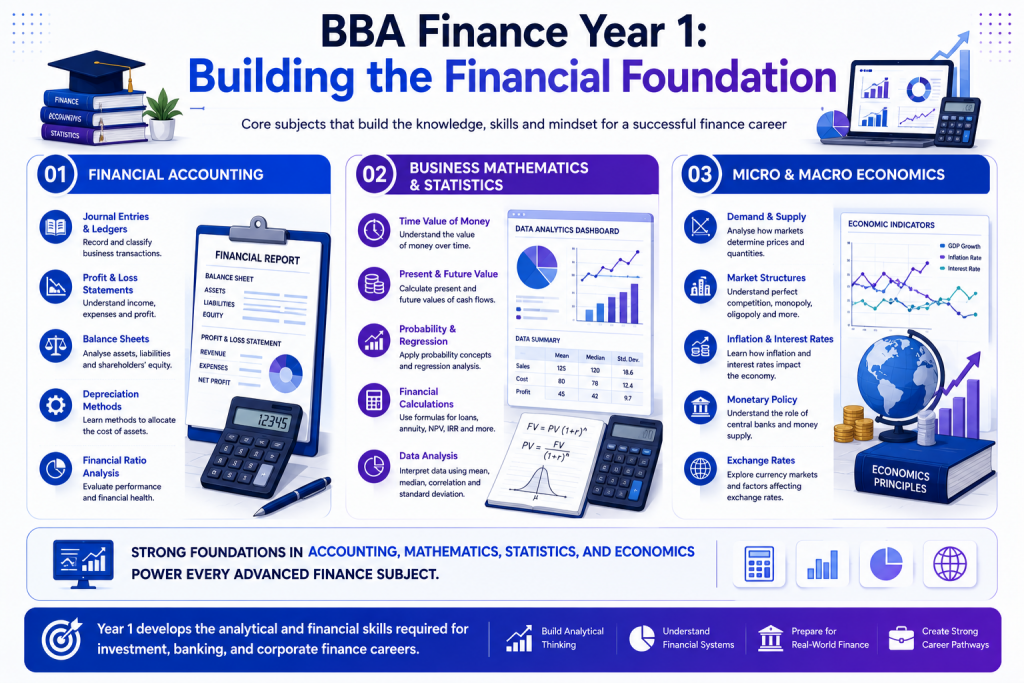
Financial Accounting
The most directly relevant year one subject for students on the BBA Finance track. It covers:
Double-entry bookkeeping, journal entries, ledger posting and trial balance
Preparation of profit and loss accounts and balance sheets for different business types
Bank reconciliation statements and rectification of errors
Depreciation methods including straight line and written down value
Ratio analysis including liquidity, solvency, profitability and efficiency ratios
Students who master financial accounting in year one find that valuation, corporate finance and financial modelling in the BBA Finance second and third year make significantly more sense. Those who memorise entries for the exam without understanding the logic consistently struggle when financial statements become raw material for investment analysis.
Business Mathematics and Statistics
These two subjects form the quantitative backbone that BBA Finance draws on throughout the three years:
Business Mathematics: Time value of money including present value, future value, annuities and EMI calculations, linear programming, matrices and basic calculus
Business Statistics: Descriptive statistics, probability, sampling methods, hypothesis testing, correlation and regression
Time value of money from Business Mathematics is used directly in every capital budgeting, investment valuation and corporate finance subject in BBA Finance. Statistics underpins financial risk measurement and portfolio analysis in later years. Both deserve serious attention in year one.
Micro and Macro Economics
Microeconomics covers demand and supply analysis, market structures and pricing theory that directly informs corporate finance and financial markets subjects.
Macroeconomics covers monetary policy, interest rate determination, inflation, balance of payments and exchange rates that are directly relevant to the banking, international finance and derivatives subjects in BBA Finance year three.
Year Two: Core Finance Subjects That Define the Programme
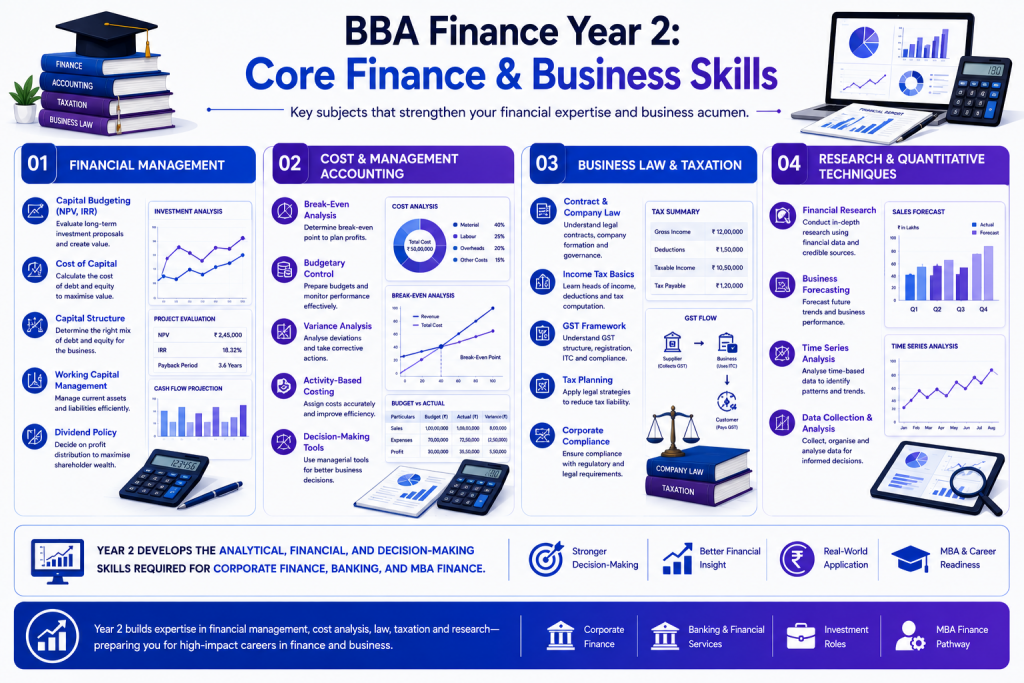
Financial Management
The most important and most heavily weighted subject in the BBA Finance second year. It covers:
Capital budgeting using NPV, IRR, MIRR and payback period for investment decisions
Cost of capital including CAPM for equity, cost of debt and weighted average cost of capital
Capital structure theory including Modigliani-Miller, trade-off theory and pecking order theory
Working capital management including cash, receivables and inventory management
Dividend policy including Gordon model, Walter model and dividend irrelevance
Sources of long-term finance including equity, debentures, term loans and venture capital
Financial management directly prepares students for corporate finance roles and MBA entrance. Capital budgeting and cost of capital topics are among the most frequently tested in CAT and XAT business situations sections making this the BBA Finance subject with the highest double return on investment.
Cost and Management Accounting
Marginal costing, contribution margin and break-even analysis
Standard costing and variance analysis including material, labour and overhead variances
Budgetary control and preparation of functional and master budgets
Activity-based costing as an alternative to traditional absorption costing
Relevant costing for make-or-buy, accept-or-reject and product mix decisions
Business Law and Taxation
Business Law covers the Indian Contract Act, Companies Act 2013, Negotiable Instruments Act and Intellectual Property basics. The Taxation component covers:
Five heads of income under the Income Tax Act, exemptions and deductions under Chapter VI-A
GST framework including registration, supply and input tax credit mechanics
Basics of tax planning for individuals and businesses in India
Transfer pricing regulations for multinational companies
Research Methodology and Quantitative Techniques
Covers financial research design, primary and secondary data collection from SEBI, RBI and company annual reports, business forecasting, time series analysis and operations research basics used in financial planning and investment analysis
Year Three BBA Finance Subjects: Advanced Specialisation
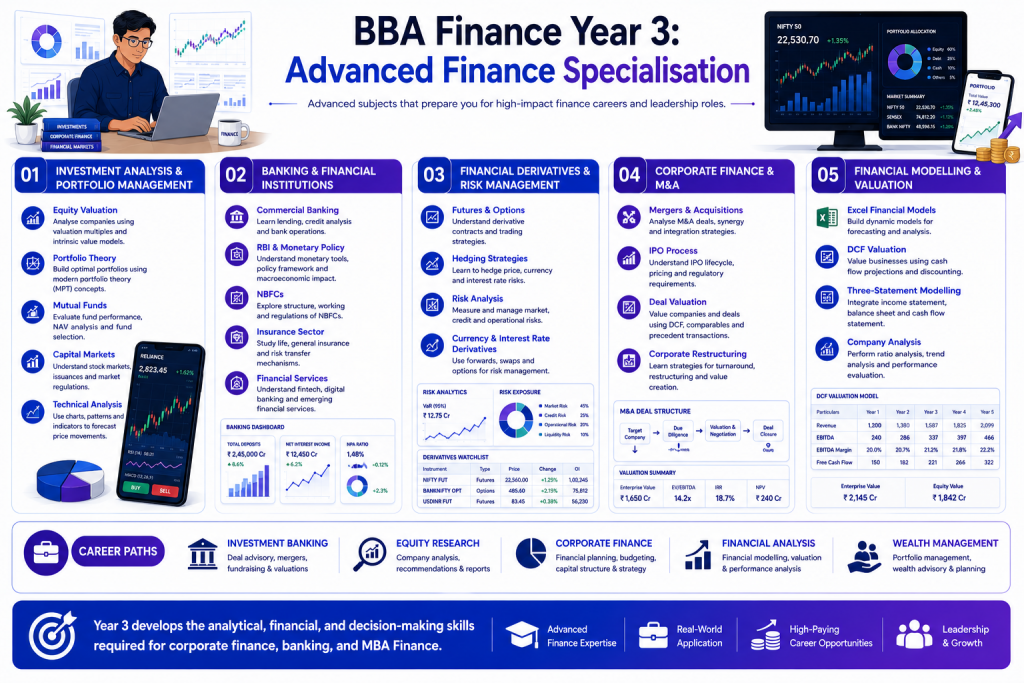
The third year is where BBA Finance becomes genuinely differentiated from other BBA tracks. Semesters five and six cover the advanced subjects that directly prepare students for specific Finance career tracks.
Investment Analysis and Portfolio Management
The most directly CFA-aligned subject in the programme. It covers:
Equity valuation using DCF, P/E, P/B, EV/EBITDA and comparable company analysis
Fixed income analysis including bond pricing, yield to maturity and duration
Portfolio theory including Markowitz efficient frontier, CAPM and Sharpe ratio
Mutual fund structures and performance measurement in India
Technical analysis basics including chart patterns and moving averages
Indian capital markets including NSE, BSE and SEBI regulatory framework
Banking and Financial Institutions
Commercial banking operations including deposit products, credit appraisal and loan monitoring
RBI monetary policy tools including repo rate, CRR and SLR
Non-banking financial companies including types, regulations and credit delivery role
Insurance sector including IRDA framework and product types
Mutual fund industry and AMFI regulations
Financial Derivatives and Risk Management
Forward and futures contracts on equity indices and commodities traded on NSE and MCX
Options including pricing using Black-Scholes basics, Greeks and hedging strategies
Interest rate swaps and currency derivatives under FEMA regulations
Financial risk types including market risk, credit risk and liquidity risk management
Corporate Finance and Mergers and Acquisitions
Advanced capital structure including agency theory and financial distress costs
Merger and acquisition process including deal structuring, due diligence and valuation
Leveraged buyouts including deal structure and private equity return mechanics
IPO process in India including SEBI ICDR regulations and book building
Corporate restructuring including divestitures, spin-offs and share buybacks
Financial Modelling and Valuation
Offered as a dedicated subject at stronger institutions and the most directly job-ready subject in the BBA Finance programme. It covers:
Building integrated three-statement models in Excel linking income statement, balance sheet and cash flows
Revenue and cost driver modelling for different business types
DCF valuation including terminal value and sensitivity analysis tables
Comparable company and precedent transaction analysis
Excel functions and shortcuts used in professional finance
At institutions offering dedicated financial modelling students graduate with a skill
directly testable in investment banking and consulting interviews. Students at institutions without this subject should self-study using CFI or Wall Street Prep resources during the final year.
Certifications That Strengthen a BBA Finance Profile
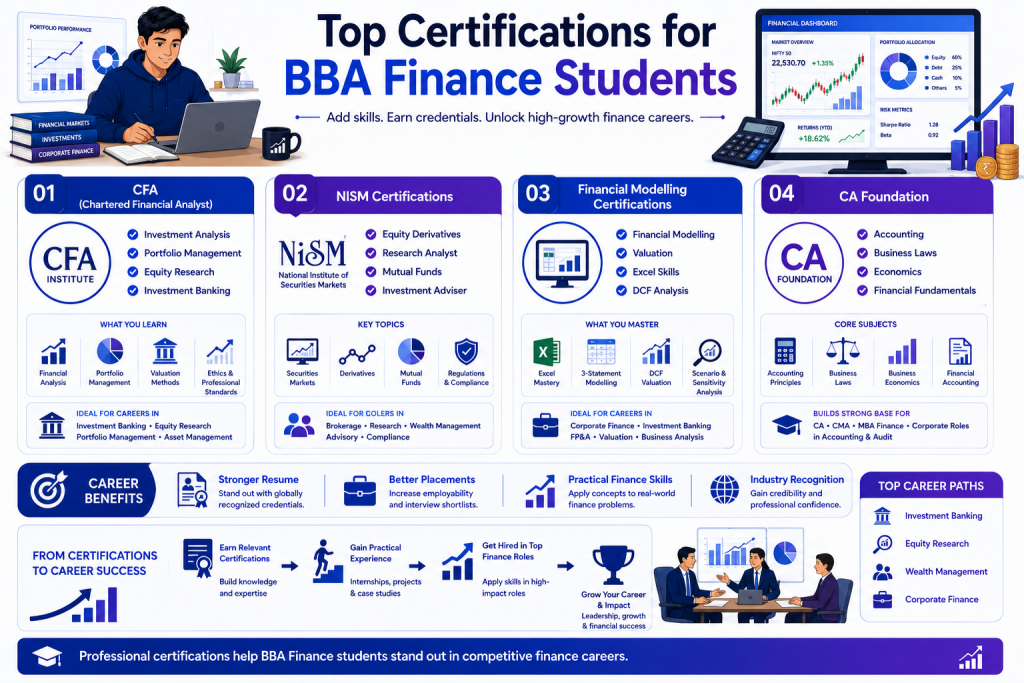
Chartered Financial Analyst (CFA)
The CFA charter from the CFA Institute is the most respected investment credential globally and aligns directly with the investment analysis, portfolio management and derivatives subjects in BBA Finance. CFA Level 1 is now offered four times a year making it feasible to attempt in the final year of the programme. Students who clear CFA Level 1 during BBA Finance enter the job market with a globally recognised credential that signals genuine investment knowledge above the standard graduate profile. For students targeting asset management, equity research or investment banking this is the most impactful single certification to begin during the BBA.
NISM Certifications
SEBI mandates NISM certifications for specific regulated functions in Indian capital markets. The most relevant for BBA Finance graduates are:
NISM Series VIII: Equity Derivatives — required for equity derivatives trading and advisory roles
NISM Series XV: Research Analyst — required for providing formal investment research and recommendations
NISM Series V-A: Mutual Fund Distributors — for mutual fund distribution roles
NISM Series X-A: Investment Adviser Level 1 — for investment advisory functions
These are legally required for specific capital market roles. BBA Finance graduates who clear the relevant NISM examinations before graduation are immediately eligible for regulated roles without the waiting period that applies to uncertified peers.
Financial Modelling Certifications
The CFI Financial Modelling and Valuation Analyst designation and Wall Street Prep Financial Statement Modelling course are the two most recognised credentials for validating Excel-based modelling skills. Both require building actual financial models rather than only theory examinations. In India these are specifically recognised by investment banks, boutique advisory firms and private equity analysts as meaningful evidence of practical modelling capability.
CA Foundation
Some BBA Finance students pursue CA Foundation alongside their degree. Clearing Foundation and Intermediate during the BBA years significantly strengthens the Finance profile.
The CA Foundation covers Accounting, Business Laws, Business Mathematics and Business Economics which overlaps substantially with BBA Finance year one and two subjects. Students who clear CA Foundation during BBA Finance carry the most credible accounting credential in India into every Finance interview.
Jobs After BBA Finance and Realistic Salary Ranges

Investment Banking and Advisory
Boutique investment banks, M&A advisory firms and research divisions of full-service brokerages hire BBA Finance graduates with strong academic records and financial modelling skills. Starting salaries at boutique advisory firms range from Rs 4 lakh to Rs 8 lakh per year. At bulge bracket banks BBA Finance graduates typically need to add CFA Level 1 or an MBA before accessing the analyst programme directly.
Equity Research Analyst
Equity research roles at broking firms, mutual fund houses and independent research firms are among the most accessible high-quality Finance roles for BBA graduates. Investment analysis and valuation subjects in BBA Finance directly prepare students for this. Starting salaries range from Rs 3.5 lakh to Rs 7 lakh per year. NISM Series XV is required for providing formal investment research and clearing it before graduation gives BBA Finance candidates a direct advantage over uncertified peers.
Corporate Finance and Financial Analyst
Financial planning and analysis, corporate treasury, investor relations and management accounting roles at listed Indian companies and MNCs are the most accessible Finance jobs from a broad range of institutions. Starting salaries range from Rs 3 lakh to Rs 5.5 lakh per year. Strong Excel, financial modelling and business communication skills are what consistently distinguish candidates in these interviews.
Banking and Financial Services
PSU banks, private banks, NBFCs and insurance companies hire BBA Finance graduates for relationship manager, credit analyst, operations and wealth management roles. HDFC Bank, ICICI Bank, Kotak, Bajaj Finserv and similar firms run campus placement programmes at top BBA colleges. Starting salaries range from Rs 3.2 lakh to Rs 6 lakh per year with private banks typically paying above PSU banks for equivalent roles.
MBA Finance as the Natural Next Step
A large proportion of BBA Finance graduates pursue MBA Finance within two to three years of graduation. The subjects covered directly prepare students for CAT and XAT and overlap substantially with first-year MBA Finance at IIMs, XLRI, FMS and SPJIMR. Students who perform well academically, build internship experience and clear CFA Level 1 during the BBA are competitive applicants at top Indian MBA programmes.
Conclusion
This is the most technically demanding and career-specific BBA specialisation and the subjects across all three years build a genuinely useful foundation across every Finance career track from investment banking and equity research to corporate treasury and financial services.
Year one builds accounting, mathematics and economics foundations, year two develops financial management and analytical depth and year three subjects cover investment analysis, banking, derivatives, corporate finance and financial modelling directly.
Students who engage seriously with the quantitative content, complete a strong Finance internship between year two and year three and pursue CFA or NISM certification during the programme consistently convert BBA Finance into better starting roles and faster career progression than those who treat it as a standard management degree with Finance as an afterthought.

Book Your
Free Session
Connect with our experts and get personalised guidance for your career, course selection, and future goals.

📖 Sources & References
✓ Verified 2026Verified BBA Finance curriculum, finance specialisation subjects, investment concepts, banking fundamentals and career scope references based on recognised educational and industry sources.
- UGC India Undergraduate business education frameworks and curriculum guidelines for finance-related programmes
- Ministry of Education Higher education policies, multidisciplinary learning and undergraduate programme reforms
- AICTE Management education quality standards, employability initiatives and industry-linked learning
- Investopedia Financial accounting, corporate finance, investment analysis, derivatives and banking concept references
- CFA Institute Investment management, portfolio analysis, ethics and financial market knowledge frameworks
- NSE India Indian capital markets, securities trading, investment products and market education resources
- BSE India Stock market operations, listed companies and investor awareness resources
- RBI Banking regulations, monetary policy, financial system operations and economic insights
- Naukri Career Insights Finance career opportunities, salary trends and entry-level job market insights in India
- Shoolini Online BBA Finance curriculum overview, finance specialisation subjects and career pathway guidance