

The BBA syllabus in India is a three-year undergraduate programme in business administration that covers management, finance, marketing, human resources and entrepreneurship and it is the most popular management degree for students who want to enter the corporate world or pursue an MBA without first completing a non-management undergraduate degree.
Understanding the BBA syllabus before you choose your college helps you evaluate whether the curriculum matches your career goals because not every institution delivers the same depth across all management functions.
The BBA syllabus across India is broadly consistent in its first year core subjects but diverges significantly in the third year where specialisation electives and industry projects create meaningful differences between strong and average programmes. This guide covers the complete BBA syllabus semester by semester across all three years, breaks down the most popular specialisation tracks and tells you which subjects matter most for placements and MBA entrance preparation.
What the BBA Programme Covers and Who It Is Best Suited For
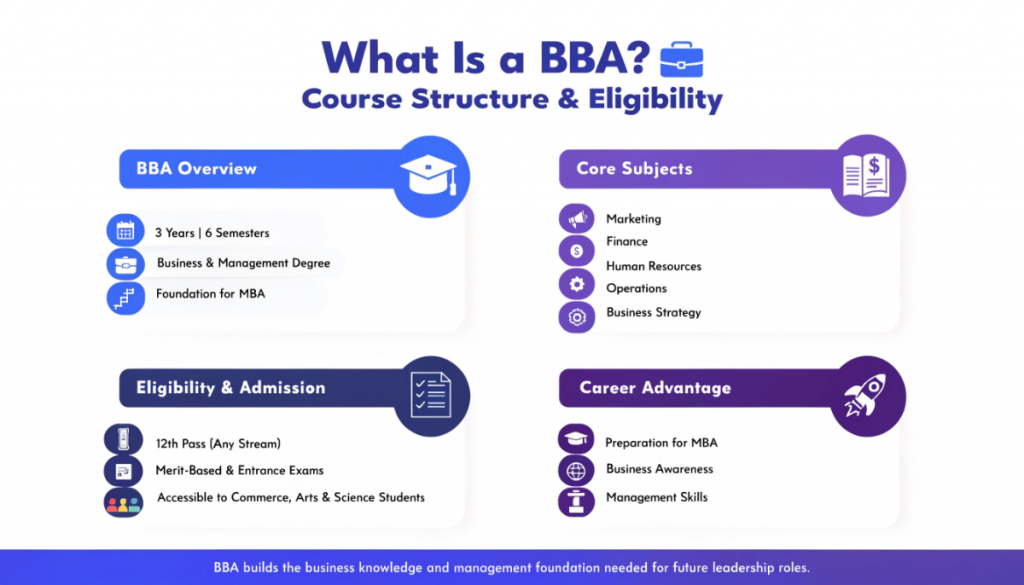
The BBA is a three-year six-semester undergraduate degree in business administration. It is specifically designed for students who know from the start that they want to work in business and management rather than in a technical or science domain. The BBA syllabus is built around the core functions of a business including finance, marketing, operations, human resources and strategy and it gives students a working knowledge of all of them before allowing specialisation in the final year.
Eligibility for BBA in India requires completion of 12th standard from any stream. Unlike engineering or pure science programmes BBA does not mandate specific science subjects at 12th level which makes it accessible to students from commerce, arts and science backgrounds equally.
Admission is through entrance examinations at competitive institutions including DU JAT for Delhi University colleges, IPM AT for IIM Indore and IIM Rohtak, SET for Symbiosis, Christ University entrance test and NMIMS NPAT among others. At most private colleges admission is through merit in 12th board examinations directly.
The BBA is also the most direct preparation route for MBA in India. Students who study the BBA syllabus thoroughly enter MBA entrance examinations including CAT, XAT, SNAP, MAT and NMAT with a genuine advantage in the business awareness and quantitative ability sections because the BBA covers foundational management theory, accounting and economics that MBA entrance tests draw from.
Year One BBA Syllabus: Building the Business Foundation
Semester One
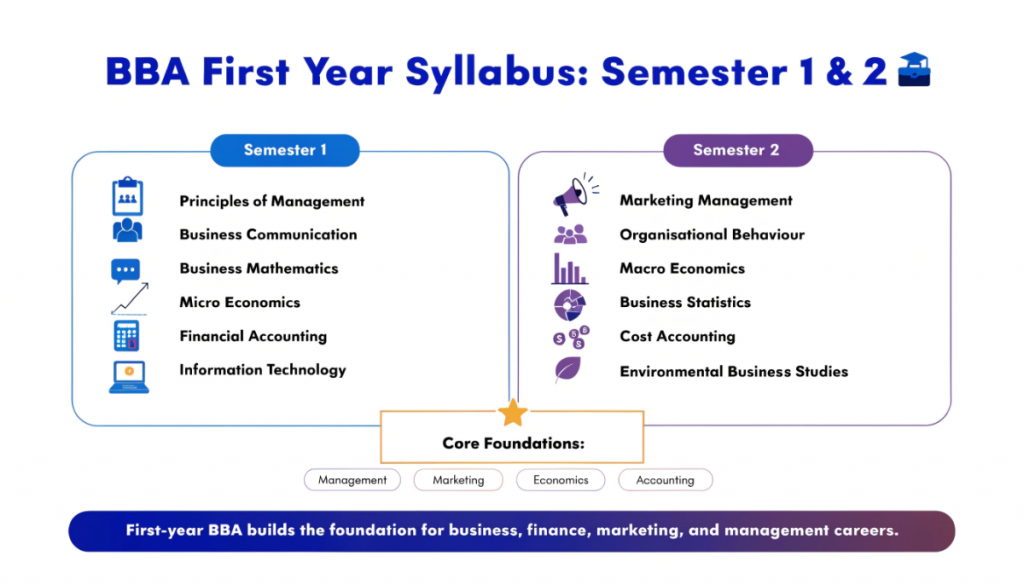
Semester one of the BBA syllabus introduces students to the fundamentals of business and management. The subjects typically covered are:
Principles of Management: Evolution of management thought, functions of management including planning organising leading and controlling, management theories from Taylor and Fayol to modern approaches and the role of a manager in contemporary organisations
Business Communication: Professional writing including reports, emails and business letters, oral presentation skills, group discussion techniques, body language and communication in cross-cultural business contexts — one of the most directly career-relevant BBA subjects from day one
Business Mathematics: Sets and functions, matrices and determinants, linear programming, permutations and combinations, sequences and series and basic calculus. The quantitative foundation for finance and economics subjects that follow
Micro Economics: Demand and supply analysis, consumer theory and utility, production theory and cost curves, market structures including perfect competition, monopoly and oligopoly and pricing strategies
Financial Accounting: Accounting principles and concepts, journal entries, ledger posting, trial balance, profit and loss accounts, balance sheet preparation and basic ratio analysis
Introduction to Information Technology: Computer basics, MS Office applications, internet and email, database concepts and the role of IT in modern business management
Semester Two
Semester two of the BBA syllabus builds directly on the first semester and introduces marketing and organisational behaviour:
Marketing Management: The marketing concept, STP framework including segmentation targeting and positioning, the 4Ps and 7Ps of marketing, consumer buying behaviour, product lifecycle management and introduction to digital marketing channels
Organisational Behaviour: Individual behaviour in organisations, personality theories, perception and attribution, motivation theories including Maslow Herzberg and McGregor, group dynamics, team behaviour, leadership styles and organisational culture
Macro Economics: National income accounting, GDP and its components, inflation and deflation, monetary policy and RBI, fiscal policy and government budgeting, balance of payments and foreign exchange basics and economic growth theory
Business Statistics: Measures of central tendency and dispersion, probability theory, sampling methods, hypothesis testing basics, correlation and regression and index numbers. Forms the analytical foundation for business research and data-driven decision-making
Cost Accounting: Difference between financial and cost accounting, cost concepts and classification, material costing, labour costing, overhead costing, marginal costing and break-even analysis
Environmental Business Studies: Business and environment relationship, corporate social responsibility, environmental regulations affecting business and sustainability in corporate strategy
The first year BBA syllabus gives every student a shared foundation in management, economics, accounting and quantitative methods regardless of their 12th stream background. Students from commerce backgrounds will find financial accounting and economics familiar while arts and science students typically need more attention on the quantitative subjects in semester two. Both profiles are equally common in BBA programmes across India.
Year Two BBA Syllabus: Going Deeper Into Management Functions
Semester Three
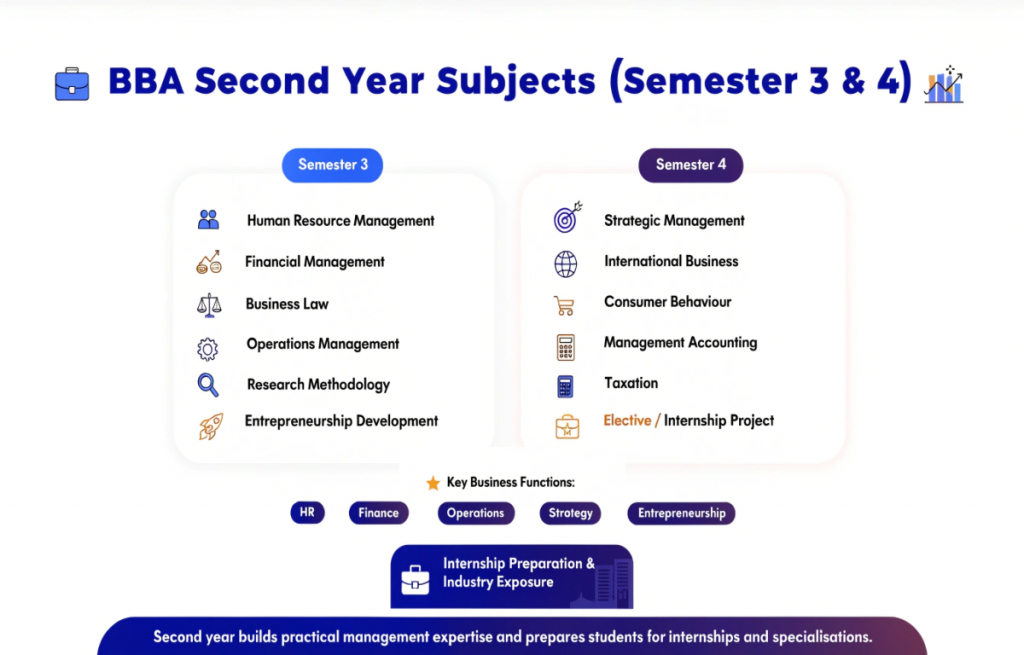
Semester three of the BBA syllabus moves into applied management subjects with greater depth:
Human Resource Management: Recruitment and selection processes, training and development programme design, performance appraisal systems, compensation and benefits management, employee relations and introduction to labour laws in India
Financial Management: Time value of money, capital budgeting techniques including NPV IRR and payback period, capital structure theory, working capital management, dividend policy and sources of long-term finance
Business Law: Indian Contract Act 1872, Sale of Goods Act, Negotiable Instruments Act, Companies Act 2013 key provisions, Consumer Protection Act and basics of Intellectual Property Rights
Operations Management: Production planning and control, plant layout, capacity planning, inventory management including EOQ, quality management basics and introduction to supply chain concepts
Research Methodology: Research design types, primary and secondary data collection methods, questionnaire design, sampling techniques, basic data analysis and presentation of research findings
Entrepreneurship Development: Entrepreneurial traits and mindset, opportunity identification, business plan development, sources of startup funding in India including angel investors and venture capital and government schemes for entrepreneurs
Semester Four
Semester four of the BBA syllabus completes the core management coverage:
Strategic Management: Strategic analysis frameworks including PESTLE and SWOT, Porter’s Five Forces, competitive advantage theory, corporate strategy options including diversification and integration, strategy implementation and the balanced scorecard
International Business: Theories of international trade, WTO and international trade regulations, foreign direct investment, modes of entry into international markets, exchange rate management and EXIM policies in India
Consumer Behaviour: Psychological and social influences on buying decisions, decision-making process, involvement theory, brand loyalty, attitude formation and change and cross-cultural consumer behaviour
Management Accounting: Budgetary control and variance analysis, standard costing, responsibility accounting, activity-based costing and management information systems for decision support
Taxation: Direct taxes under the Income Tax Act including computation of income from various heads, indirect taxes with focus on GST framework and its impact on business and basics of tax planning
Elective or Project: Some universities introduce a first elective or summer internship report in semester four
The second year of the BBA syllabus is where students develop genuine functional expertise across HR, finance, operations, strategy and international business. This is also the year most associated with summer internship preparation. A well-executed internship between year two and year three is one of the most important differentiators
for BBA students in final year placements and MBA admissions and the second year BBA subjects give students enough domain knowledge to contribute meaningfully during an internship rather than spending it as an observer.
Year Three BBA Syllabus: Specialisations, Electives and Industry Projects
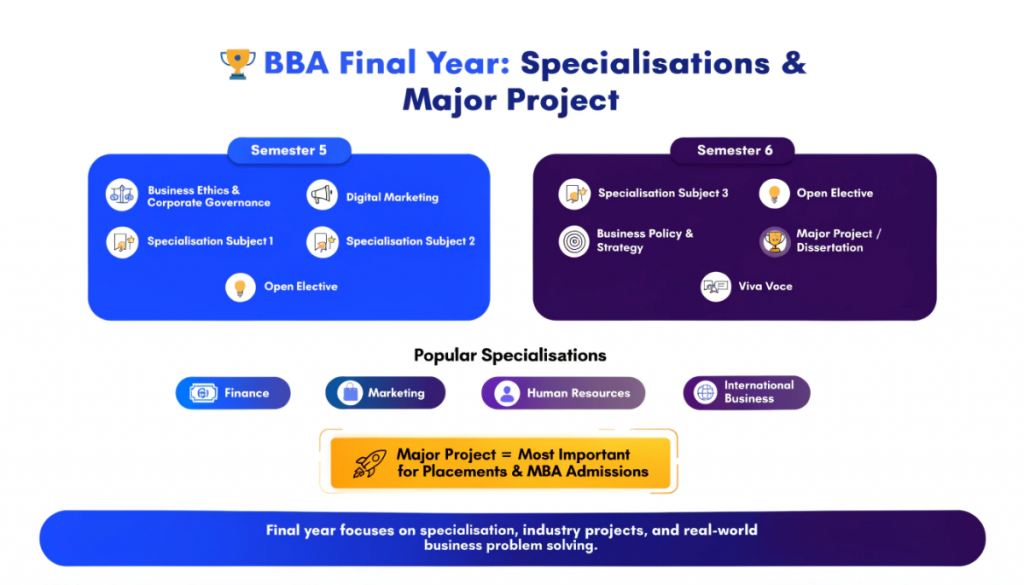
Semester Five
Semester five marks the beginning of specialisation in the BBA syllabus. Most institutions allow students to choose a major specialisation track at the start of year three:
Business Ethics and Corporate Governance: Ethical frameworks in business decision-making, corporate governance structures, board composition, shareholder rights, whistleblower protection and ESG frameworks
Digital Marketing: SEO and SEM, social media marketing strategy, content marketing, email marketing, performance marketing fundamentals, Google Analytics and measuring digital campaign effectiveness
Specialisation Subject 1: Depends on chosen track — Finance students study Investment Analysis, Marketing students study Brand Management, HR students study Industrial Relations, International Business students study Export Management
Specialisation Subject 2: Second advanced subject within the chosen specialisation track
Elective 1: Free elective chosen from any available specialisation other than the primary track
Semester Six
The final semester combines remaining electives with the project that is the most important placement asset in the entire BBA programme:
Specialisation Subject 3: Final advanced subject in the chosen specialisation completing the depth of domain knowledge
Elective 2: Second free elective from available options
Business Policy and Strategy: Capstone strategy subject integrating all functional areas studied across three years through complex multi-function case analyses
Major Project or Dissertation: Full-semester industry research project or live consulting assignment with a faculty guide. The project topic should ideally be drawn from the student’s internship experience or from the chosen specialisation area
Viva Voce: Oral defence of the major project before an external examiner panel
The major project in semester six of the BBA syllabus is what most interviewers and MBA admission committees ask about first because it demonstrates whether a student can apply classroom knowledge to a real business problem. Students who take the project seriously by working on genuine industry problems, collecting primary data through surveys or interviews and producing analysis-heavy reports are significantly more competitive than those who submit library-based reports on generic topics.
BBA Specialisation Tracks and What Each One Covers
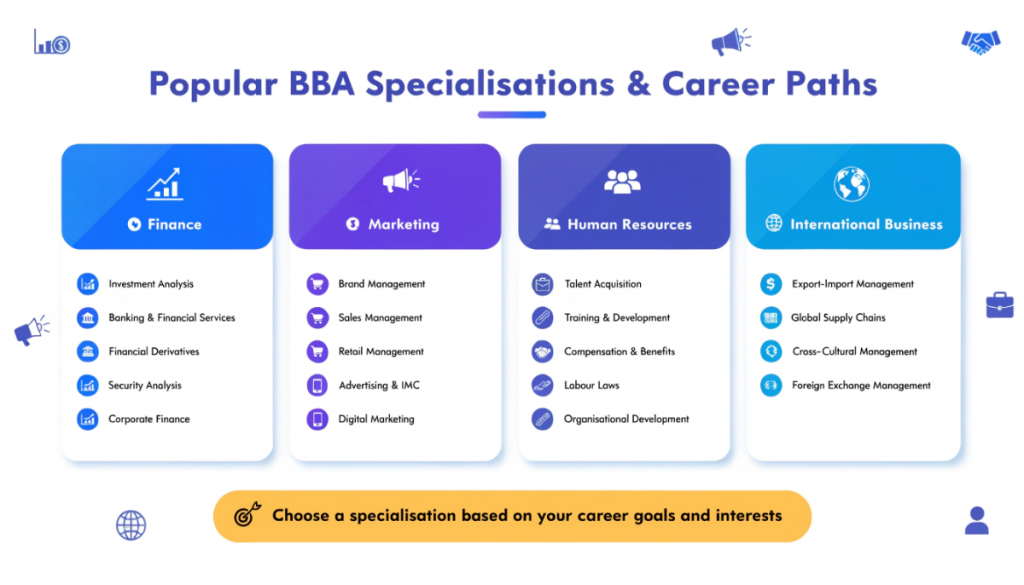
The specialisation you choose in the BBA third year determines which subjects fill your semester five and six elective slots and which career paths you are most competitive for after graduation.
Finance Specialisation
The Finance track within the BBA syllabus is the most popular specialisation and the most directly linked to MBA Finance aspirations. Core subjects in this track include:
Investment Analysis and Portfolio Management: Equity and debt valuation, risk and return, portfolio theory, mutual funds and the Indian capital markets
Banking and Financial Services: Commercial banking operations, credit analysis basics, RBI regulations, NBFCs and insurance products
Financial Derivatives: Options, futures, forwards and swaps and how businesses use them for hedging
Security Analysis: Fundamental and technical analysis of stocks, reading annual reports and company valuation basics
Corporate Finance and Mergers and Acquisitions: Deal structuring, due diligence, valuation in M&A contexts and post-merger integration concepts
Marketing Specialisation
The Marketing track is the second most popular specialisation in the BBA syllabus and is best suited to students targeting brand management, digital marketing, sales and product management careers. Core subjects include:
Brand Management: Brand equity, architecture, brand extensions, managing brand portfolios and measuring brand value
Sales Management: Sales force design, territory management, sales target setting, CRM tools and key account management
Retail Management: Store design and layout, category management, visual merchandising, retail analytics and e-commerce versus offline retail strategy
Advertising and Integrated Marketing Communications: Media planning, campaign development, ATL and BTL channels and measuring advertising effectiveness
Digital Marketing and Analytics: Performance marketing, SEO, content strategy, social media advertising and web analytics using Google Analytics
Human Resources Specialisation
The HR track in the BBA syllabus prepares students for entry-level HR roles at corporations and is particularly strong at institutions including Symbiosis, Christ University and XLRI-feeder programmes. Core subjects include:
Talent Acquisition: Recruitment strategy, sourcing channels, employer branding, selection assessments and onboarding design
Training and Development: Training needs assessment, learning and development programme design and ROI measurement of L&D investments
Compensation and Benefits: Job evaluation, salary structuring, ESOPs, incentive design and total rewards benchmarking
Labour Laws and Industrial Relations: Trade unions, collective bargaining, the new Indian Labour Codes 2020, grievance handling and dispute resolution
Organisational Development: Culture change, change management frameworks, HR technology and people analytics basics
International Business Specialisation
The International Business track is well suited to students targeting roles in export management, logistics, global supply chains and international sales. Core subjects include:
Export-Import Management: EXIM documentation, Incoterms, letter of credit, trade finance and customs procedures in India
Global Supply Chain Management: International logistics, freight forwarding, warehouse management in global contexts and supply chain risk
Cross-Cultural Management: Managing teams across cultures, cultural intelligence, negotiation across cultural contexts and global leadership
Foreign Exchange Management: FEMA compliance, hedging foreign currency exposure and international treasury management basics
How the BBA Syllabus Prepares You for MBA and Corporate Placements
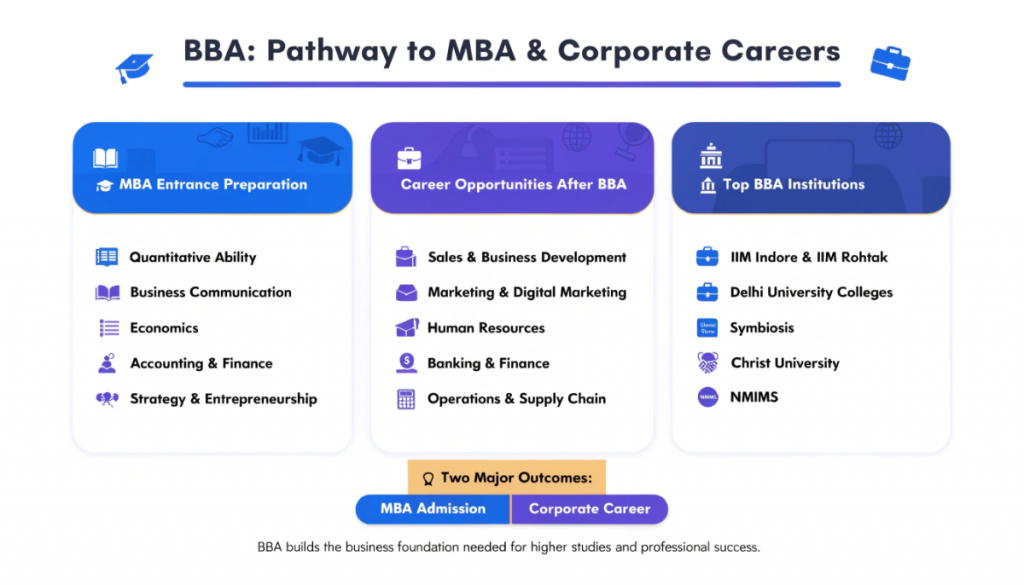
The BBA syllabus is explicitly designed with two exit outcomes in mind. The first is direct entry into the corporate sector at the entry level. The second is MBA admission. Here is how the curriculum serves both.
Preparation for CAT, XAT and Other MBA Entrance Exams
Several components of the BBA syllabus directly overlap with MBA entrance examination content:
Business Mathematics and Statistics from year one: Quantitative Ability and Data Interpretation sections in CAT and XAT draw from exactly the topics covered in these BBA subjects
Macro and Micro Economics: General Awareness sections and some GMAT Integrated Reasoning questions test economic concepts covered in the BBA syllabus
Financial Accounting and Management Accounting: Business judgement sections in XAT and scenario-based questions in CAT test accounting and financial reasoning concepts
Reading Comprehension and Business Communication: The Verbal Ability section in CAT is significantly easier for BBA graduates who have practised formal writing and comprehension throughout their degree
Entrepreneurship and Strategy: WAT and PI rounds at IIMs and other top B-schools specifically assess business awareness and strategic thinking which the BBA syllabus builds throughout all three years
Entry-Level Roles Available Directly After BBA
For students who enter the job market directly after graduation the BBA syllabus opens entry-level roles across multiple corporate functions:
Sales Executive or Business Development Executive: The most common first role for BBA graduates. Starting salaries range from Rs 2.5 lakh to Rs 5 lakh per year at FMCG, telecom, banking and technology companies
Marketing Associate or Digital Marketing Executive: BBA Marketing specialisation graduates are specifically competitive for these roles. Starting salaries range from Rs 3 lakh to Rs 5.5 lakh
HR Executive or Talent Acquisition Associate: BBA HR specialisation graduates target these roles at corporate HR departments and staffing firms. Starting salaries range from Rs 2.5 lakh to Rs 4.5 lakh
Banking and Financial Services: PSU banks and private banks recruit BBA graduates for relationship manager, credit officer and operations roles. Starting salaries range from Rs 3 lakh to Rs 6 lakh
Operations and Supply Chain: BBA graduates with Operations or International Business specialisations target logistics, procurement and supply chain analyst roles at e-commerce and manufacturing companies
Top Institutions Offering BBA and How Their Syllabuses Differ
The BBA syllabus at different types of institutions varies in quality and industry relevance:
IIM Indore and IIM Rohtak IPM: The Integrated Programme in Management is a five-year BBA plus MBA programme. The BBA component has the most rigorous quantitative and analytical curriculum in India and is the most competitive to get into through IPM AT
Delhi University colleges including Shaheed Sukhdev, Deen Dayal Upadhyaya and Lady Shri Ram: Strong BBA syllabus with consistent placement outcomes at banking, FMCG and consulting firms. Admission through DU JAT
Symbiosis Centre for Management Studies Pune: One of the most industry-interface heavy BBA programmes with a curriculum that integrates live projects, company visits and international exposure through exchange programmes
Christ University Bangalore: Known for a rigorous and structured BBA syllabus with strong Faculty and consistent placement records. Admission through Christ University entrance test
NMIMS School of Business Management Mumbai: Offers a strong BBA syllabus with Finance and Marketing specialisations and good placement outcomes at Mumbai-based BFSI and marketing firms through NPAT
Conclusion
The BBA syllabus in India in 2026 is a well-structured three-year programme that covers management, economics, accounting, marketing, finance, HR, operations and strategy across six semesters before allowing specialisation in the final year.
The first year builds the business foundation, the second year develops functional depth across all core management areas and the third year combines specialisation with real industry project work.
Students who engage seriously with the BBA syllabus rather than just clearing semester examinations consistently perform better in placements and MBA entrance examinations because the curriculum is specifically designed to build the business reasoning, communication and analytical skills that both employers and MBA admission committees look for.
Choosing the right specialisation track in year three, executing a strong internship between year two and year three and delivering a genuinely research-heavy final project are the three things that most reliably convert the BBA into strong career outcomes.

Book Your
Free Session
Connect with our experts and get personalised guidance for your career, course selection, and future goals.

📖 Sources & References
✓ Verified 2026References supporting the semester-wise BBA syllabus, management subjects, business administration concepts, specialisations, MBA preparation pathways, and industry-relevant business skills discussed in this guide.
- Shoolini Online BBA Programme BBA curriculum, management education, specialisations and career-focused learning pathways
- UGC India Higher education guidelines and undergraduate programme framework in India
- AICTE Management education standards and academic quality initiatives
- National Career Service Career pathways and employment opportunities for business graduates
- Ministry of Education Indian higher education policies and undergraduate programme information
- NASSCOM Industry trends, business skills and employability insights
- Invest India Business environment, entrepreneurship and industry growth insights
- LinkedIn Workforce Insights Business, marketing, HR and management skill demand trends
- World Economic Forum Future workplace skills, leadership and management trends
- India Skills Report Graduate employability and management career outlook in India